



By Anushka Verma | Updated: October 30, 2025
Introduction
In February 2026, India will embark on one of its most ambitious data exercises — the first-ever National Household Income Survey (NHIS) — a move that could redefine how the government views income distribution, inequality, and consumption patterns across the country.
Led by Saurabh Garg, Secretary of the Ministry of Statistics and Programme Implementation (MoSPI), the survey aims to gather authentic, micro-level data about the income, savings, and expenditure habits of Indian households.
But beneath the technical jargon lies a far tougher reality: Indians are not comfortable talking about money.
A pre-survey test conducted earlier this year revealed that 95% of households felt uncomfortable disclosing their income or tax details, citing privacy concerns, fear of scrutiny, and lack of trust in data confidentiality.
This makes the NHIS not just a statistical challenge — but a social confidence test worth ₹1 trillion, as the results will influence policy planning, welfare schemes, taxation, and India’s economic future.
The Big Picture
| Aspect | Details |
|---|---|
| Survey Name | National Household Income Survey (NHIS) |
| Conducted By | Ministry of Statistics and Programme Implementation (MoSPI) |
| Lead Official | Saurabh Garg, Secretary, MoSPI |
| Survey Timeline | February 2026 – February 2027 |
| Sample Size | 8 lakh households across 28 states and 8 UTs |
| Objective | To estimate household income, savings, and expenditure |
| Challenge Identified | 95% respondents hesitant to share income/tax info |
| Focus Areas | Urban-rural divide, informal economy, gender income gap |
| Outcome Use | Policy design, welfare targeting, GDP accuracy |
Why the NHIS Matters
For decades, India’s economic planning has leaned heavily on expenditure-based surveys like the NSSO’s Consumer Expenditure Survey. While these provided insights into what people spend, they left a critical blind spot — what people earn.
Without accurate income data, policymakers are forced to rely on indirect estimates, tax filings (which cover only a small fraction of households), and patchy administrative data.
The NHIS is designed to close that gap. It will offer a direct look into how much Indian families earn, how they earn it, and how income patterns differ between regions, classes, and occupations.
“Income data is central to understanding inequality, productivity, and the real impact of growth,” said Saurabh Garg, adding that “this survey will give India a far more accurate socio-economic map than we’ve ever had before.”
A Challenge Unlike Any Other
MoSPI officials describe the NHIS as the “toughest survey ever attempted” — not because of its size, but because of people’s hesitation.
Money remains one of India’s most guarded topics, often tied to family pride, privacy, or fear of government repercussions. During pilot surveys, households frequently resisted questions about:
- Monthly or annual income
- Sources of income (salary, business, agriculture, etc.)
- Taxes paid
- Assets owned or rented
- Loans, debts, and savings
Many respondents either refused to answer, underreported, or inflated figures — depending on their trust in the surveyor.
The 95% discomfort rate shocked researchers. “It’s not the data collection that’s hard,” Garg explained. “It’s about creating an environment where people feel safe to tell the truth.”
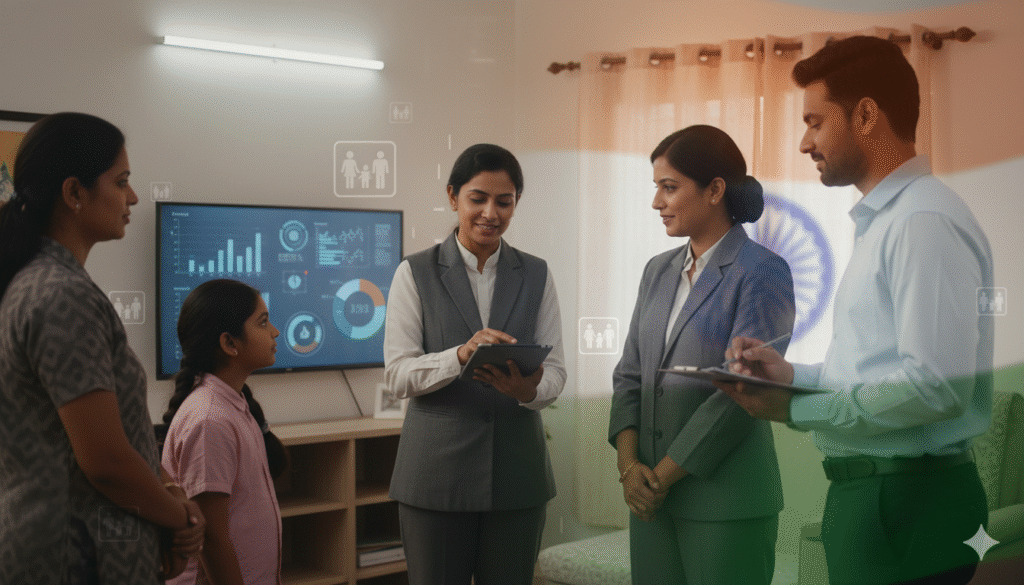
Building Trust Through Awareness and Anonymity
To tackle this, MoSPI is launching a nationwide awareness campaign before the survey rollout.
Key components include:
- Media campaigns (TV, radio, social media) explaining why the data matters.
- Assurances of anonymity — responses will not be linked to names, Aadhaar, or tax records.
- Community-level engagement — through panchayats, RWAs, and local NGOs.
- Training enumerators to be empathetic, non-intrusive, and professional.
The goal is to shift perception — from “the government is collecting my data” to “the nation is learning how we live.”
“We’re emphasizing that this isn’t an audit — it’s a mirror,” said a senior MoSPI official. “It’s about understanding ourselves, not judging.”
How the Survey Will Work
The NHIS will be conducted in three phases, covering all states and Union Territories, including remote districts.
Phase 1: Pilot and Training (December 2025 – February 2026)
Enumerators will be trained in 20 regional centers. This phase will test data accuracy and respondent comfort.
Phase 2: Full Rollout (March 2026 – December 2026)
Data collection teams will visit 8 lakh households — a mix of rural, urban, and semi-urban areas — collecting both digital and paper-based entries.
Phase 3: Verification & Analysis (January 2027 – June 2027)
Data cleaning, verification, and statistical analysis will be done using advanced AI-based validation tools.
Key Metrics to be Collected
| Category | Examples of Data Points |
|---|---|
| Household Income | Salary, business profits, agriculture income, remittances |
| Taxes & Deductions | Direct and indirect taxes paid |
| Savings & Investments | Bank savings, mutual funds, gold, insurance |
| Loans & Liabilities | Personal loans, home loans, credit card dues |
| Assets Owned | Property, vehicles, electronics, livestock |
| Demographics | Age, gender, education, occupation |
| Welfare Benefits | Subsidies received, schemes used |
The Fear Factor: Why Indians Hesitate
There are cultural and psychological reasons behind people’s reluctance to share income data.
- Privacy Concerns: Many fear their income disclosure could lead to tax scrutiny or loss of welfare benefits.
- Mistrust of Officials: Some households worry enumerators might misuse data.
- Social Sensitivity: Talking about earnings is often seen as boastful or shameful, depending on context.
- Informal Economy Dominance: Nearly 80% of India’s workforce operates in the informal sector, where income is unrecorded or irregular.
“Income is not just a number — it’s an emotion in India,” says a senior statistician. “It’s tied to status, self-worth, and survival.”
Technology as the Silent Enabler
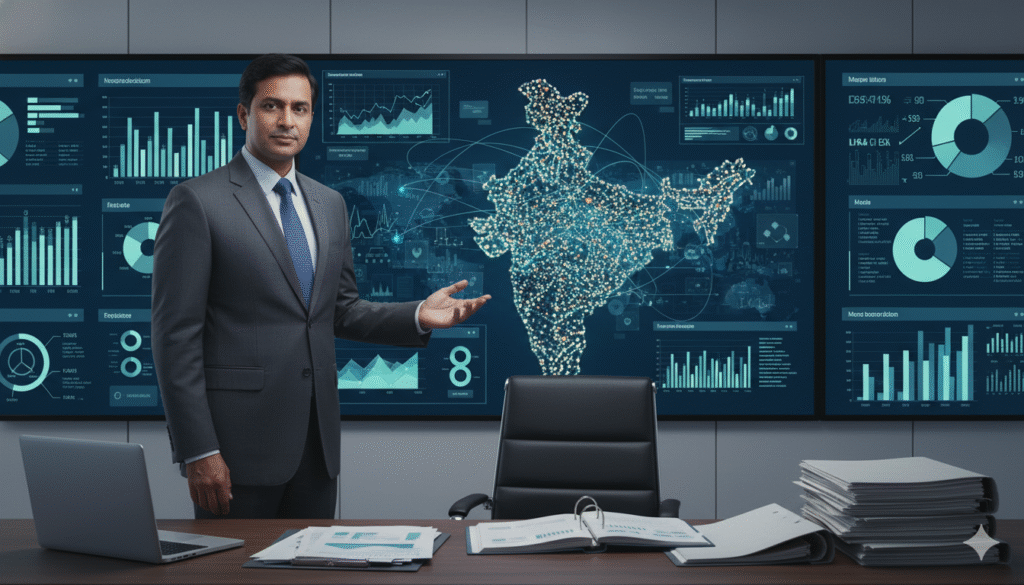
To ensure accuracy, MoSPI will use a hybrid data model — combining field surveys with digital verification through government databases.
- AI-based cross-verification of inconsistent responses
- Geo-tagged data collection for better mapping
- Blockchain-backed anonymization protocols to prevent data leaks
- Real-time dashboards for supervisors to monitor quality
These measures aim to improve reliability without breaching confidentiality.
The Scale of the Exercise
The NHIS will involve:
- 25,000 field enumerators
- 3,500 supervisors
- 8,00,000 households
- 29 languages
- ₹1,200 crore budget
It’s being called India’s largest socio-economic mirror — second only to the Census.
What Experts Are Saying
Economists, policymakers, and data scientists see the NHIS as a game changer.
“Without accurate income data, we’ve been planning in the dark,” said Dr. R. N. Mohanty, former advisor at NITI Aayog. “This survey could reshape welfare delivery, taxation fairness, and even how we define poverty.”
Data privacy advocates, however, remain cautious.
“Trust is built over transparency,” said Meera Menon, founder of India Privacy Forum. “MoSPI must show citizens exactly how data will be stored, used, and deleted.”
The Political Dimension
The NHIS also arrives at a politically sensitive time. With general elections scheduled for 2029, accurate income data could influence how welfare schemes are structured and targeted.
It may expose gaps in income inequality, urban-rural income imbalances, and sectoral disparities — especially between formal and informal workers.
Some analysts believe the data could redefine “middle class” metrics, affecting tax brackets and subsidy policies.
Comparison with Global Models
Countries like the U.S., U.K., and Japan conduct regular household income surveys, using them to shape fiscal and social policies.
India’s NHIS is modeled loosely on these systems but tailored to the diverse, multilingual, and informal nature of its economy.
If successful, India could set a new benchmark for large-scale economic surveys in developing nations.
Data Confidentiality: The Heart of the Matter
To address trust deficits, MoSPI has introduced strict confidentiality protocols:
- No linkage with Aadhaar, PAN, or tax IDs.
- Anonymous identifiers used in place of names.
- Data encryption before cloud upload.
- Access control — only authorized analysts can view data clusters.
- Destruction policy — raw personal data to be deleted after final analysis.
These steps align with global data ethics standards, similar to those used by the OECD and World Bank.
Beyond Numbers: What NHIS Could Reveal
If executed well, the survey could answer questions policymakers have long struggled with:
- How large is India’s real middle class?
- What share of income comes from informal jobs?
- How much inequality exists between states and castes?
- How effective are government welfare schemes?
- What’s the gender gap in income contribution within households?
For the first time, India may have data that connects income, spending, and well-being under one framework.
Public Awareness: The Deciding Factor
To build confidence, MoSPI plans collaborations with:
- State governments
- Educational institutions
- Media houses
- Local influencers
The message will be simple:
“Your data is your story — and India needs to hear it.”
A Message from Saurabh Garg
In a recent media interaction, Garg summarized the mission in one line:
“Data is not just about numbers; it’s about trust. We can only build better policies if citizens believe in the process.”
He emphasized that participation in the survey is voluntary, but high participation rates are crucial for credible results.
The Road Ahead
The next few months will determine whether India can overcome its deep-seated hesitation around income transparency.
The success of the NHIS will depend on:
- Enumerators’ professionalism
- Public communication strategy
- Technical safeguards
- Consistent political and administrative support
If it works, India will finally have a credible income map that reflects its 1.4 billion citizens — not just in averages, but in reality.
Final Word
The National Household Income Survey is more than a bureaucratic exercise. It’s a mirror held up to India’s economic truth — a truth that could shape the nation’s fiscal future, redefine welfare economics, and strengthen democratic planning.
For now, the question is not just how much Indians earn — but whether they trust the system enough to say it out loud.