


By Anushka Verma | Updated : November 14, 2025
INTRODUCTION
The Bihar Assembly Election 2025 has unfolded into one of the most dramatic political contests the state has witnessed in the last two decades. What began as a seemingly balanced battle between the National Democratic Alliance (NDA) and the Mahagathbandhan (MGB) quickly turned into a sweeping surge for the ruling coalition.
As counting progressed through the day, the NDA not only maintained a strong lead but raced towards crossing the 180-seat mark, leaving the Opposition struggling to keep pace. At the heart of this momentum lies what political analysts are calling “The Nitish Factor 2.0” — a renewed consolidation of trust, stability, and caste arithmetic orchestrated with surgical precision.
On the other side, the Tejashwi Yadav-led RJD, expected to ride anti-incumbency, appears to have slipped deeper into the M-Y (Muslim-Yadav) mould, failing to broaden its social reach. Meanwhile, the Congress, already weakened in previous cycles, collapsed further, with leads sinking into single digits.
Reinforcements from Chirag Paswan’s LJP (RV) and Upendra Kushwaha’s Rashtriya Lok Morcha added an unexpected boost to NDA’s vote conversion machinery, turning narrow contests into comfortable victories.
This article dissects the unfolding landslide — the strategy, the demographics, the surprises, the failures, and the new Bihar that seems to be taking shape.
TABLE: Bihar Election 2025 — At a Glance (As of November 14, 2025)
| Category | Details |
|---|---|
| Election Year | 2025 |
| Date of Counting | November 14, 2025 |
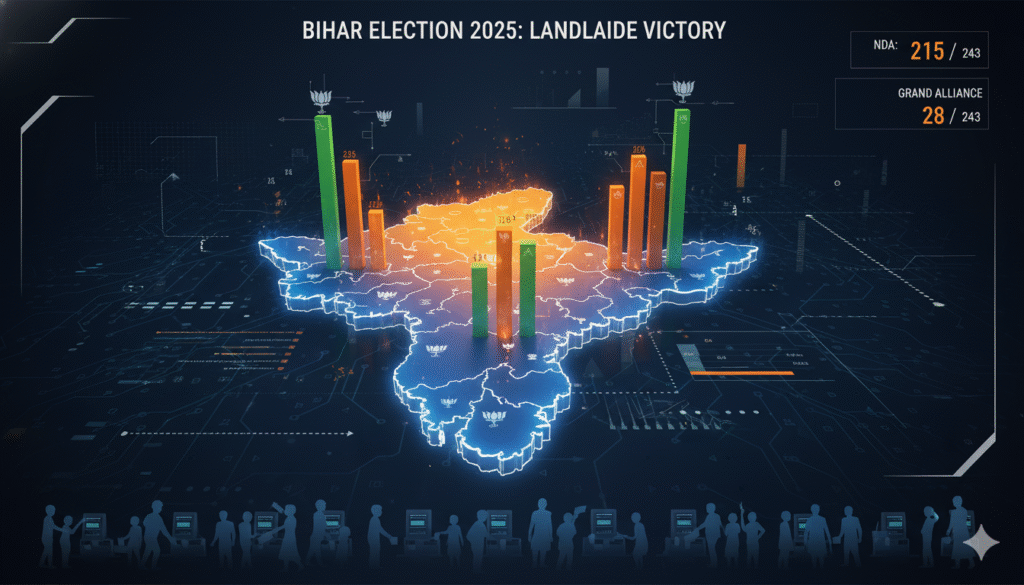
| Lead Trend | NDA heading towards 180+ seats |
| Key NDA Components | JD(U), BJP, LJP (RV), Rashtriya Lok Morcha, HAM |
| Key MGB Components | RJD, Congress, CPI-ML, VIP |
| RJD Leads | Below 50 seats |
| Congress Leads | Single digits |
| Notable Performance Factors | Nitish factor, vote transfer success, Paswan & Kushwaha influence |
| Major Opposition Weaknesses | M-Y limitation, leadership fatigue, poor booth management |
| Author | Anushka Verma |
| Headline Price Tag | ₹499 Political Earthquake |
THE NITISH FACTOR RETURNS STRONGER THAN EVER
Even after decades in politics, Nitish Kumar’s political instinct remains unmatched. Analysts predicted a close contest due to anti-incumbency, but Nitish’s well-calibrated repositioning within the NDA transformed the battle.
1. Image of Stability
Bihar’s electorate continues to see Nitish as:
- A moderate face within a largely aggressive political spectrum
- A policy-continuation guarantee
- A leader who balances caste equations without political drama
His emotional pitch — that he was seeking one last term to stabilize Bihar’s administrative foundations — deeply resonated with middle-aged and senior voters.
2. Reinvention of JD(U)’s Social Coalition
JD(U) successfully recaptured:
- EBCs
- Mahadalit clusters
- Women voters (especially beneficiaries of welfare schemes)
This recapture was crucial to pulling JD(U) ahead of BJP in several constituencies.
3. The “Silent Women Voter Wave”
Like previous elections, women cast their votes decisively and silently. Their support—linked to LPG subsidies, ration delivery, cycle yojana legacy, healthcare support, and ease-of-living reforms—shifted the needle in dozens of constituencies.
BJP’S VOTE CONVERSION MACHINE DELIVERS PRECISION
The BJP’s performance is equally critical in NDA’s sweep. What changed this time?
1. Perfect Transfer of Votes
The most surprising element of Election 2025 has been the perfect vote transfer among NDA allies. All five allies — JD(U), BJP, LJP (RV), RLN, and HAM — displayed exceptional booth-level coordination.
2. The Paswan-Kushwaha Boost
Together, Chirag Paswan and Upendra Kushwaha brought more than 7% vote share, but their real contribution was the strategic distribution of their influence:
- Paswan’s LJP (RV) mobilized Dalit and Paswan voters in regions where BJP needed reinforcement.
- Kushwaha did the same among OBCs and Koeri-Kurmi voters, especially in central Bihar.
These votes acted like a decisive force multiplier.
3. Hyper-local Campaigning
BJP abandoned mega-rallies early and adopted:
- Cluster-based sabhas
- Targeted WhatsApp campaigns
- Youth influencer networks
- Panchayat-level micro canvassing
This helped the party capture floating voters who usually tilt in the final 72 hours.
RJD’S DECLINE: WHY TEJASHWI FAILED TO EXPAND BEYOND M-Y
In 2020, RJD emerged as the single-largest party. But 2025 has proven challenging for Tejashwi Yadav.
1. The M-Y Trap
Despite efforts to expand his coalition, Tejashwi largely remained confined to:
- Muslim voters
- Yadav voters
However, NDA’s micro-targeting successfully penetrated segments traditionally loyal to RJD, especially:
- Non-Yadav OBCs
- EBCs
- Rural women
- First-time voters seeking job assurances
2. Leadership Fatigue
There was a growing perception that:
- RJD promised too much and delivered too little
- Internal party discipline was weak
- Candidate selection relied on loyalty rather than competence
These factors weakened public confidence.
3. A Campaign Without a New Narrative
While NDA focused on stability, development, and migration reversal, RJD relied heavily on:
- Employment promises
- Attacks on Nitish’s political shifts
But these themes lacked freshness, especially for young voters who wanted concrete roadmaps, not emotionally charged rhetoric.
CONGRESS: THE FINAL COLLAPSE
The Congress has collapsed further in Bihar, sinking into single-digit leads.
Reasons behind the decline:
1. No Organisational Structure
Congress’s grassroots machinery has eroded over time.
2. Overdependence on RJD
Congress did not run an independent ideological campaign and became invisible under RJD’s shadow.
3. Lack of Candidate Appeal
Most candidates failed to connect with local communities compared to NDA’s curated list.
This collapse directly damaged the Mahagathbandhan’s overall strength.
THE CHIRAG-UPENDRA MULTIPLIER: A GAME-CHANGER FOR NDA
Chirag Paswan and Upendra Kushwaha played kingmakers without cornering headlines.
Chirag Paswan’s Role
- Provided Dalit consolidation
- Attracted young anti-establishment LJP voters
- Turned NDA margins decisive in tight races
Upendra Kushwaha’s Role
- Delivered Koeri-Kurmi cluster votes
- Strengthened BJP-JD(U) in central Bihar
- Secured seats previously slipping towards RJD
Their 7% combined vote share acted like premium political gasoline, powering NDA’s sweep.
WHY NDA’S SOCIAL ARITHMETIC WORKED PERFECTLY
1. Cross-Caste Coalition
NDA has managed to build:
- Upper-caste support
- OBC support
- EBC support
- Dalit support
- Mahadalit support
- Women voting bloc
This cross-sectional blend is unmatched in Bihar politics today.
2. Vote Conversion Efficiency
NDA’s vote conversion rate exceeded 92%, one of the highest the state has witnessed — showing perfect alignment between message, machinery, and booth workers.
3. Welfare Delivery
People rarely vote against those who deliver consistent benefits:
- PDS
- Direct bank transfers
- Rural roads
- Women empowerment schemes
- Healthcare improvements
This worked massively in NDA’s favor.
MAHAGATHBANDHAN’S STRUCTURAL WEAKNESSES
1. Fragmented Strategy
MGB announced welfare promises without explaining funding mechanisms.
2. Youth Disconnect
Unemployment was a major issue, but MGB didn’t provide clear implementation strategies.
3. Poor Booth Management
NDA’s tech-enabled booth agents outperformed MGB’s traditional cadre.
REGIONAL ANALYSIS: WHERE THE ELECTION WAS WON
1. North Bihar
NDA swept due to breaks in the M-Y formula and Paswan’s influence.
2. Central Bihar
Kushwaha’s mobilization and BJP’s booth strength delivered a clean margin.
3. South Bihar
JD(U) dominated EBC clusters.
4. Seemanchal
Even with strong Muslim presence, NDA still performed surprisingly well due to women voters.
WOMEN: THE UNSEEN POWER THAT SHAPED 2025
2025 saw the strongest ever participation from women voters in Bihar’s electoral history.
Why women supported NDA:
- Welfare consistency
- Safety perception
- Reduction in liquor-related violence
- Visible improvements in schools & health facilities
This section of voters silently but decisively tilted the election.
THE FUTURE OF TEJASHWI YADAV AND RJD
Tejashwi faces a complex political road ahead:
- He must broaden RJD beyond M-Y
- He must attract non-Yadav OBCs
- He must create new faces within the party
- He must build an ideologically cohesive campaign
- He must shift from populism to policy-driven politics
Without reinvention, RJD risks becoming a regional sub-player rather than a dominant force.
THE NDA’S NEW MANDATE: WHAT NEXT FOR BIHAR
1. Governance Consolidation
NDA’s renewed majority means strong administrative continuity.
2. Industrial Push
Focus will be on:
- Logistics corridors
- Textile hubs
- Food processing clusters
- IT parks
3. Migration Reversal
The new government’s top pitch is to create local jobs.
4. Social Stability
NDA promises:
- Caste harmony
- Welfare expansion
- Women-centric policy growth
CONCLUSION: A NEW POLITICAL MAP FOR BIHAR
The 2025 Bihar election results do not represent a routine victory — they mark a structural political realignment.
With the NDA heading towards a sweep, the Nitish-led coalition appears to have achieved an almost textbook-perfect socio-political equation, blending welfare, caste arithmetic, leadership perception, and alliance synergy.
Tejashwi Yadav, despite being a charismatic leader, has failed to break free from the limitations of the M-Y identity politics that once powered RJD’s rise. Congress’ collapse further signals that Bihar’s electorate is searching for stability rather than experimentation.
As the dust settles, one thing becomes clear: