


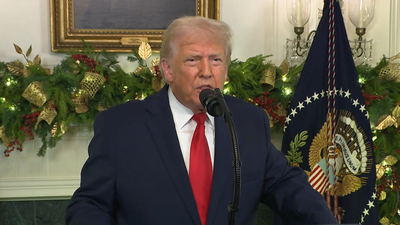
WASHINGTON: The United States has gone cold on global warming after putting climate safeguards on ice. In a sweeping move, President Donald Trump on Thursday revoked the 2009 “endangerment finding” issued under Barack Obama, which had declared that greenhouse gases threaten public health and welfare.
The ruling empowered the US Environmental Protection Agency (EPA) to regulate carbon dioxide, methane and other climate pollutants under the Clean Air Act. Without it, the legal backbone of American climate policy collapses.Calling the repeal “the single largest deregulatory action in American history,” Trump stood beside EPA Administrator Lee Zeldin and framed the decision as a victory for economic growth and consumer choice.
He dismissed climate science as a “scam,” arguing that regulating greenhouse gases had unfairly burdened the auto industry and raised costs.The 2009 endangerment finding followed the landmark Supreme Court case Massachusetts v. EPA, which affirmed that greenhouse gases qualify as pollutants. It became the foundation for limits on vehicle emissions, power plants and oil and gas operations across the world. Its repeal is expected to increase US emissions significantly over the coming decades, while taking the lid of controls across the world if it decides American abdication has nuked climate science.
Planet Earth has already warmed about 1.4°C above pre-industrial levels, according to scientists, who warn the world is on track for roughly 2.6°C of warming by century’s end — far beyond the safer threshold set in the Paris Agreement. The US withdrawal from that accord under Trump, and now the dismantling of domestic climate authority, signals a retreat at precisely the moment global cooperation is most urgent.From the vantage point of a developing nation like India, the decision reverberates far beyond American borders.
Acutely vulnerable to heatwaves, erratic monsoons, glacial melt and sea-level rise — the human and economic implications for New Delhi are stark. According to the Climate Risk Index covering 1995–2024, nearly 430 climate disasters in India have killed more than 80,000 people, while economic losses are estimated at around $170 billion (approx ₹14 lakh crore) over the past three decades.The United States remains the world’s second-largest annual emitter after China, but it is historically the single biggest contributor to greenhouse gases since the Industrial Revolution.
For years, developing nations have faced intense diplomatic pressure to curb emissions. India and China were frequently vilified in Western political discourse as climate laggards, even as they argued — correctly — that the US and Europe had built their prosperity on two centuries of fossil-fuel combustion.India, still battling poverty and energy deficits, was dragged kicking and screaming into global climate pacts, committing to ambitious renewable energy targets and net-zero timelines despite low per-capita emissions compared to the US China, too, has faced sustained criticism even as it leads the world in renewable energy deployment.The Trump repeal fulfills a long-standing goal of conservative activists and fossil fuel interests who viewed the endangerment finding as the legal linchpin of federal climate regulation. Trump’s 2024 campaign reportedly received substantial backing from oil and gas donors. The US President and his MAGA faithful framed the move as restoring economic freedom and resisting what they call “heavy-handed” mandates, particularly those encouraging electric vehicles, even though the biggest votary of EVs — Elon Musk — is a camp follower.