



Between 2010 and 2020, the religiously unaffiliated grew by 270 million to 1.9 billion, rising to 24.2% of the global population.
Nearly a quarter of the world’s population now identifies with no religion, according to the latest analysis from the Pew Research Center’s Pew-Templeton Global Religious Futures project.
Drawing on more than 2,700 censuses and surveys and covering 201 countries and territories that together accounted for 99.98% of the global population in 2020, the study finds that religiously unaffiliated people, widely known as the “nones,” grew both in absolute number and as a share of humanity between 2010 and 2020. The number of people who identify as atheist, agnostic or “nothing in particular” rose by 270 million over the decade, reaching 1.9 billion in 2020.
Their share of the global population climbed from 23.3% in 2010 to 24.2% in 2020. Alongside Muslims, they were the only major category to grow as a percentage of the world’s population during that period. Their expansion has had measurable effects on the size and distribution of other religious groups, most notably Christianity, and on the number of countries with Christian majorities.
Who are the ‘Nones ’?
In Pew Research Center surveys and in national censuses, the “religiously unaffiliated” category includes people who describe themselves as atheist, agnostic or “nothing in particular” when asked about their religion.
In other data sources, this group includes those who select “No religion” or “None.” Scholars in the United States have used the term “nones” since at least the 1960s, and it has since become common in academic and media discussions. The category is internally diverse. In Pew’s latest data:
- 17% of “nones” identify as atheist.
- 20% say they are agnostic.
- 63% describe their religion as “nothing in particular.”
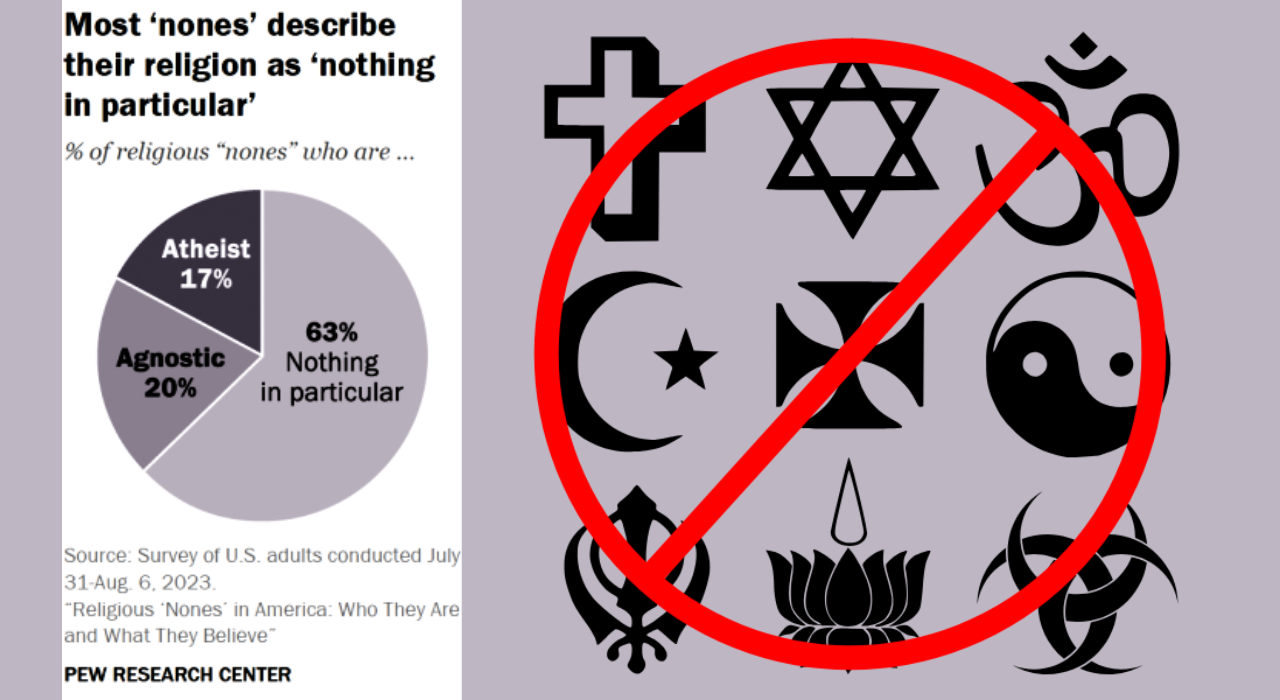
Nonreligious “nones” are now the world’s third-largest group, including atheists, agnostics, spiritual-but-not-religious, and those unaffiliated with organized religion.
As of 2020, 75.8% of the world’s population identified with a religion, while 24.2%, about 1.9 billion people, did not. This makes the religiously unaffiliated the third-largest group globally, after Christians (2.3 billion) and Muslims (2.0 billion).
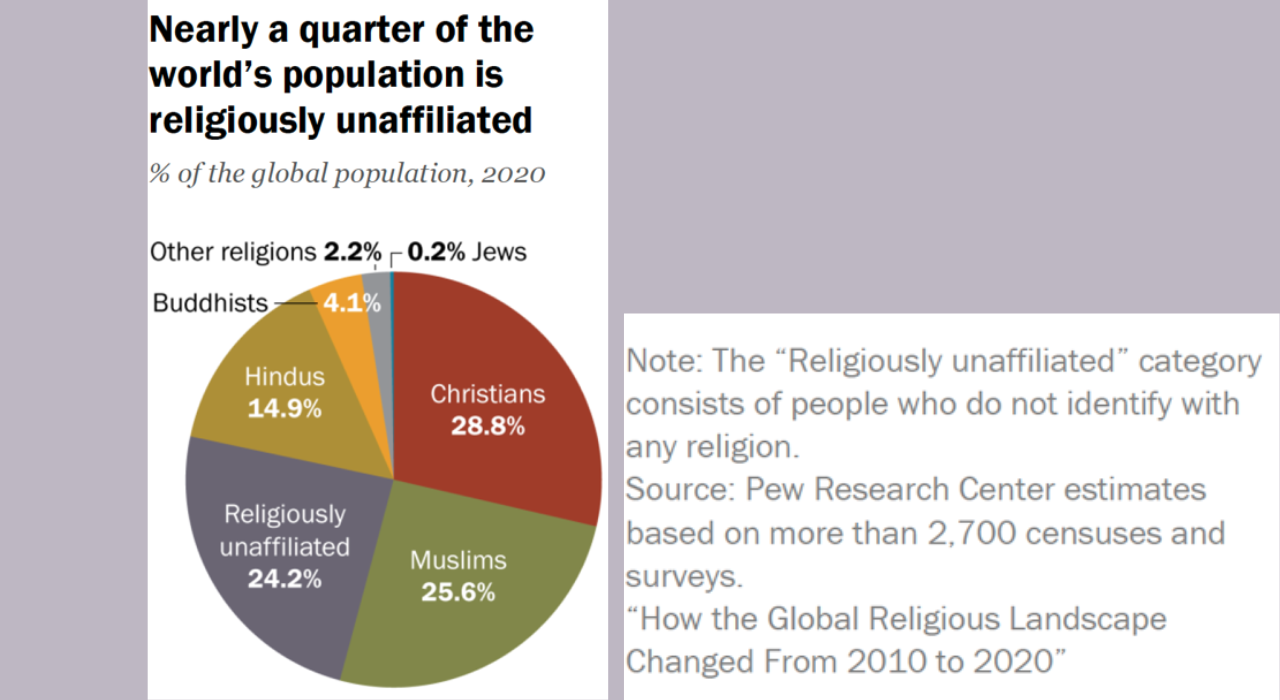
The unaffiliated now make up 24.2% of the global population, driven largely by Christian disaffiliation.
Since 2010, the share of people with a religious affiliation has declined by nearly one percentage point, from 76.7%, while the proportion with no affiliation has risen by a similar margin, up from 23.3%.
Are ‘Nones’ nonbelievers?
Not all “nones” reject belief in God or the supernatural. While they are far less likely than religiously affiliated people to believe in God “as described in the Bible,” most do believe in God or some higher power. Only 29% of “nones” say there is no higher power or spiritual force in the universe. Most were raised in a religion, typically Christianity. Their current identity reflects disaffiliation from religious institutions rather than necessarily the rejection of all spiritual belief. Their institutional disengagement is pronounced: 90% of religiously unaffiliated people say they seldom or never attend religious services. On science and religion, “nones” are not monolithic. Most reject the idea that science can explain everything.
At the same time, they express more positive views of science than religiously affiliated Americans do. In surveys, 43% say religion does more harm than good in American society, but many also acknowledge that religion can provide meaning and encourage people to treat one another well. Their views are mixed rather than uniformly hostile.
Growth despite a ‘demographic disadvantage’
The expansion of the unaffiliated is notable because, demographically, they face structural headwinds. Globally, the unaffiliated have the smallest share of children under age 15 (19%), while Muslims have the smallest share of adults ages 50 and older (13%). On average, the unaffiliated population is older and has lower fertility rates than many religious groups. In demographic terms, this places them at a disadvantage compared with groups that have younger age structures and higher birth rates. Yet their share of the global population increased.
The reason lies primarily in religious switching.
Religious switching: The main driver
Pew’s analysis of 117 countries and territories compared what adults ages 18 to 54 say about the religion in which they were raised with their current religious identity. Religious switching tends to occur earlier in life, so this age range captures recent movement.Globally, for every adult who joined a religion after being raised without one, 3.2 left religion altogether.
For every 100 people ages 18 to 54 who were raised without religion, 7.5 left the unaffiliated category while 24.2 joined it, a net gain of 16.7. As a result, the religiously unaffiliated experienced the largest net gains from switching.Christians experienced the largest net losses: for every 1.0 person who joined Christianity, 3.1 left. Most former Christians became religiously unaffiliated, though some joined other religions.
Buddhists also saw more departures than arrivals, with 1.8 leaving for every 1.0 who joined.
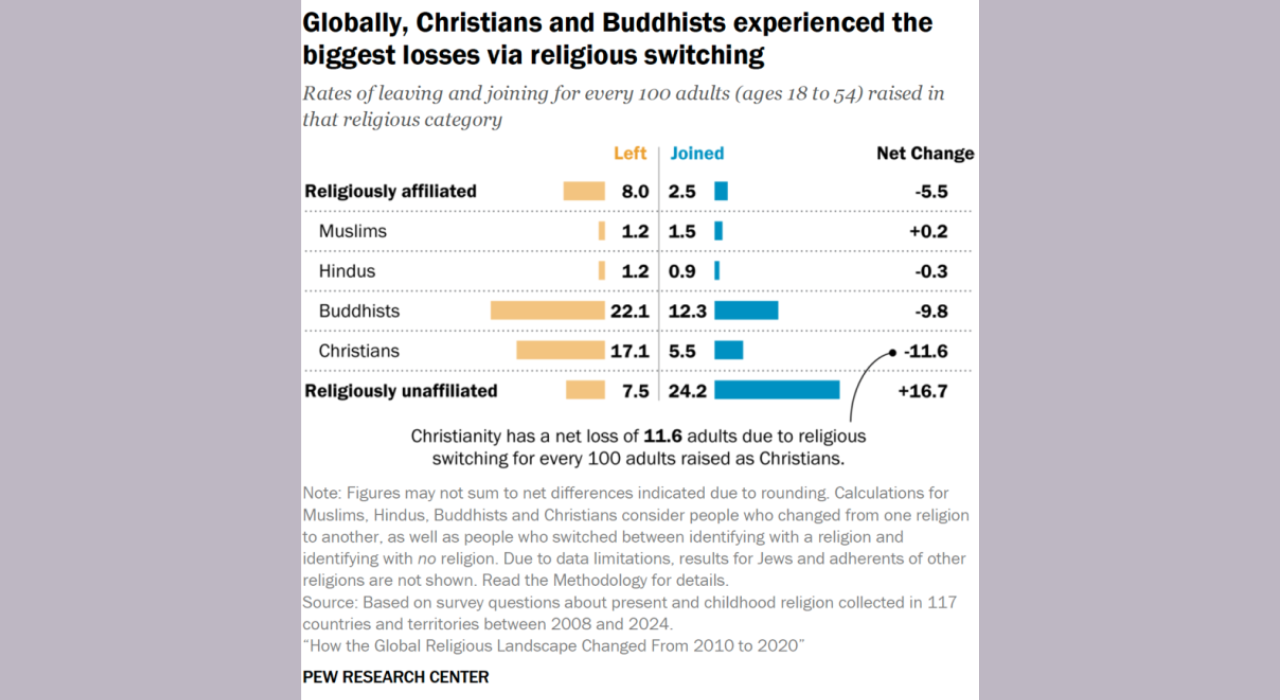
Religious switching, especially Christians leaving faith, drove the unaffiliated’s growth to 1.9 billion, despite older age and lower fertility.
Hindus experienced slightly more departures than arrivals, while Muslims experienced the reverse. However, switching into and out of Hinduism and Islam remains relatively uncommon, so these ratios have only modest overall effects on their global population sizes.Switching helps explain why Christian populations shrank as a share of the global population despite relatively high fertility, and why the unaffiliated grew as a percentage of humanity despite older age structures and lower fertility.
Country-level changes
Religiously unaffiliated people gained at least five percentage points in 35 countries between 2010 and 2020. A percentage point refers to the simple numerical difference between two percentages. For example, if a group made up 10% of a country’s population in 2010 and 15% in 2020, that represents a five-percentage-point increase. This is not the same as a 5% rise in the number of people; it reflects a change in share of the total population.The largest increases in the unaffiliated share occurred in the United States, which rose by 13 percentage points, Uruguay by 16 points, and both Chile and Australia by 17 points. These shifts indicate a significant change in religious identification within a relatively short period.Christians, meanwhile, experienced substantial declines, defined in the study as a drop of at least five percentage points, in 41 countries, more than any other religious group.
In all but one case, Christianity shrank as a proportion of the national population. The decreases ranged from a five-point drop in Benin to a 14-point decline in the United States and a 20-point fall in Australia.These changes altered religious majorities in several countries. As of 2020, Christians remained a majority in 120 countries and territories, down from 124 in 2010. Their share fell below 50% in the United Kingdom (49%), Australia (47%), France (46%) and Uruguay (44%).
In each of these nations, the religiously unaffiliated now account for 40% or more of the population.
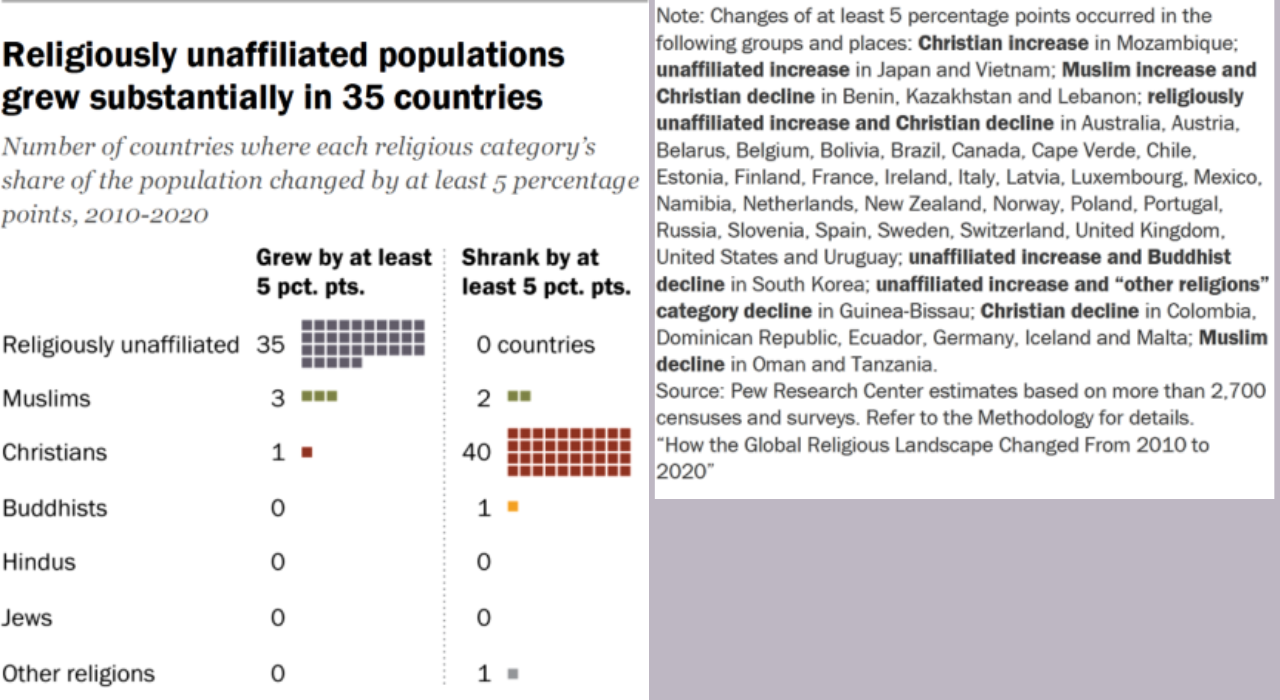
Religiously unaffiliated people gained at least five percentage points in 35 countries between 2010 and 2020.
The number of places with an unaffiliated majority increased from seven to 10 over the decade. The Netherlands (54%), Uruguay (52%) and New Zealand (51%) joined China, North Korea, the Czech Republic, Hong Kong, Vietnam, Macao and Japan, which already had unaffiliated majorities in 2010.By contrast, there was no change in the number of Muslim-majority countries (53), Buddhist-majority countries (7), Jewish-majority countries (1) or countries where “other religions” form a majority (1), indicating greater stability in those religious distributions during the same period.
Where the ‘Nones’ Are Concentrated
China remains the country with the largest number of religiously unaffiliated people. In 2020, about 1.3 billion people — roughly 90% of its population, identified as unaffiliated.The United States now has the second-largest number, with approximately 101 million religious “nones,” marking a 97% increase from a decade earlier. They make up about 30% of the U.S. population. Japan follows with 73 million unaffiliated people, up 8% over the same period, representing 57% of its population.
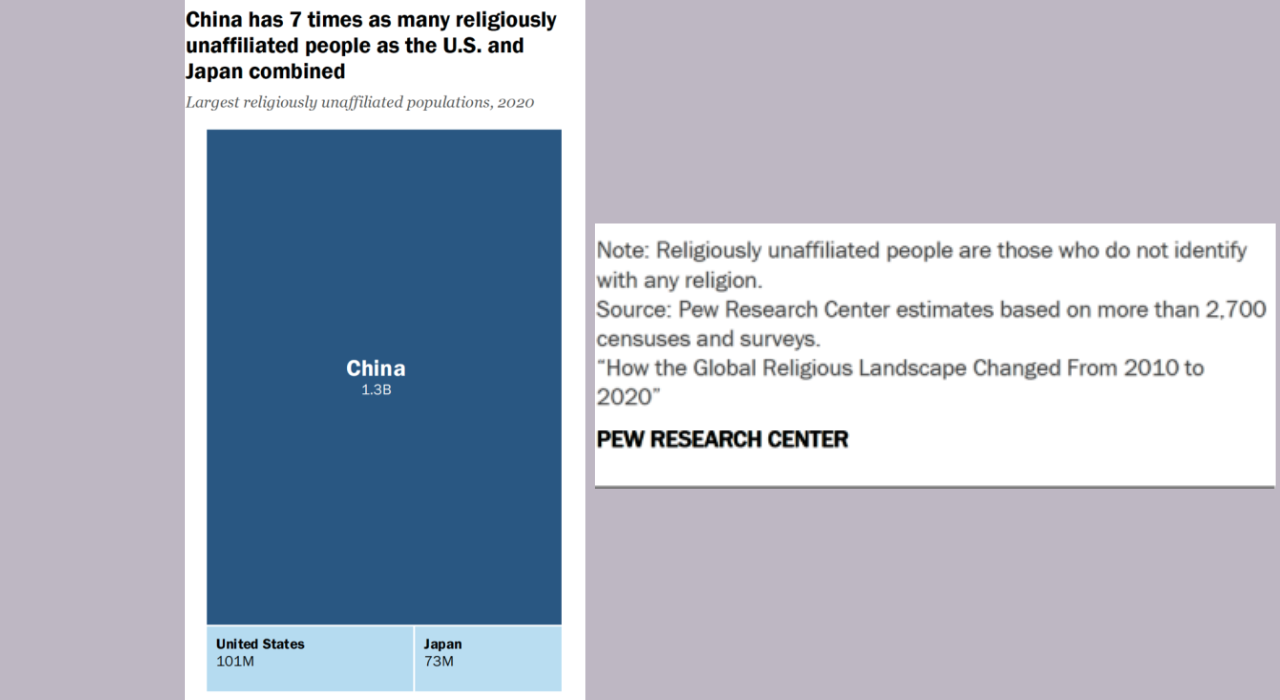
China, the United States, and Japan together account for the largest populations of religiously unaffiliated people globally.
China’s unaffiliated population alone is roughly seven times the combined total in the United States and Japan. Together, these three countries account for a substantial share of the global unaffiliated population.
A note on age patterns and Simpson’s Paradox
At the global level, unaffiliated people are older, on average, than affiliated populations. However, at the country level, the opposite pattern often appears. In China, Japan and most countries in Europe and the America, including the United States, the unaffiliated are younger than the affiliated. This apparent contradiction is an example of Simpson’s paradox. Because China and Japan have very large populations and high median ages, their demographic patterns heavily influence global averages. Both have unaffiliated majorities and aging populations, which shifts the global age profile upward.
The broader global context
Between 2010 and 2020, the global population increased, and most religious groups grew in absolute numbers.
However, only Muslims and the religiously unaffiliated expanded their share of the world’s population during that period.Christians remained the largest religious group worldwide, numbering 2.3 billion people in 2020. Yet their global share declined by 1.8 percentage points, falling to 28.8%. In contrast, Muslims grew by 347 million, more than all other religions combined, raising their share to 25.6% of the global population.The religiously unaffiliated also saw substantial growth, increasing by 270 million to reach 24.2% of humanity. Unlike many religious groups, this rise was not driven primarily by fertility rates. Instead, it stemmed largely from religious disaffiliation, particularly from Christianity. The net movement away from religion was strong enough to offset the unaffiliated population’s older age profile and lower birth rates, reshaping religious balances in dozens of countries.By 2020, nearly one in four people worldwide identified with no religion. While the pace and scale of change varied across regions and traditions, the overall shift was significant enough to reduce the number of Christian-majority countries and increase the number of nations where the religiously unaffiliated form a majority.