


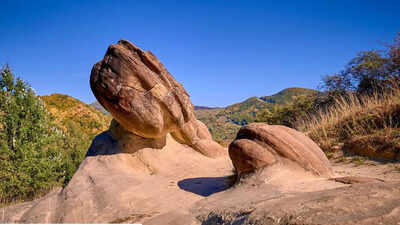
These ‘living’ rocks in Romania can grow and give birth to new stones
In a quiet part of southern Romania, rounded sandstone formations sit in open fields and woodland edges, drawing steady scientific interest. Known as ‘trovants’, these stones are often described as living rocks because they appear to grow and, in some cases, form smaller offshoots that separate from the main body.
The best-known examples are found near the village of Costeşti in Vâlcea County, where a protected site called the Muzeul Trovantilor preserves several large specimens. The structures are classified as cemented sandstone concretions formed millions of years ago. While folklore has long surrounded them, geologists attribute their unusual shapes and gradual expansion to natural chemical and sedimentary processes rather than biological activity.
Romanian trovants are sandstone concretions that expand through mineral deposits
Geologists link trovants to sediment deposits dating back to the Middle Miocene period, more than five million years ago. At that time, parts of present-day Romania were shaped by rivers and shallow waters. Layers of sand accumulated and were later compacted.The stones are made of sand grains bound together by calcium carbonate. This limestone cement formed underground, slowly hardening around a core. Earthquakes may have played a role in shaping and compressing the material.
Over time, erosion exposed the rounded masses at the surface.
Growth happens slowly through mineral deposits
Unlike most rocks that gradually wear down, trovants can expand in size. The process is subtle. During heavy rainfall, the porous stone absorbs water containing dissolved calcium carbonate. As the water moves through the rock, mineral cement can accumulate near the surface.In certain conditions, pressure builds unevenly. A small bulge may appear on one side.
With time, that bulge can enlarge and detach, creating what looks like a smaller baby rock beside the original. Growth is extremely slow. Estimates suggest only a few centimetres of expansion over many centuries.
Local folklore shaped early beliefs about living rocks
The unusual forms have long fed local stories. Some residents once believed the stones were fossilised dinosaur eggs or remnants of alien activity. The term trovant was introduced by a Romanian naturalist and translates roughly as cemented sand.There are also stories that say the rocks can move. People often say that it looks like the falling rocks in Death Valley, USA. There isn’t strong proof to prove that the stones are moving, but some researchers think that the stones might move slightly as the soil expands and contracts during heating and cooling cycles.Trovants are still interesting geological features, but they are no longer secrets. They are watching the rain and time slowly fall on fields near Costeşti. The land was formed by water long before people came.