


It started as a week of trade wins for President Trump. On Tuesday, Japan committed $36 billion in investments in the US, and on Thursday, the president of Indonesia signed a deal in Washington to open up critical sectors of the country’s economy to American companies.
The moves were part of trade deals both countries had signed under the threat of massive tariffs, unlike anything they had faced in modern times – up to 35% in Japan’s case and 32% for Indonesia. Trump hailed the developments as signs that the US was “WINNING again.”But by the end of the week, it was no longer clear who, if anyone, was winning. On Friday, the Supreme Court struck down the legal premise of Trump’s punitive tariffs.
After the ruling, he insisted that many of the deals would stand, although even he acknowledged that some might not. The court’s decision has left the fate of the deals highly uncertain.In Asia, where most of the world’s goods are made, govts had raced to do deals with Trump. The goal was to negotiate lower tariffs for their export-dependent industries. Many govt leaders who brokered deals and made significant pledges faced political recrimination at home, accused of giving away too much and, at times, sacrificing sovereignty.
With damaging tariffs hanging over them, countries like Japan and Indonesia – not to mention South Korea, Taiwan, Malaysia, Cambodia- made difficult concessions like lifting many of their tariffs on imports from the US. Some even promised to align with Washington sanctions, issues of national security and sourcing minerals, major undertakings that have irked constituencies at home as well as trading partners like China.For the Asian countries that struck deals with Trump, China looms large. In nearly every country, it is the most important regional economic and geopolitical partner or rival. So far, China has kept Trump at a standstill in trade negotiations and could end up with a better deal than its neighbours and American allies.Now, after the court decision constraining Trump’s trade cudgel, countries throughout Asia were left wondering if they had made a mistake in quickly finalising deals with Trump and whether existing agreements would stand.
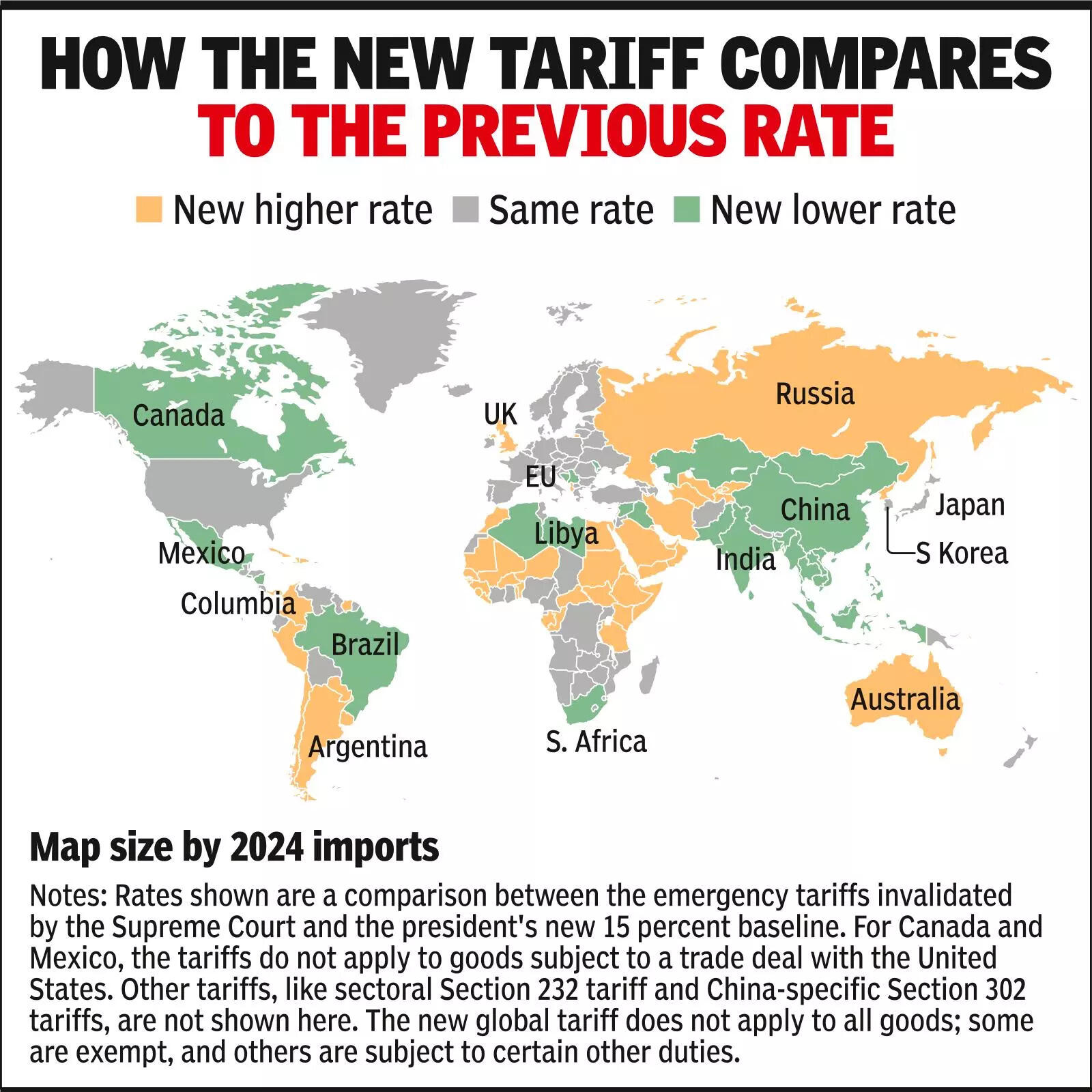
“Countries which signed deals with the US and agreed to a tariff above 15% are now disadvantaged,” said Steven Okun, chief executive of APAC Advisors, a geopolitical consulting firm. “Do you renegotiate and drive a harder bargain since Trump’s leverage is diminished? Or keep what you have to avoid retaliation?” he said.In recent months, Japan, South Korea and Taiwan secured 15% tariffs in return for hundreds of billions of dollars in investments.
For them, little has changed. Indonesia, Malaysia and Cambodia agreed to 19% tariffs in exchange for large purchases of American goods and the opening up of certain sectors, putting them at a relative disadvantage to rival Asian economies. Countries that chose to conclude deals with Washington, knowing that the Supreme Court could overturn the tariffs, negotiated with the assumption that President Trump would find another way to impose import duties. “The winner countries are the ones that haven’t actually negotiated a trade deal or, like Japan, committed a lot of money,” said Paul Nadeau, a Tokyo-based adjunct fellow at the Center for Strategic and International Studies, a think tank.WhileNadeau expects tariffs to persist in some form, he said that the Supreme Court decision could change the dynamic of future talks. “Trump may be more constrained in ways that change his leverage at the negotiating table,” he said. “He comes to the table with less of a strong bat.”