


AA
Text Size
- Small
- Medium
- Large
1/6
Most beautiful galaxies ever captured by NASA telescopes
Humanity has always been fascinated by space. We are able to see the universe with breathtaking clarity because of NASA’s powerful telescopes. Astronomers have been able to take pictures of galaxies that resemble cosmic art thanks to tools like the Hubble Space Telescope. In addition to being stunning, these galaxies shed light on how stars form, how galaxies interact, and how the universe evolves over time. Every discovery, from ring-shaped galaxies created by cosmic collisions to spiral giants brimming with young stars, tells a tale. We investigate the cosmos beyond our Milky Way by fusing science and awe.
2/6
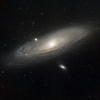
The Andromeda Galaxy – Our nearest galactic neighbour
The Andromeda Galaxy (M31) is the closest large galaxy to the Milky Way and one of the most studied objects in astronomy. It is about 2.5 million light-years away and can be seen with the naked eye under dark skies. For more than ten years, NASA’s Hubble Space Telescope captured an enormous mosaic of this galaxy. The resultant image shows intricate structures throughout Andromeda’s spiral arms and contains hundreds of millions of stars. Because Andromeda provides a close-up view of a galaxy like our own, astronomers study it. Researchers hope to learn more about how massive galaxies expand and change over billions of years by studying their stars and satellite galaxies.
Image Credit: NASA
3/6
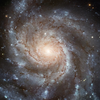
The Pinwheel Galaxy – A grand design spiral
A magnificent illustration of what astronomers refer to as a “grand design spiral galaxy” is the Pinwheel Galaxy (Messier 101). It is distinguished by its massive, distinct spiral arms and is located roughly 21 million light-years away. One of the most complex depictions of the galaxy was made when NASA and the European Space Agency published a detailed Hubble image of the galaxy. Numerous star-forming regions were visible throughout its massive disk in the image. New stars are continuously forming in the enormous gas and dust clouds that make up the Pinwheel Galaxy. The galaxy resembles a cosmic firework due to the bright pink and blue areas created by these glowing star nurseries.
Image Credit: NASA
4/6
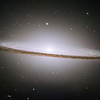
The Sombrero Galaxy – The galaxy that looks like a hat
The Sombrero Galaxy (Messier 104) is one of the most unique galaxies captured by NASA’s telescopes. It gets its name from its shape, which resembles a broad-rimmed Mexican hat when viewed from Earth. NASA describes it as having “a brilliant white, bulbous core encircled by thick dust lanes.”
A gentle glow surrounds the galaxy’s core due to the billions of old stars that make up its massive central bulge. Dark dust bands simultaneously create an eye-catching ring across the disk of the galaxy. Researchers have discovered that the Sombrero contains roughly 2,000 globular star clusters much more than those that orbit the Milky Way.
It is among the most famous pictures in astronomical photography because of these striking contrasts between light and shadow.
Image Credit: NASA
5/6
The Cartwheel Galaxy – Beauty born from a cosmic collision
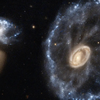
Among the most spectacular NASA Hubble telescope galaxy images is the Cartwheel Galaxy. Unlike spiral galaxies, this system creates a huge glowing ring of stars. According to NASA scientists, the shape was created when a smaller galaxy collided violently with the center of a larger galaxy. Shock waves were created by this incident, and they dispersed like water ripples. Massive star formation was sparked by the shock wave’s passage through gas and dust. NASA paints a vivid picture of it, likening it to “a rock tossed into a lake,” creating ripples that spark star formation explosions.
The Cartwheel Galaxy is one of the most striking galactic structures ever photographed, with clusters of young blue stars glowing in the ring.
Image Credit: NASA
6/6
The Whirlpool Galaxy – A classic spiral masterpiece
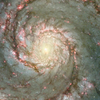
One of the most striking spiral galaxies ever captured on camera is the Whirlpool Galaxy (M51). It is well-known for its bright clusters of young stars and sweeping spiral arms, and it is located approximately 30 million light-years away. NASA explains that this galaxy is “one of the brightest and most picturesque galaxies in the sky.” Scientists have observed interactions between the Whirlpool Galaxy and NGC 5195, a smaller companion galaxy. NASA’s Jet Propulsion Laboratory claims that as the gravitational pull disturbs the gas and dust inside the spiral arms, this interaction initiates the formation of new stars.
The Whirlpool Galaxy’s striking appearance in telescope images is caused by this cosmic encounter, which produces clusters of brilliant blue stars and glowing hydrogen regions.
Image Credit: NASA
Follow Us On Social Media