


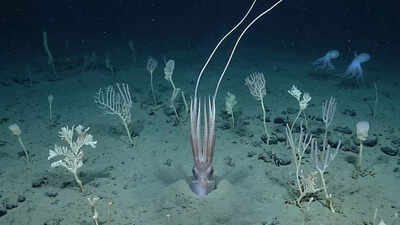
The new finding, made by researchers in a new era for marine biology, is the first such discovery of footage of an undescribed species of whiplash squid; this creature is capable of having an aggressive form of mimicry that makes it look like part of the seafloor.
Scientists were able to record video evidence of this event by capturing images at a depth of 4.1 km in the Clarion-Clipperton Zone (CCZ), which is located in the Pacific Ocean. Researchers also found evidence of another new type of squid, which they believe is a member of the Mastigoteuthidae family, based on the footage recorded from the CCZ, and the researchers believe it was an instance of this previously unknown squid.
While the use of technology advances to allow for more research and documentation of the variety of life in the ocean, researchers from the National Oceanography Centre (NOC) indicate that these discoveries put to rest previous beliefs about how much biodiversity exists in the deep-sea ecosystem. This remarkable camouflage strategy, known as aggressive mimicry, allows the predator to effectively vanish against the sediment, waiting to ambush unsuspecting prey in the abyss.
Deep-sea discovery: Squid camouflages a tree in 4,100-metre depth
An astonishing piece of footage released by the National Oceanography Centre (NOC) has shown a rare form of the unidentified whiplash squid in a vertical position in the deep sea, over 4,100 metres below sea level. By inserting its head into the soft mud that forms the seabed and stiffening its arms so that they trail upwards, the squid takes on a tree-like or plant-like appearance as it becomes vertical.
Robotic discovery in the CCZ
This unusual behaviour is an excellent example of aggressive mimicry because the squid can now blend in with its surroundings of sea sponges and stalks, hiding from creatures that dive deep to hunt for food, or ambushing unsuspecting prey that mistake the squid’s tentacles for harmless seafloor flora.Using the high definition cameras of the remotely operated vehicle (ROV) Isis, scientists with the SMARTEX expedition have documented this behaviour for the first time in the Clarion-Clipperton Zone (CCZ). The clarity and detail of the footage also supported scientists’ conclusions that the squid was not merely ‘stuck’ but, rather, intentionally posed itself in a rigid tree-like position through the process of aggressive mimicry.
The groundbreaking discovery of this relatively new form of aggressive biological mimicry supports substantial shortcomings in our knowledge about the biology of the deep ocean, and provides evidence that even some well-known marine predators, like the squid, have evolved extraordinary morphological adaptations. These ‘disguises’ provide some degree of protection in the extreme conditions of the Pacific Ocean deep sea.
The future of deep-sea protection
The ‘muddy squid’ is not only a biological wonder, but also a significant measure of the amount of knowledge still to be gained from the Clarion-Clipperton Zone. National Oceanography Centre (NOC) researchers note that this film demonstrates the significant ‘knowledge gaps’ we have regarding abyssal ecosystems. As interest in deep-sea mining continues to increase, the muddy squid shows that the seabed is an intricate, vibrant ecosystem and is a complex, three-dimensional habitat. The discovery of the muddy squid also highlights the need for wide-ranging biological surveys to protect these ‘masters of illusion’ from being irreversibly damaged by man before we can learn more about them.