


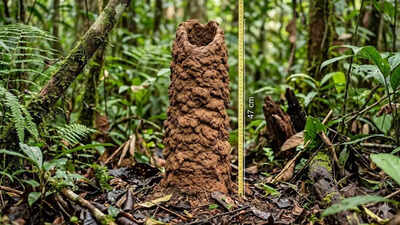
Researchers have discovered the purpose of the bizarre clay chimneys located at the base of the Amazon rainforest based on reputable research published in the scientific journal Biotropica. The results are from an extensive field study conducted in and around Manaus, Brazil, led by Serrapilheira Institute, which included the documentation of a record-setting 47 centimetre-high cicada tower (the tallest tower documented) representing the cicada species Guyalna chlorogena.
The experiment’s procedure utilised an empirical method by sealing the cicada towers with 40 latex condoms to measure the level of gas exchange activity occurring within the towers.
The Amazon’s record-breaking 47-centimetre cicada towers
The Serrapilheira Institute’s reports show that researchers conducted an extensive exploration of the region surrounding Manaus (Brazil) to evaluate and record characteristics associated with the architectural form of the cicada species Guyalna chlorogena.
One of the major discoveries of this expedition was a clay structure (also called a ‘clay chimney’) that measured 47 centimetres high and exceeded all previously documented measurement records for Guyalna chlorogena.
Cicada nymphs regularly construct these large clay towers using mud and soil that they excavate from below ground, and the authors of this study note that reaching such heights is an exceptional biological accomplishment due to the large amount of sediment that must be transported by the nymph from its underground tunnel to the surface (forest floor) before being exposed to the humid climate of the Amazon.
The condom method: An innovative approach to gas exchange
Renato de Jesus Rodrigues has led a research team to prove the function of the towers through a unique ‘gas trapping’ method. Scientists utilised 40 latex condoms to accommodate the openings of the clay chimney so they could monitor the amount of carbon dioxide build-up and the amount of oxygen taken in within the structure using the condoms as flexible, airtight membranes. The Biotropica journal demonstrated that the towers were not simply arbitrary mounds but rather active respiratory systems.
The experimental design provided the first empirical evidence that the towers provide significant gas exchanges for nymphs that reside in hypoxic conditions.
The ‘external lung’ hypothesis and survival strategy
Towers constructed by cicada nymphs are thought to serve as an ‘extended phenotype’- an anatomical feature located outside the organism that allows for greater survival. This is especially important in the swamped and highly compact soils of the Amazon.
These nymphs have a high chance of experiencing hypoxia (not enough oxygen) when submerged in water and are prone to flooding. The study indicates that the 47 cm high towers support the function of the ‘external lung’ by using the Venturi effect and/or diffusion to draw in new oxygen into the deep tunnels. The height of the structure also serves as protection from terrestrial predators by keeping the entrance above ground, where foraging ants will not go and eliminating any possibility of the cicada’s burrow becoming flooded when it rains heavily.