


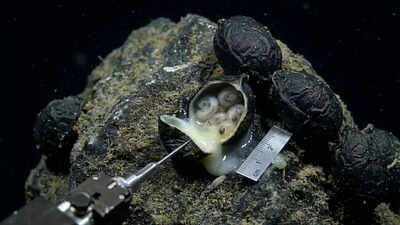
The record for deep-sea biology has been rewritten by a Japanese Research group. During a sampling of the Kuril-Kamchatka Trench, located in the northwestern Pacific Ocean, researchers from Hokkaido University sampled unusual leathery black cocoons attached to rock samples at a depth of 6200 meters.According to the Biology Letters report, the cocoons were 3 millimetre-wide, leathery black capsules; the cocoons contained embryos of free-living flatworms (phylum platyhelminthes). The investigators found embryos submerged in a nutrient-rich yolk, which provided protection for the developing embryos from the extreme pressure in the deep-sea environment. Hokkaido University has indicated that this discovery provides a new world record for this species of flatworm (at the deepest known location so far) and that lifeforms with complicated, relatively simple body plans are essentially the same and can continue to exist no matter how high the pressure the lifeforms experience in deep seas.
A record-breaking find at 6,200 meters under the Pacific Ocean
As part of their research on the Kuril-Kamchatka Trench in the northwest Pacific, a Japanese research team recovered several exotic, jet-black ‘eggs,’ attached to rock fragments. According to the study published in Biology Letters, the specimens were discovered at a depth of 6200 meters (over 20,000 feet). This discovery provides a new world record for the deepest known location of free-living flatworms, as they were found at nearly twice as deep as the previous record of 3,232 meters.
What was inside? The secret of the black cocoons
Although the structures were about 3 millimetres in diameter, they were not actually eggs, but leathery egg capsules (known as cocoons). When Dr Keiichi Kakui from Hokkaido University opened the cocoons using a microscope, each cocoon produced a milky liquid (later identified as yolk) that leaked out. Each egg capsule contained between three and seven flatworm embryos, with some of the embryos already showing signs of developed internal organs, according to the research archived by the Royal Society Publishing.
The blueprint for deep-sea survival
An unexpected discovery from this study was the finding that there are some species of flatworm in the hadal (abyssal) zone of the ocean, and many members of the family of flatworms have similar embryonic morphology. As their embryological development does not require undergoing large changes, these organisms were able to migrate into the abyssal zone from shallow coastal waters over geological time. This was accomplished through ‘time capsules’ developed around their eggs as they developed into adults, thus protecting them from crushing underwater pressure and the harsh chemical environment of the abyss.Accordingly, finding intact embryos in these depths is a first for this study (as it cannot be predicted). Therefore, these findings establish a basis upon which additional studies may be conducted to learn how organisms with simple body plans have been able to move from the shallow coasts of the world into the deepest regions of our oceans over geological time.