


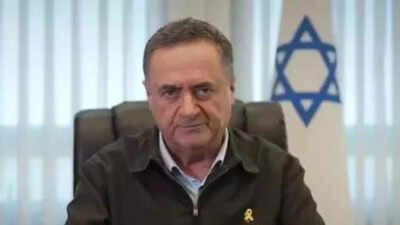
File photo: Israeli defence minister Israel Katz
Israel said on Tuesday that its military would take control of southern Lebanon up to the Litani River to create a “security zone”, marking a major escalation in its campaign against Hezbollah, while Lebanon took the unprecedented step of declaring Iran’s ambassador persona non grata and ordering him to leave by Sunday.As per news agency AFP, Israeli defence minister Israel Katz said the military “will control… the security zone up to the Litani”, around 30 kilometres (20 miles) from the border, and added that displaced Lebanese residents would not be allowed to return south of the river “until security is guaranteed for the residents of the north” of Israel.Katz, for the first time, publicly spelled out Israel’s intent to seize territory amounting to nearly a tenth of Lebanon, saying Israeli forces would “control the remaining bridges and the security zone up to the Litani.”
Israel outlines plan for ‘defensive buffer’ in southern Lebanon
The Israeli military has previously described its ground operations in Lebanon as limited, targeted raids near the border. But Katz’s remarks were the clearest indication yet that Israel intends to hold territory inside Lebanon as a defensive buffer, reported Reuters.At a meeting with military chief of staff, Katz said forces were establishing a “forward defensive line”, destroying Hezbollah-linked infrastructure and clearing buildings near the border.
For the second time this week, Katz compared the strategy to Israel’s approach in Gaza, saying areas near the border were being cleared and demolished “to create a defensive buffer and push the threat away from communities”.Katz said Israel was “following the model of Rafah and Beit Hanoun”, two Gaza cities that were effectively razed during more than two years of war and remain under Israeli military control.Israel has already destroyed five bridges over the Litani River since March 13 and accelerated the demolition of homes in Lebanese border villages.Under international law, attacks on civilian infrastructure, including homes and bridges, are generally prohibited.
Hezbollah vows resistance, calls move an ‘existential threat’
Hezbollah signalled it would resist any attempt by Israel to occupy the south.The Lebanese armed group said it would fight to prevent Israeli troops from occupying southern Lebanon, calling such a move an “existential threat” to the Lebanese state.Senior Hezbollah lawmaker Hassan Fadlallah told Reuters, “We have no choice but to confront this aggression and cling to the land.”Hezbollah had claimed regular attacks on Israeli troops in southern Lebanon in recent days, including in the strategic border town of Khiam and in the village of Qawzah on Tuesday.
Strikes continue across Lebanon as civilian toll mounts
Israel kept up strikes across Lebanon on Tuesday, with attacks in the south, east and near Beirut, after overnight bombardment of the capital’s southern suburbs.An AFP photographer in south Beirut saw widespread destruction near the site of an overnight Israeli strike, with rubble and debris covering the street.The Israeli army said overnight it had “struck Hezbollah terrorist infrastructure in Beirut and in additional areas in Lebanon”.The fighting has taken a heavy toll on Lebanon. Israeli strikes have killed at least 1,039 people and displaced more than one million people in more than three weeks of fighting.Lebanese authorities, also reported that strikes across southern Lebanon and parts of Beirut have killed more than 1,000 people and forced over a million residents from their homes.According to Lebanon’s health ministry, those killed include almost 120 children, 80 women and 40 medical personnel, though the ministry does not otherwise distinguish between civilians and militants. It also said two Israeli soldiers have been killed in fighting in Lebanon.
Lebanon expels Iranian ambassador in major diplomatic rupture
In a parallel escalation, Lebanon moved directly against Iran’s diplomatic presence.Lebanon’s foreign ministry summoned the Iranian charge d’affaires over what it called “Tehran’s violation of diplomatic norms” and said Beirut had withdrawn approval of the accreditation of the appointed Iranian ambassador.The ministry declared the Iranian envoy persona non grata and gave him until Sunday to leave.The envoy, identified as Mohammad Reza Sheibani, said the move did not amount to a full severing of diplomatic ties with Iran.Lebanese Prime Minister Nawaf Salam had said on Sunday that members of Iran’s Revolutionary Guards were commanding Hezbollah’s operations in the war against Israel. Lebanese authorities had already banned the Guards’ activities in the country earlier this month.Lebanon had also ordered the departure of dozens of other Iranian nationals, including diplomats, earlier this month.
Israel welcomes move, France calls it ‘courageous’
Israel quickly welcomed Beirut’s action against the Iranian envoy.Israeli foreign minister Gideon Saar called the expulsion a “justified and necessary step” and urged Lebanon’s government to take stronger measures against Hezbollah.“We call on the Lebanese government to take practical and meaningful measures against Hezbollah, whose representatives still serve as ministers within it,” Saar said in a post on X.France also backed Lebanon’s decision.French foreign minister Jean-Noel Barrot praised the move as “courageous” and said he wished to commend the Lebanese government for expelling the Iranian ambassador.Barrot also accused Hezbollah of dragging Lebanon into a new conflict.
France warns Israel against wider ground operation
While backing Lebanon’s diplomatic move against Iran, France also warned Israel against expanding its military push in the south.Barrot urged Israel to “refrain” from sending forces to take control of a zone in southern Lebanon.“We urge the Israeli authorities to refrain from such ground operations, which would have major humanitarian consequences and would exacerbate the country’s already dire situation,” Barrot was quoted as saying by AFP.