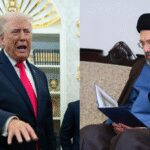



US President Donald Trump has announced a two-week suspension of planned military strikes on Iran, linking the move to Iran’s willingness to reopen the Strait of Hormuz and engage in negotiations.
The temporary halt in hostilities between Washington and Tehran has offered a narrow window for diplomacy, but there is little indication yet that the conflict has fully subsided.The decision came after a serious escalation in rhetoric earlier in the day by Trump, threatening to destroy the entire civilization viz-a-viz Iran, followed by last-minute diplomatic intervention by the mediators in conflict. Trump said the US had already achieved its military objectives and suggested that both sides were close to a broader agreement.
Watch
U.S. Bows To Iran? Trump Declares CEASEFIRE After Accepting Iran’s 10-Point Demand | Details
Iran, meanwhile, has signalled conditional cooperation. Its leadership has agreed to a temporary ceasefire window and proposed a comprehensive framework for ending the conflict, while making it clear that any halt in military operations depends on the cessation of attacks against it.However, developments on the ground, including missile activity across the Gulf and continued Israeli operations, reflect that the situation remains volatile.
1. A temporary ceasefire
The arrangement announced by the US is limited to a two-week period and is designed as a pause rather than a resolution. Trump described it as a “double sided ceasefire,” but officials on both sides have emphasised its conditional and reversible nature. Iran’s supreme national security council has also clarified that the move “does not signify the termination of the war,” reinforcing that this is a tactical halt aimed at enabling negotiations rather than ending hostilities altogether. It said in a statement, “It is emphasized that this does not signify the termination of the war,” the statement said. “Our hands remain upon the trigger, and should the slightest error be committed by the enemy, it shall be met with full force,” reported AP.
2. The Strait of Hormuz is the central bargaining chip
A key US demand is the reopening of the Strait of Hormuz, a critical global energy corridor through which about 20% of the world’s oil supplies passes. Trump has made its “complete, immediate, and safe” reopening a precondition for suspending strikes.
Iran has agreed in principle but with caveats, stating that safe passage will be allowed only through coordination with its armed forces and subject to technical constraints. Iran since the beginning of the war has used Hormuz as a strategic lever.

3. Iran’s says ceasefire depends on reciprocity
Iran has not declared an unconditional halt to military operations. The country’s foreign minister Abbas Araghchi has said, “If attacks against Iran are halted, our Powerful Armed Forces will cease their defensive operations.” The lack of trust between both sides has only deepened over the last month, and Araghchi’s statement only makes it evident, where any violations could quickly unravel the arrangement. It also leaves room for interpretation on what constitutes “defensive operations.”
4. Formal talks are expected to begin in Islamabad
During the two-week window, negotiations between the US and Iran are expected to take place in Islamabad. It comes as Trump, in his Truth Social post, said, “Based on conversations with Prime Minister Shehbaz Sharif and Field Marshal Asim Munir of Pakistan, and wherein they requested that I hold off the destructive force being sent tonight to Iran.”Iranian authorities have confirmed their participation, signalling a willingness to engage diplomatically after weeks of military escalation.
5. Iran’s 10-point peace framework
Tehran has put forward a sweeping 10 point-peace proposal to bring hostilities to end. The proposal goes beyond a temporary truce and calls for a comprehensive end to the conflict. Key demands include a permanent cessation of hostilities across multiple regions, including Iran, Iraq, Lebanon, and Yemen, reopening of the Strait of Hormuz, lifting of US sanctions, release of frozen Iranian assets, and financial compensation for reconstruction.It also includes a commitment by Iran not to pursue nuclear weapons, positioning the proposal as a broader settlement framework.
6. Discrepancy over nuclear ‘enrichment’ raises fresh questions
A key difference has emerged between Iran’s Farsi and English versions of its 10-point proposal, potentially complicating negotiations. According to AP, the Farsi-language version explicitly includes the phrase “acceptance of enrichment” in reference to Iran’s nuclear programme, wording that was absent from the English version. It remains unclear why the term was omitted in translation, but the distinction is significant. Trump has maintained that ending Iran’s nuclear programme entirely is a central objective of the conflict, and had earlier dismissed Tehran’s proposal as “fraudulent” without providing details.The discrepancy could indicate unresolved differences on one of the most sensitive issues in the talks.
7. Military activity continues despite announcement
Even after the ceasefire declaration, multiple reports indicate ongoing hostilities. According to CNN, missile and drone threats were detected across the Gulf, with countries such as Qatar and the UAE working to intercept them. Israel also reported incoming missiles from Iran and continued its own strikes, highlighting the gap between political announcements and ground realities.
8. The US claims major progress has already been made
Trump has asserted that negotiations are already at an advanced stage, saying, “Almost all of the various points of past contention have been agreed to.” He also described Iran’s proposal as a “workable basis” for a final agreement. These claims suggest optimism from Washington, although key sticking points remain unclear.The ceasefire is not limited to the US and Iran alone. Pakistani leadership had a role in facilitating the pause, while statements suggest the arrangement may extend to other theatres such as Lebanon. At the same time, Gulf countries and Israel remain directly affected, with ongoing security alerts underscoring the broader regional dimension of the conflict.
9. Iran’s military structure may delay full compliance
Iran’s decentralised military command system means that ceasefire orders may not be implemented uniformly or immediately. While state media reported that the supreme leader had instructed all units to stop firing, the structure allows regional commanders a degree of autonomy. This could lead to delays or inconsistencies in adherence, increasing the risk of accidental escalation.
10. Fundamental issues behind war remain unresolved
Despite the diplomatic opening, core disputes, including Iran’s nuclear programme, regional influence, and long-standing geopolitical tensions, have not been settled. According to NYT, the ceasefire leaves intact critical concerns such as Iran’s nuclear stockpile and the broader balance of power in the Middle East. This suggests that even if the current pause holds, a lasting resolution will require far more extensive negotiations.
The bottom line
The US-Iran ceasefire represents a significant de-escalation, but it is not an end to the conflict. With conditions attached, military activity still being under way, and major issues unresolved, the situation remains precarious. The next two weeks of negotiations will be crucial in determining whether this pause can evolve into a durable agreement, or whether it remains a brief interruption in an ongoing war.