


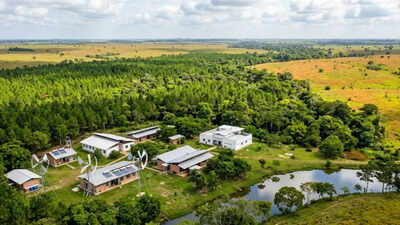
In the 1960s, visionary Paolo Lugari sought to prove that if a sustainable civilisation could survive in the harshest conditions, it could thrive anywhere. Lugari selected the Llanos in Colombia (a vast area known to be one of the harshest environments) to create an experimental village: Las Gaviotas in 1971, with the help of a scientific team.
Through the work of Las Gaviotas’ founders and their team of scientists, the previously uninhabited area of nearly 20,000 acres was transformed into an abundant, self-sufficient tropical ecosystem where trees and plants thrive without the assistance of chemicals or artificial pest control products. As of today, Las Gaviotas has developed more than 30 per cent of their original land into a tropical rainforest and has proven that by man’s ingenuity, the vegetated skin of the Earth can be restored.
Las Gaviotas: The vision of a tiny town in Colombia
The radical idea that tropical countries can create their own specific technologies instead of needing to purchase from northern developed nations is the foundation of this project. According to the paper ‘Sustainability in the Tropics’, this thinking led to the development of ‘bioclimatic urbanism,’ in which each building will be constructed in a manner that is appropriate for the weather conditions found in the Llanos region.
One example of this would be the building of a community-based health centre with subsurface air duct systems and double-wall facades that use the Venturi effect to allow for natural ventilation and cooling. Thus, eliminating the need for air conditioning systems that use up a significant amount of electricity and depend on outside systems. The same approach to self-governance is evident through the ‘all-archy’ social structure in which decisions are made through community consensus, rather than by the use of an arched hierarchy or top-down method of making decisions.
How Las Gaviotas increased regional rainfall
According to Devalt, Las Gaviotas is environmentally important for having planted more than 8000 hectares of forest in an area previously thought too acidic to grow food. The Gaviotans showed that when they inserted a specifically chosen fungus called Pizolithus tinctorius into the roots of Caribbean pines, those trees could pull nutrients from the otherwise lifeless soil. This artificial forest provided a protective cover for the ungerminated seeds of over 250 species of native tropical plants, allowing the seeds to become re-established in the area.
The tremendous return of biodiversity has changed the environmental conditions of the area, causing regional rainfall to increase by 10 per cent. In addition to an increase in rainfall, many other species of animals, such as tapirs and deer that had disappeared from this environment, have returned.
How Las Gaviotas stays independent
The village was able to sustain its independence while living in such an isolated location by creating a variety of low-cost/high – efficiency devices and then making the designs available as open-source blueprints to the developing world.
Some examples of engineering achievements include the use of double-action windmills, which can harness not only moderate but also some very light wind in tropical environments and special sleeve pumps, which allow a person to lift water from a depth of 40 meters with little physical exertion on their part, as noted in The Ecologist.
The village gets its power supply through solar-powered kettles to sterilise water, and through a biodiesel plant that produces fuel for the village’s large machinery from locally grown palm oil. The use of these innovative devices has allowed the village to remain economically sustainable and environmentally neutral, which shows that a high standard of living can be achieved without destroying natural resources.