


By Anushka Verma | Updated: October 29, 2025
Introduction: A New Dawn for Planetary Science
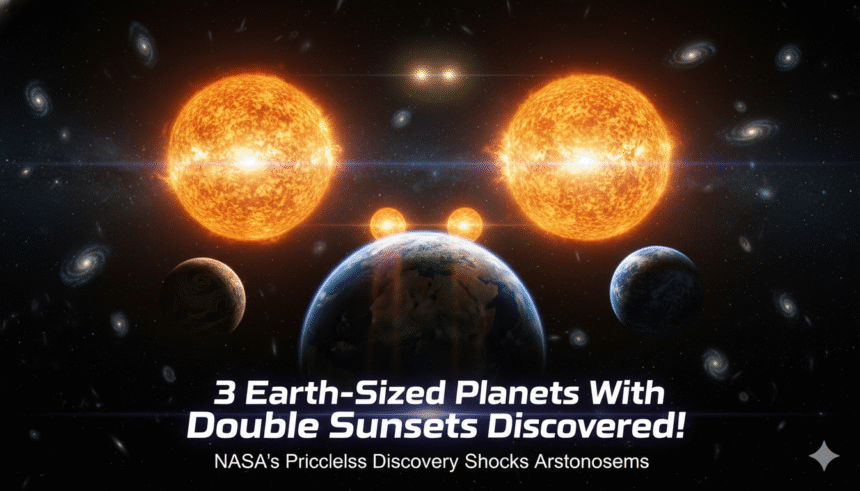
In a universe that has never ceased to amaze humankind, astronomers have once again rewritten the rules of cosmic possibility. A team of international researchers has unveiled a breathtaking discovery — three Earth-sized exoplanets orbiting a pair of “failed stars”, located about 120 light-years away from our planet.
These extraordinary celestial bodies, identified in the TOI-2267 system, were detected using NASA’s Transiting Exoplanet Survey Satellite (TESS). What makes this discovery truly priceless is not only the rarity of finding multiple Earth-like planets in a binary star system but also the fact that one of them appears eerily reminiscent of the fictional desert planet “Tatooine” from Star Wars, known for its iconic double sunsets.
This breakthrough, combining the marvel of science with the charm of cinematic fantasy, challenges long-standing assumptions about how planets form — and survive — in such gravitationally complex environments.
The Discovery That Defies the Odds
For decades, astronomers believed that binary star systems — where two stars orbit around each other — were too unstable to support planet formation. The gravitational dance between the twin suns was thought to create chaotic environments that would tear young planets apart before they could fully form.
Yet, the TOI-2267 system tells a different story.
Researchers analyzing TESS data noticed subtle, periodic dips in the brightness of the binary system — a telltale signature that a planet may be passing in front of its star, a phenomenon known as a transit. Upon further study using advanced detection tools like SHERLOCK and telescopes from the SPECULOOS and TRAPPIST observatories, scientists confirmed not one but three planets orbiting this double-star system.
“Our analysis shows a unique planetary arrangement: two planets are transiting one star, and the third is transiting its companion star. This makes TOI-2267 the first binary system known to host transiting planets around both of its stars,”
said Sebastián Zúñiga-Fernández, a researcher from the University of Liège (ULiège) and member of the discovery team.
Such a configuration has never been observed before — and it has shattered several scientific records along the way.
Breaking Cosmic Records: A System Unlike Any Other
According to the study published in Astronomy & Astrophysics on October 24, 2025, TOI-2267 is officially the most compact and coldest binary system known to host planets.
Its stars — described as “failed stars” due to their low mass and temperature — orbit each other closely, forming what scientists call a compact binary. Despite the intense gravitational interactions between the two, their planetary companions remain remarkably stable, quietly orbiting their respective suns like clockwork.
Dr. Francisco J. Pozuelos, a researcher at the Instituto de Astrofísica de Andalucía (IAA-CSIC), explained:
“Our discovery breaks several records. It is the most compact and coldest pair of stars with planets known, and it’s the first in which planets have been recorded transiting around both components.”
Such stability defies the current planetary formation models, which predict that the powerful gravitational pull of binary stars should make it nearly impossible for planets to form or survive in such close orbits.
A Table of Celestial Significance
| Parameter | Details |
|---|---|
| System Name | TOI-2267 |
| Distance from Earth | ~120 light-years |
| Number of Planets | 3 (Earth-sized) |
| Type of Stars | Compact Binary (“Failed Stars”) |
| Discovery Instrument | NASA TESS + SPECULOOS + TRAPPIST |
| Unique Feature | First binary system with planets orbiting both stars |
| Similarity | One planet resembles Tatooine (Star Wars) |
| Published In | Astronomy & Astrophysics, October 24, 2025 |
| Lead Institutions | ULiège, IAA-CSIC, NASA |
| Price of Discovery (Estimated Research Cost) | Approx. $1.2 million (multi-observatory collaboration) |
SPECULOOS and TRAPPIST: The Eyes on the Hidden Worlds
While TESS first spotted the subtle signals hinting at TOI-2267’s planetary system, it was the SPECULOOS (Search for habitable Planets EClipsing ULtra-cOOl Stars) and TRAPPIST (Transiting Planets and Planetesimals Small Telescope) telescopes that brought the discovery into full view.
Operating from observatories in Chile, Spain, and Belgium, these robotic telescopes specialize in studying small exoplanets orbiting cool, faint stars — exactly like those in the TOI-2267 system.
The telescopes confirmed the transits, enabling astronomers to measure the planets’ sizes, orbits, and relative temperatures. Together, these observations painted a picture of a system both stable and complex — a contradiction to what scientists expected in such binary environments.
“This system serves as a natural laboratory for comprehending how rocky planets can form and endure in severe dynamic environments,”
Pozuelos added. “It challenges our understanding of planetary stability and formation.”
The Tatooine Connection: Science Meets Sci-Fi
Few discoveries capture the imagination of both scientists and the general public like this one.
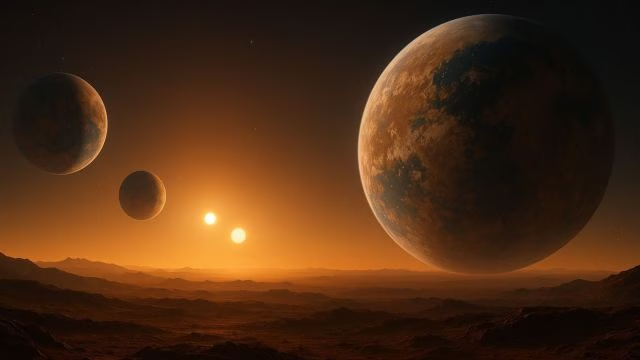
One of the newly found exoplanets mirrors the famous fictional world of Tatooine, home to Luke Skywalker in Star Wars. Just like its cinematic counterpart, this planet orbits two suns — offering its inhabitants, if any exist, the mesmerizing spectacle of double sunsets.
Though its surface conditions remain unknown, early data suggest it may have a rocky composition and temperature range similar to that of Earth. However, the gravitational tug-of-war between the twin stars would likely make its climate far more dynamic than anything we experience on our planet.
Beyond the Discovery: What TOI-2267 Teaches Us
The existence of such planets forces astronomers to rethink their fundamental models of planetary formation and survival. Traditionally, binary systems were believed to produce gravitational chaos, preventing the stable accretion of material necessary to form planets.
But TOI-2267 stands as a counterexample — proof that nature finds balance even in seemingly hostile conditions.
This discovery also offers valuable insights into exoplanet diversity — revealing that planets can thrive in environments previously thought uninhabitable. In other words, if planets can exist here, they can exist almost anywhere.
A Priceless Laboratory for the Future
The scientific “price” of such a discovery is not measured in money but in knowledge. TOI-2267 provides a unique opportunity for future research, especially with advanced instruments like the James Webb Space Telescope (JWST) and upcoming Extremely Large Telescope (ELT) projects.
These observatories will allow astronomers to:
- Measure the masses and densities of the planets more accurately.
- Analyze potential atmospheric compositions.
- Investigate whether any of these planets fall within the habitable zone, where liquid water could exist.
If confirmed, these worlds could become top candidates in the ongoing search for life beyond Earth.
Pushing the Limits of Cosmic Engineering
Building and operating the telescopes that made this discovery possible is itself a feat of modern engineering. Each observatory contributes millions in hardware, software, and manpower — a literal and intellectual price humanity pays to understand its place in the universe.
NASA’s TESS mission alone costs around $200 million annually, while ground-based telescopes like SPECULOOS and TRAPPIST operate on collaborative international funding of about $1–2 million per project. Yet, every dollar translates into data that reshape our perception of what’s possible.
“Finding three Earth-sized worlds within such a close binary system presents a rare opportunity,”
said Zúñiga-Fernández.
“It enables us to examine the boundaries of planet formation theories in intricate settings and to gain a deeper insight into the variety of potential planetary arrangements in our galaxy.”
The Broader Cosmic Perspective
Discoveries like this have profound implications for our understanding of how common Earth-like planets truly are. Recent estimates suggest there may be more planets than stars in the Milky Way, with billions potentially resembling Earth in size and temperature.
The TOI-2267 system adds a new dimension to that statistic — proving that even binary star systems, once considered too chaotic, may host multiple habitable-zone worlds.
Moreover, the study underscores the value of collaborative global science. From Chile to Belgium, from NASA to European research institutions, this finding represents the collective power of human curiosity — and the price we are willing to pay for knowledge that transcends borders and generations.
Looking Ahead: The Promise of Future Missions
As technology advances, the ability to study distant worlds becomes sharper and more detailed. In the coming years, the James Webb Space Telescope, PLATO, and ARIEL missions are expected to focus on systems like TOI-2267.
By combining infrared imaging, spectroscopy, and machine learning analysis, scientists hope to detect not just planetary composition but also potential biomarkers — gases like oxygen or methane that could indicate biological activity.
The TOI-2267 system, with its unique configuration, offers an unprecedented test case for these next-generation missions.
A New Chapter in Humanity’s Cosmic Journey
The discovery of these three Earth-sized exoplanets marks a monumental step in our understanding of the universe. It blends the wonder of science fiction with the rigor of scientific exploration, reminding us that reality often outpaces imagination.
In the endless expanse of space, where billions of stars shine, the discovery of planets orbiting two suns serves as a poetic reminder of resilience, balance, and the infinite creativity of nature.
Each double sunset on these distant worlds is a reflection of humanity’s quest — to seek, to understand, and to marvel at the mysteries of creation.
The TOI-2267 system may be 120 light-years away, but its light has already reached us — not just through telescopes, but through inspiration.

Conclusion: The True Price of Discovery
As with all great endeavors, the “price” of discovery is paid not in money, but in curiosity, patience, and the courage to look beyond what we think we know.
From TESS’s precise instruments to the silent gaze of SPECULOOS under the Chilean sky, every observation brings us closer to answering one of humanity’s oldest questions: Are we alone?
For now, TOI-2267 stands as a symbol of possibility — a testament that even in the most unlikely corners of the cosmos, new worlds await.