


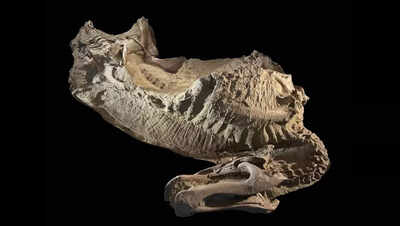
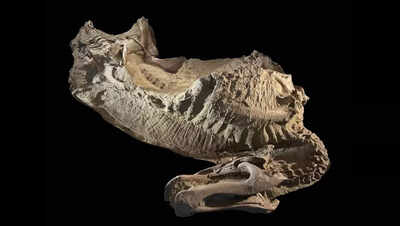
In a remarkable palaeontological breakthrough, scientists have uncovered two mummified duck-billed dinosaur fossils in the Wyoming badlands, marking the first-ever discovery of hooves in dinosaurs. These exceptionally preserved specimens, identified as Edmontosaurus annectens, offer an unprecedented look into the anatomy and lifestyle of one of the last great herbivores of the Cretaceous period. The find provides vital clues about how these duck-billed dinosaurs walked, lived, and adapted to their prehistoric environment. By revealing intricate details such as skin texture and limb structure, this hooved dinosaur discovery is reshaping what experts know about dinosaur evolution and preservation, offering a rare window into Earth’s distant past.
How the dinosaurs became ‘mummified’
The fossilisation process that preserved these creatures was as fascinating as the find itself. Researchers believe that the dinosaurs died during a drought, their bodies drying out under the sun before being buried rapidly by a flash flood. This combination of dehydration and rapid sediment coverage helped protect their outer layers.According to the study, static electricity interacting with microorganisms in the surrounding clay caused fine particles to cling to the decaying skin, forming a thin clay “template” around the remains. Over millions of years, this clay layer hardened into rock, perfectly capturing the shape and texture of the dinosaurs’ skin and hooves.
Insights into edmontosaurus biology
Using X-rays, micro-CT scans, and other modern imaging techniques, the research team reconstructed the anatomy of both “Ed Jr.” and “Ed Sr.” in remarkable detail. Their analyses revealed a fleshy crest running along the dinosaurs’ neck and back, which transitioned into a row of tail spikes. The lower body was covered in tiny pebble-like scales, giving scientists a realistic idea of what these dinosaurs might have looked like in life.At full size, an adult Edmontosaurus could grow over 12 metres (40 feet) long. These herbivorous dinosaurs roamed ancient floodplains alongside Tyrannosaurus rex and Triceratops, just before the catastrophic asteroid impact that ended the dinosaur era around 66 million years ago.
Wyoming’s mummified dinosaurs offer landmark insight into prehistoric life
The discovery of these mummified Edmontosaurus fossils is being hailed as a landmark moment in palaeontology. It bridges the gap between what scientists know from skeletal remains and what life might have truly looked like millions of years ago.The team’s work also builds upon early 20th-century discoveries in the same region. By studying old excavation records, letters, and photographs, researchers were able to pinpoint a specific region in the Wyoming badlands now dubbed the “mummy zone”, a hotspot for exceptionally preserved dinosaur fossils.
Discovery of hoofed dinosaurs offers new insights into prehistoric adaptation
Beyond the excitement of finding the first hoofed dinosaurs, this research provides valuable clues about dinosaur evolution, behaviour, and environment. It suggests that some species may have evolved hoof-like structures to adapt to their habitats, much earlier than scientists previously thought.Moreover, these fossils demonstrate that under the right conditions, soft tissues and skin can be preserved in incredible detail, offering scientists new ways to study prehistoric life without relying solely on bones.Also read | Australia’s deep ocean reveals two new species: A glow-in-the-dark shark and a tiny porcelain crab; discovered by CSIRO