


By Anushka Verma | November 2, 2025
Introduction
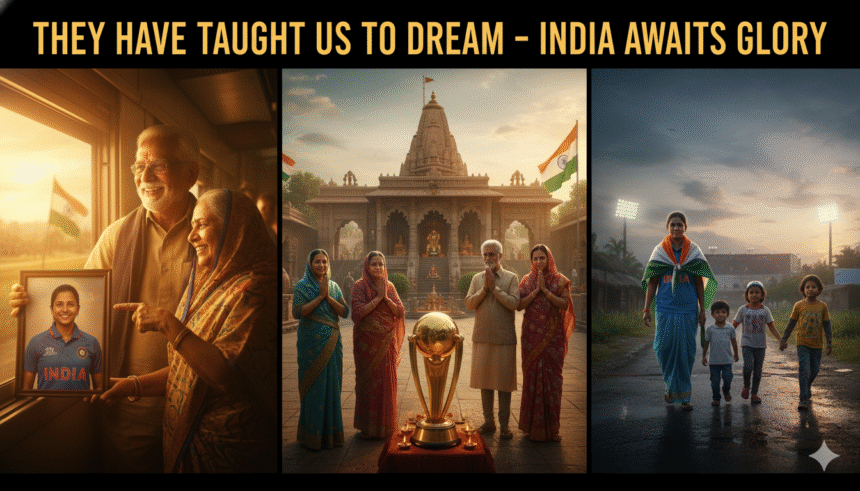
As the Indian women’s cricket team stands on the brink of history, preparing to face South Africa in the ICC Women’s World Cup Final 2025, the entire nation holds its breath. But while the spotlight shines on the players at Mumbai’s Wankhede Stadium, another kind of preparation is happening quietly — hundreds of miles away, in temples, homes, and on winding Indian roads.
Across towns and villages, families of these cricketers are making their own emotional journeys — long road trips, temple visits, community prayers — each filled with hope, pride, and a touch of nervousness. The match may be played on the field, but the battle of faith and emotions is being fought across the country.
For parents, siblings, and coaches who saw these girls rise from dusty grounds to global arenas, this isn’t just a sporting final. It’s the culmination of a lifetime of belief — a shared dream that began in small backyards and local academies and has now reached the world stage.
“They’ve taught us to dream, to believe that even girls from small towns can change the map of Indian cricket,” says Sunita Thakur, mother of pacer Renuka Singh Thakur.
Families on the Move — A Nation in Motion
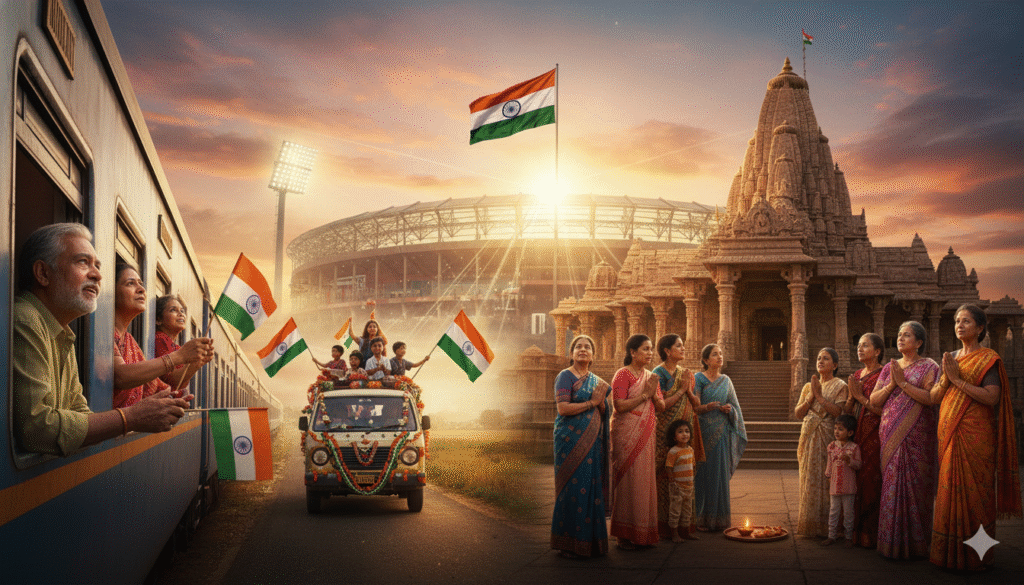
In almost every corner of India, travel plans are unfolding like stories of devotion. A tempo traveller filled with chants and snacks hums along the highways of Madhya Pradesh. On an Agra-Mumbai train, a brother sits by the window, carrying a childhood photograph of his sister — now one of India’s brightest stars. In Haryana, a father completes a 300-km temple trip, while in Himachal Pradesh, a family gathers at a village shrine, praying that work emergencies stay away on Sunday.
From Kolkata to Mumbai, Agra to Rohru, Indore to Rohtak, families are united by one emotion — faith. Some pray before dawn, others travel through the night. For many, this journey is their way of contributing, of feeling part of their daughter’s greatest moment.
“We couldn’t be in the dressing room, but we can be on the road with faith,” says Sakshi Thakur, Renuka’s sister-in-law. “That’s our match — keeping our hearts steady.”
The 21-Hour Road to Mumbai
In a small town in Madhya Pradesh, a group of 18 people squeezes into a tempo traveller. Their destination: Mumbai, 900 kilometers away. Leading the group is Kranti Gaud’s brother, who refused to miss his sister’s big day.
“When she first joined the academy, we didn’t even have money for shoes,” he recalls. “Today, the whole town has contributed to our travel expenses. Everyone wants to be part of this.”
Inside the van, the mood swings between excitement and silence. Someone plays patriotic songs; others fold their hands when they pass a temple. The van driver, too, wears a lucky bracelet.
“If India wins, it’s a win for every small-town family who said ‘yes’ to their daughters’ dreams,” says Kranti’s mother.
The road to Mumbai is not just asphalt — it’s memory, struggle, and faith rolled into one.
The Train of Faith — Deepti Sharma’s Brother on the Move
On an overnight Agra-Mumbai train, Deepti Sharma’s brother, Sumit, adjusts his seat and stares out of the window. The rhythmic sound of the tracks echoes the heartbeat of millions.
In his bag lies a small wooden bat — Deepti’s first one, which she had used when she was eight. Sumit calls it their “lucky charm.”
“We’ve carried this bat to every important match since her U-19 days,” he says. “Deepti told me, ‘Just bring it, bhaiya — it brings me luck.’”
As dawn breaks, Sumit’s phone fills with messages from their Agra neighborhood — people promising to light diyas when the match begins. His journey is more than just support; it’s a pilgrimage of pride.
“When she bowls her first over tomorrow, I’ll close my eyes,” he says. “Because in that moment, all our years of struggle will flash before me.”
A Father’s Promise — Shafali Verma’s Haryana Ritual
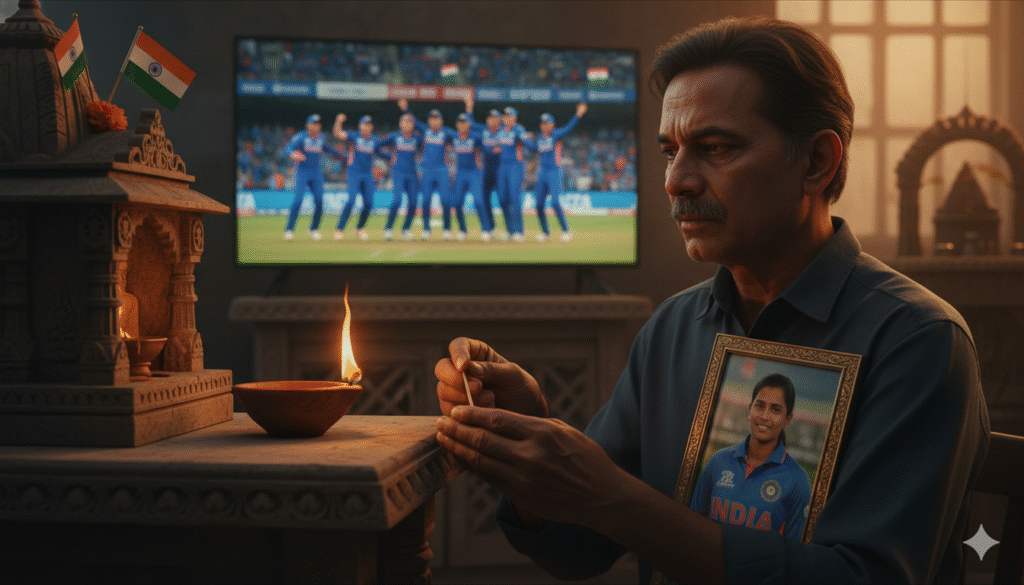
In Rohtak, Haryana, Sanjeev Verma, father of opener Shafali Verma, stands outside a temple in Rajasthan. The trip took him more than five hours each way, but he says it was worth every kilometer.
“When Shafali started playing, people told me to stop wasting time,” he remembers. “Now they call me to say, ‘Sir, your daughter is a hero.’”
He folds his hands, whispering a simple prayer — not for runs or trophies, but for peace of mind for his daughter.
“She plays best when she smiles,” he says softly. “I just pray that tomorrow, she plays with joy.”
Back home, the Verma family has tied red threads on their main gate — one for every boundary Shafali has hit this tournament.
A Village Awaits — The Thakur Family in Himachal
High up in the misty hills of Himachal, Renuka Singh’s family waits for the big day. Her brother, Vinod Singh Thakur, has been trying to keep calm, but the excitement is impossible to hide.
“Our house has become a mini stadium,” he laughs. “Everyone in the village wants to come and watch on our TV.”
The Thakurs begin their day early, cleaning the small temple near their home. It’s a family ritual — lighting lamps and offering coconuts before every match.
“Renuka always calls after the toss,” Vinod says. “She asks, ‘Bhaiya, diya jala diya?’ (Have you lit the lamp?) That’s our good luck signal.”
As the mountain air cools, the family gathers in front of the TV. The emotion in their eyes reflects the journey of a girl who once carried her own kit on local buses, now leading India’s bowling attack on the world stage.
The Captain’s Calm — Harmanpreet Kaur’s Mumbai Moments
In Mumbai, Harmanpreet Kaur’s family keeps its rituals simple. They visit the Siddhivinayak Temple early in the morning and later the local Gurudwara, offering prayers for calmness and strength.
Her coach, Kamaldeesh Singh Sodhi, who has been with her since her early days in Moga, says he’s never seen her more focused.
“Harmanpreet has matured as a leader,” Sodhi says. “She doesn’t chase records anymore — she chases moments.”
For Harmanpreet’s parents, being in Mumbai feels surreal.
“Every parent dreams of seeing their child lead the nation,” her father says. “We just hope that tomorrow, she leads us to history.”
The Girl from Kolkata — Richa Ghosh’s Family in the City of Dreams
From Kolkata, the Ghosh family has flown to Mumbai with one thing packed carefully — a handmade Indian flag created by neighborhood kids. It carries hundreds of tiny signatures from children who call Richa their inspiration.
“We told her, ‘Play with your heart,’” says her mother. “Every time she hits a six, the whole neighborhood bursts crackers.”
Richa’s father, a former club cricketer, still remembers watching her first training session.
“She used to get teased for playing with boys,” he says. “Now, the same boys ask for her autograph.”
The Ghosh family plans to hold the flag high if India wins. “This isn’t just Richa’s win — it’s the dream of every child who’s told ‘you can’t’,” says her father.
Temples, Prayers, and the Power of Faith
Across India, faith takes different forms — from Sikh Ardas to Hindu Aartis, Muslim Duas to Christian Prayers. But on this weekend, they all share one wish — victory for India.
In Varanasi, priests perform a special Ganga Aarti dedicated to the women’s team. In Chennai, a church congregation prays for their safety and success. And in Bengaluru, a group of schoolgirls lights candles, chanting, “India! India!”
The players might be thousands of kilometers apart, but the collective vibration of these prayers travels with them.
“The world calls it superstition,” says Sunita Thakur, smiling. “We call it faith. And faith wins matches too.”
Dreams That Defied Doubt
Every girl in this team has a story — of struggle, of resistance, of finding her place in a world that often questioned her choices. They are not just athletes; they are symbols of change.
Shafali broke social barriers.
Deepti broke through financial hardship.
Renuka rose from the mountains.
Richa fought judgment.
Harmanpreet carried leadership with grace.
Their families were the invisible pillars behind these journeys — the mothers who stitched jerseys, fathers who cycled miles to coaching centers, brothers who skipped their own ambitions, and coaches who believed before the world did.
A Nation Holds Its Breath
On Saturday evening, Mumbai is electric. Fans crowd around hotels, waving flags and chanting names. Television crews capture emotional reunions between players and families. The air feels heavy with pride.
In living rooms, chai stalls, and roadside dhabas, the same conversation repeats: “Kal jeet lenge, na?” (We’ll win tomorrow, right?)
The players are calm but focused. Behind them, unseen but deeply felt, stand their families — their first cheerleaders, their lifetime believers.
What Sunday Means
Sunday, November 3rd, 2025 — for most, it’s a cricket match. For these families, it’s the day the years of sacrifice might finally bloom into joy.
“It’s not about fame or money,” says Deepti’s brother, his voice trembling. “It’s about seeing your sister hold the flag and knowing — you were part of that story.”
In small towns, prayers will begin at sunrise. Radios will buzz. Neighbors will gather. For millions of girls watching, this final isn’t just about runs or wickets. It’s proof that dreams, when believed in, can cross every boundary.
Conclusion — They Have Taught Us to Dream
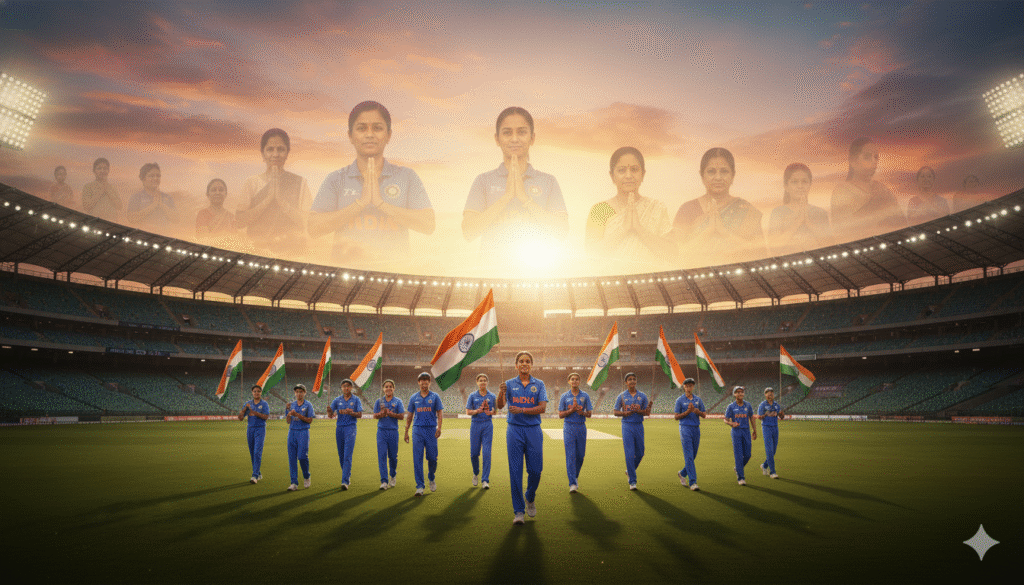
As the stadium lights rise over Mumbai and the world watches the Indian women walk out to the anthem, somewhere in Madhya Pradesh a tempo traveller halts by a roadside temple. In Himachal, a lamp flickers. In Agra, a brother clutches a bat. In Rohtak, a father whispers a prayer. And in Kolkata, a little girl waves the tricolor.
They are all connected — by love, by pride, by faith.
No matter what the scoreboard reads tomorrow, these women have already changed something much larger — India’s imagination.
They have made a billion people dream again — not just of victory, but of possibility.
“Win or lose, they’ve already won our hearts,” says coach Sodhi.
“Because they didn’t just play cricket — they taught us how to dream.”