


By Anushka Verma |November 3, 2025
Summary Table
| Key Details | Information |
|---|---|
| Organization | Tata Trusts |
| Principal Shareholder of | Tata Sons |
| Proposed Appointment | Mehli Mistry as Lifetime Trustee |
| Trusts Involved | Sir Ratan Tata Trust, Sir Dorabji Tata Trust, Bai Hirabai Jamsetji Tata Navsari Charitable Institution |
| Supporters of Proposal | Darius Khambata, Pramit Jhaveri |
| Nature of Appointment | Lifetime Trustee Reappointment |
| Estimated Philanthropic Value Managed by These Trusts | Approx. ₹1,000 crore (annual charitable disbursement) |
| Article Written By | Anushka Verma |
| Date | November 3, 2025 |
Introduction
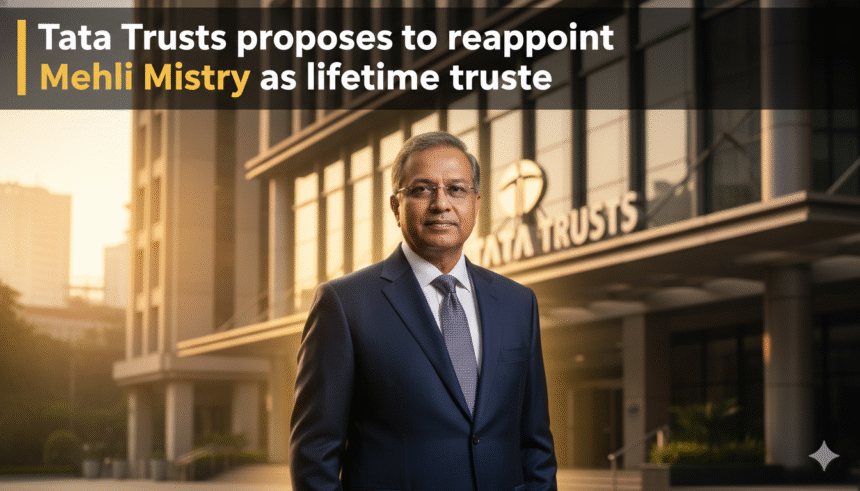
In a move that reinforces continuity and legacy within India’s most respected philanthropic network, Tata Trusts — the principal shareholder of Tata Sons, the holding company of the Tata Group — has proposed to reappoint Mehli Mistry as a lifetime trustee across three of its core charitable arms:
the Sir Ratan Tata Trust, the Sir Dorabji Tata Trust, and the Bai Hirabai Jamsetji Tata Navsari Charitable Institution.
The reappointment proposal, currently being circulated among trustees, symbolizes the Trusts’ intent to uphold their founding principles while ensuring strategic continuity in their philanthropic and corporate oversight roles.
This decision comes at a time when India’s charitable ecosystem is undergoing a transformation — with growing emphasis on transparency, measurable impact, and visionary leadership. The reappointment of Mehli Mistry, a figure deeply familiar with the Tata Group’s ethos, marks an important chapter in the governance of the Trusts that collectively manage billions of rupees in charitable funds across India.
A Legacy of Philanthropy: The Tata Trusts at a Glance
Few organizations in the world have maintained such a consistent tradition of structured giving as the Tata Trusts. Founded in the early 20th century by Jamsetji Tata and his successors, these trusts have long stood as the moral and financial backbone of the Tata Group’s social vision.
The Sir Dorabji Tata Trust (established in 1932) and the Sir Ratan Tata Trust (established in 1919) collectively own over 66% of Tata Sons, the parent company of the Tata Group. The income from these holdings funds projects in health, education, rural livelihoods, science, arts, and environmental sustainability.
Their annual philanthropic spending exceeds ₹1,000 crore, covering more than 4,000 projects across India — from cancer care infrastructure to educational fellowships and climate change research.
Thus, the appointment or reappointment of a trustee at this level is not just a ceremonial move — it’s a decision that carries strategic and moral weight for the nation’s largest philanthropic network.
Who Is Mehli Mistry? The Man Behind the Decision
Mehli Mistry, a low-profile yet deeply influential figure, has long been associated with the Tata ecosystem. Known for his discretion, operational efficiency, and deep trust within Tata circles, Mistry has held advisory and fiduciary roles across several Tata entities and trusts.
Though rarely in the public eye, his association with the Tata Group extends over two decades, making him one of the few individuals who have witnessed both the corporate and charitable dimensions of the conglomerate from close quarters.
Insiders describe Mistry as someone who embodies the Tata philosophy of integrity, humility, and long-term vision. His professional background in infrastructure, business management, and institutional governance has made him a valuable link between Tata Trusts’ philanthropic initiatives and their administrative mechanisms.
Inside the Reappointment Proposal
According to internal communication seen by sources familiar with the development, the trustees of Tata Trusts have been asked to consider a proposal for the reappointment of Mehli Mistry as trustee on a lifetime basis.
This means that Mistry, upon approval, would serve indefinitely — without the standard tenure limitations that typically accompany trustee positions.
At the Sir Dorabji Tata Trust, prominent trustees Darius Khambata (former Advocate General of Maharashtra) and Pramit Jhaveri (former Citibank India CEO) have expressed their support for Mistry’s continuation, citing his “consistent stewardship and value alignment.”
If ratified, this move would confer a lifetime trustee status upon Mistry, placing him among a select group of individuals who hold permanent stewardship of Tata Trusts’ most important philanthropic assets.

Why Lifetime Appointments Matter
In the world of philanthropy, particularly at the scale of Tata Trusts, governance continuity is crucial. Lifetime trusteeships are not granted lightly; they signify deep institutional trust and recognition of long-standing service.
For Tata Trusts, the decision carries additional significance because of its governance model — one that links philanthropic oversight to the corporate control of Tata Sons.
By ensuring stable leadership within its trusts, Tata Trusts effectively secures the long-term moral compass and decision-making framework of the entire Tata Group.
Experts believe that Mistry’s reappointment as a lifetime trustee would reinforce the Trusts’ commitment to continuity, discretion, and principled philanthropy, values that have guided Tata institutions for over a century.
Philanthropy Meets Governance: The Tata Model
Tata Trusts occupy a unique position in global corporate philanthropy — functioning both as charitable entities and as major shareholders in a corporate empire.
The dual role means that trustees like Mehli Mistry not only oversee billions of rupees in social spending but also influence Tata Sons’ corporate decisions through their voting rights and strategic oversight.
This balance between philanthropy and corporate responsibility is what makes Tata Trusts a model of purpose-driven capitalism — one where business growth fuels social progress.
Under this framework, trustees act as both guardians of heritage and architects of impact, shaping how the Tata Group aligns its resources with India’s developmental priorities.
The Philanthropic Footprint of the Three Trusts
Let’s take a closer look at the three trusts associated with this reappointment:
1. Sir Ratan Tata Trust
Established in 1919, the Sir Ratan Tata Trust is among India’s oldest philanthropic organizations. Its initiatives focus on education, livelihoods, and healthcare, especially in underserved regions. The Trust has played a pivotal role in rural transformation projects and healthcare innovation across India.
2. Sir Dorabji Tata Trust
Founded in 1932, this Trust has been a leader in promoting scientific research, arts, and social welfare. It supports premier institutions like the Tata Institute of Social Sciences (TISS), the Indian Institute of Science (IISc), and the Tata Memorial Centre for cancer treatment.
3. Bai Hirabai Jamsetji Tata Navsari Charitable Institution
This lesser-known but historically significant trust is based in Navsari, Gujarat — the Tata family’s ancestral town. It supports community development, education, and welfare programs in the region, maintaining the Tata family’s legacy of grassroots philanthropy.
Together, these trusts represent the core of Tata’s philanthropic heritage, and trustees like Mehli Mistry play a critical role in ensuring that these missions continue with integrity.

Support Within the Boardroom
At the Sir Dorabji Tata Trust, trustees Darius Khambata and Pramit Jhaveri are said to have supported Mistry’s continuation. Their endorsement carries weight — both are respected professionals with deep expertise in law, finance, and governance.
A senior person familiar with the Trusts’ operations noted,
“Mehli Mistry’s reappointment brings stability at a crucial juncture. His stewardship ensures that Tata Trusts’ values remain undiluted even as their operations expand and evolve.”
The reappointment is expected to receive formal ratification after review by the Trusts’ internal committees in the coming weeks.
Tata Trusts in the Post-Ratan Tata Era
As Ratan Tata, the patriarch of the group, gradually stepped back from active roles, the question of succession and stewardship within the Trusts gained prominence.
Since Tata Trusts hold over two-thirds of Tata Sons, whoever sits on the boards of these trusts indirectly shapes the leadership and direction of the entire Tata Group.
Mistry’s reappointment therefore represents not just continuity, but a careful balancing of legacy and evolution. It signals the Trusts’ desire to preserve Ratan Tata’s values-driven leadership style while adapting to a new generation of challenges.
Philanthropy in a Changing India
India’s social sector has transformed dramatically over the past decade. New-age philanthropy now demands data-driven impact, digital transparency, and scalable innovation.
Tata Trusts, while rooted in legacy, have embraced this evolution — funding social enterprises, supporting clean energy initiatives, and investing in digital learning platforms.
The reappointment of seasoned trustees like Mehli Mistry ensures that while the Trusts modernize their operations, their core philosophy of nation-building remains intact.
A Broader Perspective: Comparing Global Philanthropy Models
Globally, few corporate entities wield the kind of dual influence that Tata Trusts do — combining corporate ownership with deep social responsibility.
Comparatively, organizations like the Rockefeller Foundation or the Gates Foundation operate purely as grant-making bodies, detached from corporate ownership.
Tata Trusts’ model — intertwining business and philanthropy — has made it an outlier, admired for its sustainable funding structure and ethical governance.
This structure allows Tata Trusts to remain financially self-reliant, shielded from market volatility, and able to fund long-term projects without dependency on external donors.
Challenges and Opportunities Ahead
While the Tata Trusts’ scale and credibility remain unmatched, they are not without challenges. Over the past few years, the Trusts have faced scrutiny over governance reforms, financial audits, and alignment with regulatory norms under the Charitable Trusts Act.
However, leadership continuity through appointments like Mistry’s can strengthen internal coherence and maintain the Trusts’ reputation for integrity and accountability.
Analysts expect the next decade to be pivotal, as Tata Trusts expand their role in climate action, digital education, and health infrastructure, aligning their mission with India’s sustainable development goals (SDGs).
Expert Opinions
Dr. Priya Deshpande, a philanthropy researcher at IIM Ahmedabad, notes:
“Lifetime trusteeships in organizations like Tata Trusts ensure moral continuity. The Tata model works because it balances capitalism with compassion — and leaders like Mehli Mistry help maintain that equilibrium.”
Rohan Gupta, a governance analyst, adds:
“In modern philanthropy, institutional memory is as valuable as innovation. By retaining experienced trustees, Tata Trusts safeguard their credibility and operational depth.”
Looking Ahead: The Road for Tata Trusts
The next phase for Tata Trusts will likely involve three major focus areas:
- Digital Transformation of Philanthropy – integrating technology into project tracking, beneficiary mapping, and transparent reporting.
- Collaborative Impact Models – partnering with startups, NGOs, and government agencies to scale proven social models.
- Sustainability and Green Philanthropy – expanding initiatives in renewable energy, climate resilience, and ecological conservation.
Under experienced trusteeship, Tata Trusts is expected to remain a lighthouse of ethical philanthropy — demonstrating how private wealth can serve public good with consistency and conscience.
Conclusion
The proposed lifetime reappointment of Mehli Mistry as trustee of the Sir Ratan Tata Trust, Sir Dorabji Tata Trust, and Bai Hirabai Jamsetji Tata Navsari Charitable Institution represents more than a governance update — it’s a reaffirmation of faith, continuity, and the Tata legacy.
For over a century, Tata Trusts have embodied the spirit of “nation first” — channeling corporate dividends into social development, and ensuring that wealth serves humanity before shareholders.
As Tata Trusts move forward in a rapidly changing philanthropic landscape, figures like Mehli Mistry stand as guardians of that moral architecture — ensuring that the Tata legacy of compassion, responsibility, and vision continues to define Indian philanthropy for generations to come.