


by Anushka Verma | Updated: 13 November 2025
Introduction: Bihar’s Turnout Hits a Historic High
Bihar’s 2025 Assembly Election has produced one of the most remarkable democratic shifts in recent memory, with voter turnout hitting an unprecedented 66.91%, the highest since the state’s first Assembly polls in 1951. This represents a massive 9.62-percentage-point jump from 2020’s turnout of 57.29%. With results expected on Friday, the political ecosystem — from party war rooms to independent analysts — is buzzing with speculation over what this record-breaking turnout means.
In a politically bipolar state like Bihar, higher turnout has historically served as a predictor of change. Whenever Bihar’s voters turn up in large numbers, they tend to vote decisively. The pattern has repeated itself across decades — from the anti-Emergency wave of 1977 to the rise of social justice politics in 1990 and the Grand Alliance victory in 2015.
But Bihar’s electoral history also has one extraordinary exception: the year 2005, when low turnout led to major political change and brought Nitish Kumar to power for the first time. That unusual political moment continues to be studied by analysts even today.
This article examines how rising turnout has shaped Bihar’s political destiny across decades, why turnout holds such predictive power in Bihar’s bipolar contests, and what the historic 2025 turnout surge might indicate for the upcoming results.
Historical Turnout Patterns and Political Outcomes
To understand Bihar’s present election dynamics, it is essential to observe its past turnout trends and how they have corresponded with changes in government over time. The table below summarises the key patterns from 1951 to 2025.
Bihar Assembly Elections: Turnout and Outcomes (1951–2025)
| Year | Turnout (%) | Change | Outcome | Government | Insight |
|---|---|---|---|---|---|
| 1951 | 34.14 | — | First election | Congress | Low baseline turnout |
| 1962 | 47.14 | +13 | Internal shift | Congress retained | Voter awakening |
| 1967 | 44.85 | -2.29 | Fragmentation | SVD coalition | Fall strengthened opposition |
| 1977 | 57.76 | +12.91 | Anti-Emergency wave | Janata Party | A turnout-driven political wave |
| 1990 | 62.69 | +4.93 | Social justice rise | Janata Dal | High rural mobilisation |
| 2005 Feb | 46.50 | -16.07 | Hung House | President’s Rule | Extreme voter fatigue |
| 2005 Oct | 45.85 | -0.65 | Change of govt | NDA (Nitish) | Rare case: low turnout → change |
| 2015 | 56.66 | +7.61 | Mahagathbandhan wins | GA Govt | Turnout spike toppled NDA |
| 2020 | 57.29 | +0.63 | NDA retains | NDA | Marginal rise = status quo |
| 2025 | 66.91 | +9.62 | Awaited | — | Highest turnout ever |
Why Turnout Matters More in Bihar Than Other States
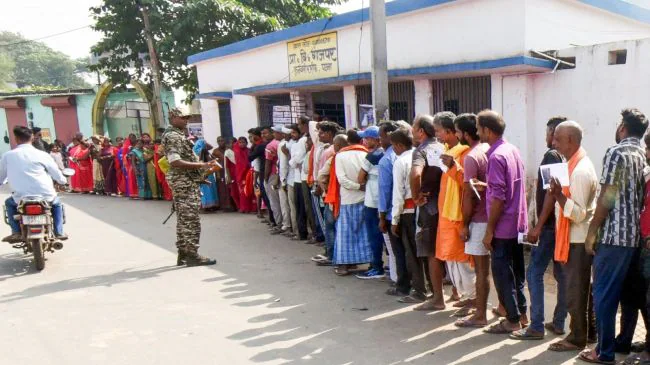
Bihar’s elections are primarily bipolar, unlike states where multi-party contests complicate voter behaviour. This means:
- Even a 2–3% turnout change can flip dozens of seats.
- Anti-incumbency becomes more measurable.
- Mobilised voters tend to vote uniformly for change.
- Silent segments (women, youth, migrants) significantly influence outcomes.
Turnout in Bihar is not just a statistical indicator — it is a political signal.
The Five Turnout Surges That Led to Change in Bihar
1962: The First Wave of Political Awareness
The jump from 34% to over 47% turnout reflected rising political engagement. While Congress retained power, internal changes and increased accountability were direct outcomes of higher participation.
1977: Anti-Emergency Sentiment Translates into Votes
One of Bihar’s strongest turnout waves — nearly 13 percentage points — led to Congress’s most dramatic defeat. The Janata Party’s rise was rooted in voter anger and political awakening.
1990: The Social Justice Revolution
A new political era emerged with turnout crossing 62%. Rural backward classes, marginalised groups, and youth voters shifted the political centre of gravity towards Lalu Prasad Yadav and the Janata Dal.
2015: Turnout Spike Brings Grand Alliance Victory
A 7.61-percentage-point increase marked one of the clearest anti-incumbency waves. Women, youth, migrants, and the rural poor played crucial roles in unifying behind the Mahagathbandhan.
2025: The Highest Turnout in 74 Years — A Tipping Point?
With 66.91% turnout, Bihar has crossed all historical benchmarks.
Such sharp increases have always indicated change — except in one unique case (2005), which had different psychological factors at play.
The Nitish Kumar Exception: When Low Turnout Led to Change
The 2005 elections remain a fascinating anomaly. Turnout fell by over 16 percentage points, leading to a hung assembly and President’s Rule. When elections were held again months later and turnout dropped slightly more, the NDA emerged victorious and Nitish Kumar became Chief Minister.
Why did lower turnout cause change then?
- Public frustration with lawlessness
- Voter fatigue after years of misgovernance
- Fear-driven low participation
- Strong mobilisation of middle-class and urban voters
- Silent anti-Lalu sentiment
Thus, 2005 stands out as a completely different kind of political moment — not driven by enthusiasm, but by exhaustion and fear.
The Political Psychology Behind Bihar’s Turnout Surges
Bihar’s voters are uniquely expressive through turnout. Several factors shape their participation patterns:
Youth Power
Bihar has one of India’s youngest populations. They turn out in large numbers when they want disruption or change.
Women Voters as a Decisive Block
Women have emerged as Bihar’s most influential voter group since 2010, often voting independently of traditional caste lines.
Migration Cycles
Return of migrant labourers (economic slowdowns, festive seasons) significantly boosts turnout.
Rural Dominance
Rural turnout consistently surpasses urban turnout, making rural mood a clearer predictor of outcomes.
Silent Anti-Incumbency
Bihar rarely sees loud protests. Dissatisfaction is expressed quietly — at the ballot box.
2025: Why This Turnout Surge Feels Different
The 2025 turnout surge reflects several historically significant patterns:
- Highest turnout ever indicates political confidence
- Women voters participated in exceptional numbers
- Youth mobilisation was unusually strong
- Rural areas recorded heavy voting
- Absence of fear or intimidation marks a mature democracy
- Silent consolidation of caste groups is visible
Historically, such massive turnout shifts almost always favour the Opposition.
Which Alliance Benefits? NDA or Mahagathbandhan?
NDA’s Confidence
- Claims welfare schemes and women-centric benefits boosted turnout
- Strong law and order narrative
- Development messaging targeted toward youth
Mahagathbandhan’s Confidence
- Believes unemployment and inflation drove voters toward change
- Hopes for OBC-Dalit consolidation
- Youth frustration may favour them
- Migrants might have shifted sentiment
Historical Trends Say
Higher turnout → typically benefits the Opposition.
But Bihar 2025 is too polarised for easy predictions.
What This Election Means for Bihar’s Political Future
The 2025 election could reshape Bihar’s governance model:
- Turnout has become a symbol of democratic maturity
- Youth and women now act as decisive swing blocs
- Any new government must focus on unemployment, education, rural development, and safety
- The traditional caste equation is increasingly blended with aspiration politics
- Political parties must now redesign mobilisation strategies for the next decade

Conclusion: Bihar Awaits a Historic Verdict
The 2025 Bihar Assembly Election turnout has broken all records. History shows that whenever voter turnout rises dramatically, Bihar’s voters deliver a decisive message. The only exception, 2005, emerged under unique political and social stress. Today’s political climate is very different — more confident, more assertive, and more participatory.
As the state awaits the verdict on Friday, one thing is clear: the voter has spoken louder than ever before. Whether this historic turnout mandates continuity or change, it will mark a defining chapter in Bihar’s democratic journey.