


By Anushka Verma | Updated : November 14, 2025
Introduction
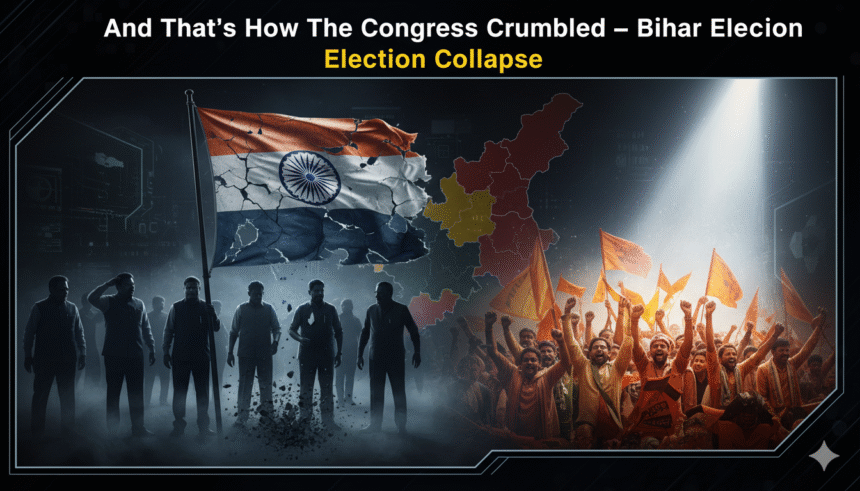
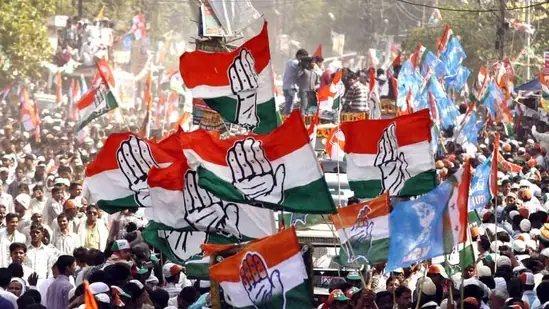
The Bihar Assembly Election 2025 has delivered one of the most dramatic and consequential political verdicts in recent memory. The Congress party—once a historical heavyweight and now the second-largest partner of the RJD-led Mahagathbandhan—found itself reduced to an electoral footnote, struggling to register even minimal gains. For many within the Congress, the writing had been on the wall in faint handwriting, but few expected the entire wall to collapse so violently. What happened in Bihar was not merely a defeat—it was a political implosion.
The NDA’s sweeping victory revealed three brutal truths about contemporary Bihar politics:
- Congress misjudged the social justice narrative,
- It crippled itself with turncoats and credibility issues,
- It leaned too heavily on a “vote-chori” narrative that voters did not believe or care about.
But beyond these three headline reasons lies a deeper story—of miscalculated strategies, organizational decay, caste realignment, alliance fatigue, leadership confusion, and a complete misunderstanding of Bihar’s electoral culture.
This long-form article—crafted with the precision of a professional newsroom analysis and the depth of an experienced political commentator—explores not just why the Congress fell flat, but how the collapse unfolded from within. Every layer is unpeeled, every misstep examined, and every structural weakness exposed.
The Calm Before the Political Storm
Before counting day, the Congress camp was oddly optimistic. Internal surveys suggested some traction in urban and minority-dominated seats. The leadership believed their aggressive campaign against alleged election manipulation would resonate. And the Mahagathbandhan, recovering from earlier setbacks, felt this election could be their window to reposition themselves.
But beneath this surface confidence lay troubling signs:
- Congress had no chief ministerial face.
- The alliance messaging was inconsistent.
- Nitish Kumar had silently regained trust among EBCs and women.
- The BJP’s grassroots machinery was far more efficient.
- Congress’s experiments in caste politics lacked depth.
The Congress believed it was ready for a battle. But politically, it showed up with wooden swords against a well-armed establishment.
Reason 1: The Social Justice Pitch That Missed the Mark
Congress’s Attempt at Reinvention
In an effort to tap into Bihar’s massive OBC and EBC voter base, the Congress recalibrated its strategy ahead of the 2025 elections. The leadership hoped to shed the image of being an upper-caste-centric party and present itself as a champion of backward communities. They launched targeted outreach campaigns, alliances with community influencers, and promises of socio-economic reforms.
Strategically, the idea looked powerful on paper. But electorally, it turned disastrous.
The Upper-Caste Alienation
For decades, Congress found consistent support among Bihar’s upper castes—especially in cities, semi-urban pockets, and traditional strongholds. These voters may not have been enough to win the state, but they formed a reliable cushion.
By aggressively shifting towards backward communities without careful calibration, Congress unintentionally signaled to upper-caste voters that they were no longer a priority.
This alienation created two immediate effects:
- Upper castes consolidated even more strongly behind the NDA, especially BJP.
- Congress lost an existing vote bank before gaining a new one.
In electoral terms, this was fatal.
Failure to Attract EBCs and OBCs
Congress had hoped backward communities would view them as a fresh alternative to Nitish Kumar. But this was completely miscalculated.
Why EBCs didn’t move to Congress:
- Nitish Kumar had delivered for them consistently for nearly two decades.
- Welfare programs for women, students, and rural households created deep emotional trust.
- Congress lacked strong backward community leaders who could mobilize votes.
- RJD already monopolized the MY combination, leaving Congress no space.
The Congress’s new positioning ended up being a political identity crisis—alienating old supporters without gaining new ones.
A senior party leader admitted privately:
“We tried to reinvent ourselves in eight months; Nitish built trust over two decades. This gamble was bound to fail.”
Reason 2: Turncoats, Ticket Mismanagement & a Crisis of Credibility
The Turncoat Flood
As elections approached, Congress welcomed a large number of defectors from JD(U), LJP factions, and smaller regional outfits. They were given tickets, positions, and priority over grassroots party workers. The leadership believed this would strengthen them in tough constituencies.
But voters in Bihar are not easily fooled.
Turncoats triggered four major problems:
- Local workers felt insulted and demotivated.
- Old loyalists distanced themselves from campaigning.
- Voters viewed Congress as a party lacking ideological clarity.
- Candidates appeared opportunistic rather than credible.
This was not a smart expansion—it was an identity dilution.
Cadre Collapse on Ground
Booth management is the backbone of any election in Bihar. Congress workers—already less organized than BJP or JD(U)—felt sidelined due to outsiders invading their space. As a result:
- Many booths lacked Congress polling agents.
- Field-level data collection was weak.
- Voter outreach became inconsistent.
- Organizational disconnect grew deeper.
While BJP deployed workers at every booth, Congress struggled to even maintain presence in several blocks.
Perception of Opportunism
In Bihar, loyalty is culture.
People trust:
- those who stay
- those who fight
- those who are consistent
When candidates switch sides weeks before election day, the assumption is simple:
“He came for his personal benefit, not for us.”
Congress underestimated how damaging this perception could be.
Reason 3: The Vote-Chori Narrative That Fell Flat
The Slogan That Became a Complaint
Congress ran an aggressive campaign accusing the NDA of manipulating elections, the system, and democratic processes. The message was:
- “Your vote is being stolen.”
- “The system is rigged.”
- “Only the opposition can save democracy.”
But voters didn’t buy it.
Not because they supported malpractice—but because:
1) They saw no evidence personally.
2) They were exhausted by blame-based politics.
3) They preferred development and stability over chaos.
Bihar’s voters have seen decades of political drama. They no longer vote on fear—they vote on trust.
The vote-chori narrative made Congress look like a party that lacked solutions and relied on emotional manipulation.
A Congress critic said:
“The vote-chori campaign sounded like crying, not leadership.”
Deeper Problems Beneath the Collapse
Now that the three primary reasons are clear, let’s explore the deeper ecosystem that shaped Congress’s downfall.
Congress Misunderstood Bihar’s Political Psychology
Bihar’s voters are:
- caste-aware
- loyalty-driven
- emotionally attached to welfare outcomes
- politically sharp
- sensitive to stability
Congress tried to win Bihar using:
- emotional slogans
- last-minute caste alignment
- outsider candidates
- borrowed narratives
This mismatch led to an inevitable defeat.
Weak Booth-Level Organization
BJP has:
- panna pramukhs,
- digital voter lists,
- booth teams,
- women volunteers,
- village captains.
Congress has:
- outdated lists
- low-motivation workers
- fewer ground visits
- limited data-driven strategy
This asymmetry is devastating in a state like Bihar, where booth strength often determines winners.
Leadership Confusion
Congress never projected:
- a clear CM face
- a cohesive Bihar-specific plan
- a strong administrative vision
While NDA projected stability with Nitish Kumar, Congress appeared as a chaotic alliance partner dependent on RJD’s leadership.
Leadership matters. Bihar voters reward clarity.
The RJD Factor & Alliance Fatigue
Congress’s alliance with RJD came with baggage:
- Upper castes distrusted it.
- Some OBCs saw it as old-style politics.
- Youth saw no dynamism.
- Many believed Congress had become a “junior sidekick.”
Congress didn’t gain from RJD—if anything, it suffered from association.
Nitish Kumar’s Remarkable Comeback
While Congress attacked him, Nitish quietly visited:
- villages
- women groups
- student gatherings
- SHGs
- panchayat sabhas
He focused on:
- dignity programs
- safety
- women empowerment
- education
- governance continuity
Congress tried to be emotional.
Nitish was practical.
Congress tried to shock voters.
Nitish reassured them.
Congress made noise.
Nitish maintained trust.
This contrast shaped the outcome.
Internal Reactions: What Congress Leaders Whispered
After the loss, leaders admitted privately:
- “We misread caste dynamics.”
- “Turncoats destroyed morale.”
- “The vote-chori slogan was a mistake.”
- “We lacked a local face.”
- “Ground reports were ignored.”
This rare internal consensus reveals how deep the crisis truly is.
What This Means for Congress Nationally
The Bihar meltdown sends a clear message:
- Congress cannot rely on alliances alone.
- It must rebuild organizational structure.
- It needs strong regional faces.
- It must stop depending on defectors.
- It must reconnect with grassroots voters.
Without structural reforms, Congress risks shrinking further in Hindi heartland politics.
What Congress Needs to Do Now
1. Rebuild the cadre from scratch.
2. Develop young leaders rooted in caste realities.
3. Offer solutions, not allegations.
4. Stop last-minute experiments.
5. Build a Bihar-specific ideological identity.
6. Empower district-level committees.
7. Improve digital and booth-level machinery.
This is not optional—it is survival.
Conclusion
The Congress did not merely lose Bihar.
It misread Bihar.
It misunderstood Bihar.
It misrepresented its own strengths.
The 2025 results were not just a mandate—they were a message.
A message that voters want stability over slogans.
Trust over theatrics.
Local leadership over imported candidates.
And institutional strength over emotional noise.
The collapse of the Congress in Bihar was not sudden.
It was the outcome of layered mistakes—strategic, structural, ideological, and organizational.
If the party hopes to rise again, it must learn from this crash not emotionally but analytically.
Bihar does not reward drama.
Bihar rewards discipline.
Until Congress understands that, its revival will remain a distant dream.