


Written by Anushka Verma
Published: 24, December, 2025
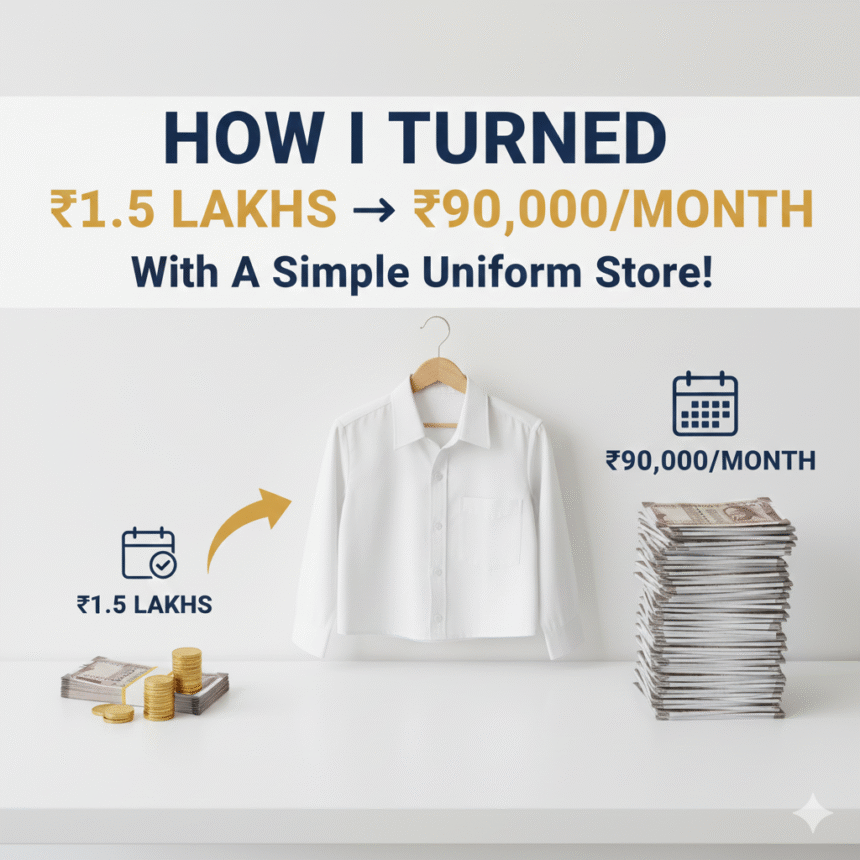
In an era where economic independence and entrepreneurial success are highly coveted, moving beyond traditional employment to establish a self-sustaining business is a compelling aspiration for many. The allure lies not in monumental, high-risk ventures, but often in identifying stable, evergreen market niches that promise consistent returns. Today, we delve into one such resilient and often underestimated business model: The Uniform Store. This venture stands out for its remarkable potential to generate substantial monthly profits—projections suggest up to ₹90,000—starting with a relatively modest inventory investment of around ₹1.5 lakhs. This article is not merely a presentation of an idea; it is a comprehensive, strategic blueprint designed to guide you through the intricacies of transforming this opportunity into a thriving, profitable reality. We will explore market dynamics, setup logistics, financial projections, scaling strategies, and the inherent stability that makes this business an ideal choice for students, women entrepreneurs, and retirees alike.
Understanding the Uniform Business: A Perennial Market
At its core, a uniform store specializes in supplying standardized clothing required by various institutions and organizations. Unlike fashion retail, which is subject to the whims of trends, the uniform business is built on the bedrock of necessity, identity, and regularity. Its demand is non-cyclical and remarkably consistent, driven by formal requirements rather than discretionary spending.
The vast and varied demand drivers include:
- Educational Institutions: Schools, colleges, and coaching centers form the backbone of this demand. Annual renewals, new admissions, and replacement purchases ensure a predictable, recurring revenue stream.
- Corporate Sector: Offices, IT parks, hotels, restaurants, and airlines require formal corporate wear, blazers, and branded apparel for their staff.
- Healthcare: Hospitals, clinics, and diagnostic centers need scrubs, lab coats, and supportive staff uniforms.
- Service & Security Industries: A massive sector encompassing security agencies, logistics and delivery companies, housekeeping services, and catering businesses.
- Government & PSUs: Various departments have specific uniform requirements for their field staff.
This diversity shields the business from market volatility. When one sector slows, another compensates, ensuring year-round operations.
Strategic Foundation: Laying the Groundwork for Success
Launching any business requires meticulous planning. For a uniform store, the following pillars are critical.
1. Location Analysis and Store Setup:
The ideal location is a blend of visibility, accessibility, and proximity to your target customers. Consider areas near educational hubs, commercial complexes, or industrial estates. While a high-street storefront offers walk-in customers, a strategically located warehouse-style outlet in a semi-commercial area can reduce rental overhead significantly—a key factor in maximizing profitability. The store should be organized, clean, and capable of displaying samples effectively.
2. Sourcing and Inventory Management:
Your initial investment of ~₹1.5 lakhs must be allocated wisely. Building relationships with manufacturers or large wholesalers in textile hubs like Tiruppur, Delhi-NCR, or Surat is crucial for competitive pricing.
Sample Inventory Investment Breakdown (Approx.)
| Uniform Type | Target Sector | Initial Stock Quantity | Estimated Cost (₹) |
|---|---|---|---|
| School Sets | Schools | 150 sets | 60,000 |
| Corporate Shirts/Trousers | Offices, Hotels | 100 pieces | 40,000 |
| Lab Coats & Scrubs | Healthcare | 50 pieces | 25,000 |
| Security & Utility Wear | Security Agencies | 50 sets | 20,000 |
| Miscellaneous & Accessories | Ties, belts, badges | – | 5,000 |
| TOTAL ESTIMATED INVENTORY INVESTMENT | ₹1,50,000 |
Focus on quality and durability. Starting with a few reliable suppliers for key items is better than a scattered, poor-quality inventory.

3. The Digital Imperative: Omnichannel Presence
A physical store is your anchor, but a digital presence is your sail. This is non-negotiable in the modern retail landscape.
- Social Catalogs: Use WhatsApp Business and Telegram to share catalogs, take orders, and provide customer support.
- Visual Portfolio: An Instagram/Facebook page showcasing your products, client testimonials (with permission), and behind-the-scenes processes builds credibility.
- Local E-commerce: List your store on platforms like Google Business Profile, Justdial, and local delivery apps to enhance discoverability.
The Financial Blueprint: Deconstructing the ₹90,000 Monthly Profit Projection
Let’s move from abstract promise to concrete numbers. The claimed profit is achievable but hinges on strategic execution, not mere hope.
Revenue Model & Calculation:
The primary revenue streams are walk-in retail sales and institutional bulk orders.
- Scenario A (Retail Focus): As posited, serving an average of 15 customers per day with an average billing of ₹500.
- Daily Sales: 15 x ₹500 = ₹7,500
- Monthly Sales (30 days): ₹7,500 x 30 = ₹2,25,000
- Scenario B (Bulk Order Mix): This is where margins improve. Securing just 2-3 institutional orders a month can significantly boost revenue. For instance, one order for 100 school uniform sets at ₹800/set = ₹80,000.
Profitability Analysis:
Gross profit in this trade typically ranges from 35% to 50%, depending on sourcing efficiency and order type (bulk orders have better margins).
- Monthly Revenue (Conservative Estimate): ₹2,25,000
- Cost of Goods Sold (COGS @ 60%): ₹1,35,000
- Gross Profit: ₹90,000
- Operational Expenses (OPEX):
- Store Rent (Tier 2/3 City): ₹15,000
- Utilities & Miscellaneous: ₹5,000
- Staff Salary (1 helper): ₹12,000
- Marketing & Contingencies: ₹3,000
- Total OPEX: ₹35,000
- Net Profit (Pre-Tax): ₹90,000 (Gross Profit) – ₹35,000 (OPEX) = ₹55,000
Key Insight: The initial claim of ₹90,000 net profit is ambitious for a pure retail startup model. However, a net profit of ₹55,000-70,000 is highly realistic from the outset. Critically, the ₹90,000 figure is entirely attainable as a Gross Profit margin, and with efficient operations and a growing base of bulk clients, it can swiftly translate into a similar net profit within 6-12 months. The focus must be on rapidly transitioning from retail to a B2B (Business-to-Business) model.
Scaling the Empire: From Single Store to Recognized Brand
The true potential of this business unfolds in its scalability.
1. Vertical Integration: Manufacturing
Once you have established a steady demand, investing in or partnering with a small-scale manufacturing unit is a game-changer. It dramatically reduces your cost per unit, improves quality control, allows for customization (embroidery, specific tailoring), and increases your profit margins from ~40% to 60-70%. This is the single most effective step for exponential profit growth.
2. Horizontal Expansion: Franchising and Multi-city Presence
After perfecting the model and creating a strong brand identity in your locality, franchising offers a capital-efficient path for rapid expansion. You provide the brand blueprint, sourcing networks, and operational know-how to franchisees for a fee and royalty. This transforms your business from an independent store into a scalable brand.
3. Product Line Diversification
Expand into adjacent, high-margin categories:
- Corporate Gifting: Branded diaries, bags, stationery.
- Sportswear: Supply for school and college sports teams.
- Safety Gear: Helmets, shoes, reflective jackets for industrial clients.
Why This Business is a Strategic Fit for Diverse Entrepreneurs
The uniform store model is uniquely accessible and rewarding for various demographics:
- Students & Young Graduates: A perfect startup with manageable risk. It teaches core business skills—inventory, sales, client management—and can be grown parallel to or after studies.
- Women Entrepreneurs: Offers flexible hours, is less physically intensive, and leverages skills in organization, customer service, and relationship management. It can be started from home initially as an online/catalog business.
- Retired Professionals: An excellent avenue for active post-retirement engagement. It utilizes a lifetime of networking and managerial experience to secure bulk institutional contracts, turning it into a legacy-building venture.

Conclusion: A Confluence of Stability and Opportunity
The uniform store business is a testament to the principle that profound success often lies in addressing fundamental, repetitive needs. It is not a speculative gamble but a calculated entry into a sector characterized by enduring demand. By starting lean, focusing on quality and relationships, leveraging digital tools, and strategically planning for scale, an investment of ₹1.5 lakhs can indeed seed a venture capable of generating five-figure monthly profits. It offers a clear path from a small shop to a significant brand, providing not just income but also community value and long-term business equity. In the landscape of small business ideas, it stands out as a pragmatic, profitable, and profoundly sustainable choice.
Frequently Asked Questions (FAQs)
Q1: Is prior experience in textiles or tailoring necessary to start this business?
A: No, it is not a prerequisite. While beneficial, the key skills required are relationship management (for sourcing and clients), basic inventory understanding, and customer service. You can partner with a tailor or hire one for measurements and alterations initially.
Q2: What is the biggest challenge in this business?
A: The primary challenge is securing the first few institutional contracts. This requires persistence, effective negotiation, and often providing exceptional service on smaller initial orders to build trust. Competition from established players is another hurdle, which can be overcome by niching down (e.g., specializing in premium corporate wear or innovative school uniforms).
Q3: How long does it take to break even?
A: With an initial total investment (inventory + setup) of ~₹2-2.5 lakhs and a net profit of ₹50,000+ per month, the business can potentially break even on its initial outlay within 4-6 months, assuming consistent sales and prudent expense management.
Q4: Can I start this online-only, without a physical store?
A: Yes, absolutely. A “home-office + warehouse” model focused entirely on B2B bulk orders is viable. You would use digital catalogs, samples, and meetings to secure contracts. This drastically reduces overhead (no rent for a prime shop), allowing for more competitive pricing and higher initial profitability. A basic website showcasing your portfolio is essential here.
Q5: How do I ensure a steady flow of customers beyond the first sale?
A: Implement a Customer Relationship Management (CRM) system, even a simple spreadsheet. Track order dates, sizes, and preferences. Proactively reach out before new academic years or contract renewals. Offer loyalty discounts for repeat institutional clients. Exceptional after-sales service (easy alterations, quick replacement of defective pieces) is the best marketing.
Q6: What are the legal formalities required?
A: You will need to:
- Register your business (Proprietorship, LLP, or Private Limited).
- Obtain a GST registration (mandatory for B2B sales and if turnover exceeds threshold).
- Open a dedicated business bank account.
- Consider trademarking your store/brand name as you scale.
Consulting with a local CA or business advisor for specifics is highly recommended.
Disclaimer: This article is for informational and educational purposes only. It is not a substitute for professional business, legal, or financial advice. Market conditions, location-specific factors, and individual execution capabilities significantly impact results. Prospective entrepreneurs are urged to conduct thorough market research, create a detailed business plan, and consult with qualified experts before making any investment or business launch decisions.