


Written by Anushka Verma | Published: December 15, 2025
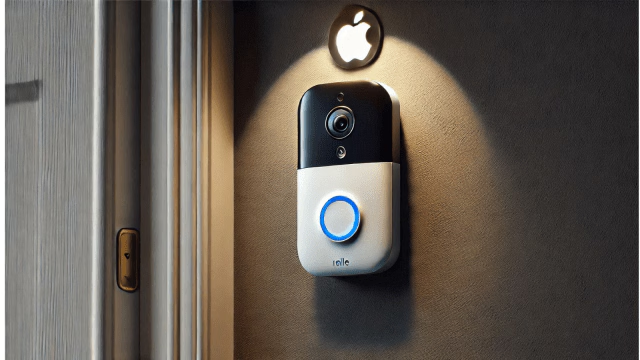
For decades, Apple Inc. has orchestrated revolutions from our pockets and wrists, redefining communication with the iPhone, personal computing with the iPad, and health awareness with the Apple Watch. Today, as the lines between the digital and physical realms continue to blur, the company is poised to turn its design-led, privacy-focused gaze toward a new frontier: the very threshold of our homes. According to persistent and detailed industry rumours, Apple is in the advanced stages of developing a smart doorbell, a move that could fundamentally alter the landscape of home security and automation. This isn’t merely about adding another camera to the market; it’s about integrating the doorstep into the cohesive, intelligent fabric of the Apple ecosystem, potentially powered by a groundbreaking new in-house chip and secured by the company’s gold-standard privacy architecture.
The concept of a smart doorbell is not novel. Established players like Ring, Nest, and Arlo have cultivated the market, offering homeowners remote visibility, two-way audio, and motion alerts. However, these solutions often exist as isolated islands of functionality or within less integrated ecosystems. They can raise valid concerns about data privacy, subscription models, and user interface fragmentation. Apple’s entry, as history has shown with music players, smartphones, and smartwatches, is rarely about being first. It is about being definitive—about synthesizing existing ideas into a product that feels singularly intuitive, secure, and powerful. A smart doorbell from Apple promises to be less of a peripheral device and more of a natural extension of the HomeKit framework, offering a level of seamless interoperability and user-centric design that could set a new benchmark.
The Heart of the Matter: The Proxima Chip
The most compelling technical revelation surrounding the rumoured device is its purported brain: the Apple-designed Proxima chip. This silicon represents a strategic masterstroke, aligning with Apple’s multi-year journey of bringing its processor expertise to every product category. The Proxima is speculated to be more than just a doorbell component; reports suggest it will form the computational core of a new generation of Apple home devices, including upcoming iterations of the HomePod and Apple TV.
This common architectural foundation is significant. For the doorbell, the Proxima chip would enable capabilities far beyond basic video streaming and motion detection. We can anticipate:
- On-Device Processing Prowess: The Proxima would allow for advanced, real-time analysis directly on the doorbell itself. This means sophisticated person, package, and vehicle detection with极高的accuracy, without needing to constantly stream footage to the cloud for analysis. This reduces latency for critical alerts and enhances privacy.
- Seamless Ecosystem Integration: With a shared chip architecture, the doorbell could communicate and orchestrate actions with other Proxima-powered devices effortlessly. Imagine the doorbell detecting a recognized family member and instructing the HomePod to play a welcoming greeting, or the Apple TV pausing your movie when the doorbell is pressed.
- Power Efficiency: Apple’s chip design is renowned for balancing high performance with remarkable energy efficiency. This is crucial for a doorbell, which must operate continuously in all weather conditions, potentially on existing doorbell wiring or with a battery solution that lasts considerably longer than current alternatives.
Face ID: The Ultimate Keymaster
While facial recognition exists in some competitor products, Apple’s potential implementation of Face ID technology would be a game-changer in terms of security, precision, and utility. This wouldn’t be a basic camera analysis; it would be the same secure, depth-mapping TrueDepth system that unlocks your iPhone.
- Personalized Notifications: Instead of a generic “Motion at your front door” alert, your iPhone could display “Anushya is at the door” or “A courier is at the door.”
- Intelligent Automation Triggers: Face ID could enable profound HomeKit automations. Upon recognizing you, the doorbell could disarm the home security system, unlock the smart lock, and trigger the hallway lights—a truly hands-free homecoming.
- Enhanced Security: The secure enclave and anti-spoofing technologies of Face ID would make it incredibly resistant to being tricked by photographs or masks, offering a layer of authentication security currently absent from the consumer doorbell market.
- Familiar & Welcome: For friends and family enrolled in your “Home” app, the door could unlock automatically as they approach, offering a seamless and welcoming experience.
iCloud and Privacy: A Fortified Data Vault
In an era of heightened data sensitivity, Apple’s privacy-centric approach could be its most potent differentiator. The rumoured integration with iCloud+ would likely follow the company’s established privacy framework.
- Secure Video with End-to-End Encryption: Footage would almost certainly be handled through iCloud’s Secure Video feature, where video is encrypted on the device, during transmission, and while stored in iCloud. Not even Apple would have the keys to decrypt it.
- Inclusive Storage: Apple typically bundles Secure Video storage with iCloud+ subscriptions. This could mean that a 200GB or 2TB iCloud+ plan would include video recording from your doorbell and other HomeKit Secure Video cameras without an additional, device-specific monthly fee—a stark contrast to the layered subscriptions common elsewhere.
- HomeKit Secure Router Integration: For users with a compatible router, internet traffic from the doorbell can be firewalled from the wider web, adding an extra layer of network security against potential intrusions.
Design and Integration: The Apple Aesthetic Meets the Doorframe
While specifics remain under wraps, one can confidently extrapolate from Apple’s design philosophy. The doorbell would likely feature a minimalist, durable enclosure made from premium materials like anodized aluminum or ceramic. It would be designed to withstand extreme temperatures and moisture. The focus would be on a discreet, elegant form that complements a home’s entrance rather than imposing upon it.
Integration would be the cornerstone of the experience. Setup would occur through the Home app in a few taps, using the same familiar Apple ID. Notifications would appear on the iPhone, iPad, Apple Watch, and Mac. Live feeds and recorded clips would be accessible in one centralized location, alongside all other HomeKit accessories. Siri would offer hands-free control: “Hey Siri, show me the front door” on any HomePod or Apple TV.
Potential Market Impact and Competitive Landscape
Apple’s entry would validate and simultaneously disrupt the smart home security market. It would immediately become the premium, ecosystem-locked option, appealing most strongly to existing Apple households. For competitors, the challenge would shift from competing on camera resolution alone to competing on holistic user experience, privacy assurances, and deep integration—areas where Apple has decades of consumer trust.
The product could also act as a powerful catalyst for the broader adoption of the Matter smart home standard, which Apple helped develop and champions. By offering a best-in-class, Matter-compatible doorbell, Apple could accelerate the industry-wide move towards true interoperability, even as it deepens the allure of its own ecosystem.
Estimated Pricing and Availability
Based on Apple’s pricing strategy for prosumer accessories and the advanced technology involved, industry analysts project the device will occupy the premium tier of the market.
| Feature Set | Estimated Price (USD) | Estimated Price (INR) | Key Inclusions |
|---|---|---|---|
| Apple Smart Doorbell (Standard) | $299 | ≈ ₹24,999 | Doorbell unit, Face ID sensor, Proxima chip, standard mounting hardware. |
| Apple Smart Doorbell (Pro) | $449 | ≈ ₹37,999 | All standard features, plus wider field of view, enhanced low-light sensor, extended warranty. |
Note: Prices are speculative and based on current market analysis. Official pricing will be confirmed by Apple at launch. iCloud+ subscription required for video recording and storage features.
Looking Ahead: The Connected Home’s New Sentinel
The rumoured Apple smart doorbell represents more than a new product category for the company; it signifies a deeper commitment to owning the intelligent home experience. By leveraging the Proxima chip for unparalleled on-device intelligence, Face ID for personalized and secure identification, and iCloud+ for private data stewardship, Apple is not just building a doorbell. It is constructing a sentinel for the modern home—one that recognizes, understands, and protects, all while adhering to a principle the company holds dear: that advanced technology should empower the user without compromising their privacy.
As we await an official announcement, likely at a spring or fall event in 2025, the industry watches with anticipation. If the rumours hold true, the humble doorbell is about to become the latest, and perhaps one of the most personal, embodiments of the Apple ecosystem, forever changing how we greet the world at our door.
Frequently Asked Questions (FAQs)
Q1: When will the Apple Smart Doorbell be officially announced and released?
A: While unconfirmed, based on Apple’s product cycle, a reveal could happen at an event in March or September 2025, with availability likely within a few weeks of announcement.
Q2: Will the Apple Doorbell require a subscription to work?
A: Basic functionality like live viewing, notifications, and two-way talk will likely not require a subscription. However, to access video recording, history, and person/package alerts (features powered by iCloud Secure Video), an active iCloud+ subscription will be required.
Q3: Can the Apple Doorbell work with non-Apple devices or smart home systems?
A: It will fully integrate with the Apple HomeKit ecosystem. For broader compatibility, it is expected to support the Matter smart home standard, allowing for basic functionality with other Matter-certified platforms like Google Home and Amazon Alexa, though advanced features will be exclusive to the Apple ecosystem.
Q4: Will it work with existing doorbell wiring?
A: It is highly anticipated that the Apple Doorbell will offer both wired (using standard low-voltage doorbell wiring) and wireless (battery-powered) installation options to cater to different home setups.
Q5: How does Apple’s approach to privacy with this doorbell differ from competitors?
A: Apple emphasizes on-device processing and end-to-end encryption through iCloud Secure Video. This means identifiable data and video analysis happen on the doorbell itself where possible, and stored footage is encrypted so that only you can access it, not Apple or any third parties.
Q6: Can the Face ID feature recognize multiple people?
A: Yes, it is expected to support multiple facial profiles managed through the Home app, allowing for personalized recognition and automations for family members and frequent guests.
Q7: What happens if my internet goes down?
A: The doorbell should still function as a traditional doorbell (triggering an indoor chime if wired). Events occurring during an outage would be processed and uploaded as alerts once the connection is restored, provided the device has local storage buffer capability.