


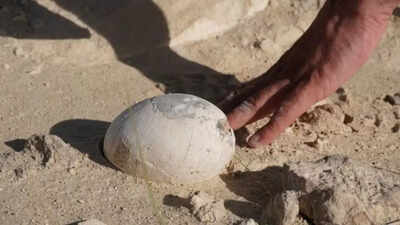
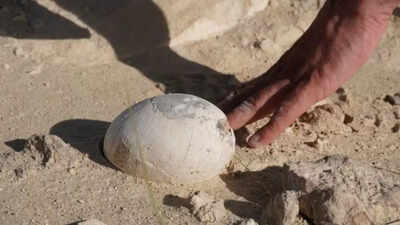
A fossilised dinosaur egg was uncovered in South America, and scientists are calling it a remarkable discovery. The egg is estimated to be around 70 million years old and is astonishingly well-preserved. The find was made by the Laboratory of Comparative Anatomy and Evolution of Vertebrates (LACEV) at the Argentine Museum of Natural Sciences. Palaeontologist Federico Agnolín and his colleague Matías Motta believe it could be the first complete egg of a carnivorous dinosaur ever found in South America. As reported by Discover Magazine, the discovery was revealed during a live broadcast, allowing colleagues and the public to witness it simultaneously.
A 70-million-year-old carnivorous dinosaur egg might have a baby inside
Fossilised eggs of carnivorous dinosaurs are really rare. That makes this one especially interesting. The egg is oval, more like a modern bird’s, not the round, thick shells of long-necked sauropods. Its shape, along with the unusual markings on the shell, suggests it might belong to a species we haven’t seen before. At first, the team thought it could be Bonapartenykus, a small local theropod, but that seems unlikely now.Agnolín and his colleagues believe it might be a different kind of carnivorous dinosaur. They plan to scan the egg with a micro-CT before the year ends. This could show if there is any embryonic skeleton inside. Even if the embryo isn’t complete, it might still reveal posture, growth, or how its breathing system worked.Dinosaur embryos are extremely rare anywhere in the world. In Argentina, only sauropod embryos have been found before. If this one does have a carnivorous embryo inside, it would be a huge opportunity to learn more about these predators while they were still developing.
Evidence of dinosaur nesting shows how they raised babies
Near the egg, researchers also found fossils of Rocasaurus muniozi, a titanosaur that appears to have breathed like modern birds. Additional egg fragments and eroded shells suggest a nest, which could shed light on the reproductive behaviour of carnivorous dinosaurs. Until now, no known carnivorous dinosaur nests have been documented in South America. The discovery may help scientists understand how nesting behaviours evolved, bridging the gap between reptiles that simply lay eggs and modern birds that build nests, incubate eggs, and care for their chicks.Skeletons alone rarely provide behavioural information, but nests can reveal a great deal. They may indicate whether these dinosaurs were social, solitary, or attentive parents. This find also helps trace the evolutionary path that led to bird-like parenting. Agnolín emphasises that the discovery is not just about the egg itself, but also about showing the scientific process in real time.