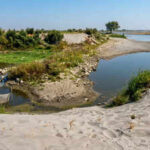


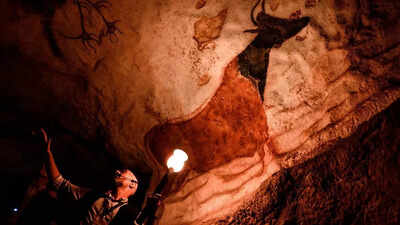
In 1940, Marcel Ravidat, an 18-year-old from Montignac, France, followed his dog, Robot, into a hole near a fallen tree. Inside, he found a cave that had been untouched for thousands of years. The walls were covered in paintings, some over six feet long, depicting animals in motion. This marked one of the most important archaeological finds of the 20th century.The forested hills above Montignac offer no hint of what lies beneath. The slope is ordinary. The entrance, once hidden by a tree, is barely noticeable. The cave remained sealed for millennia until Marcel and his dog discovered it in 1940.
How four teenagers uncovered over 2,000 ancient wall paintings
On September 12, 1940, Marcel returned with three friends: Jacques Marsal, Georges Agnel, and Simon Coencas. Together, they widened the hole and entered the cave. They found chambers filled with wall paintings. The boys later told Léon Laval, a local teacher and amateur prehistorian. Laval visited and identified the images as prehistoric. He contacted Henri Breuil, a French archaeologist, who confirmed the cave’s significance two days later. The Lascaux cave contains over 2,000 images and about 6,000 figures painted or engraved across nine sections. The Hall of the Bulls, The Nave, and The Shaft are key areas. The artwork is attributed to the Magdalenian culture, dated between 17,000 and 19,000 years ago.The paintings feature horses, aurochs, deer, ibex, felines, and symbolic shapes. Pigments include red ochre, hematite, charcoal, and manganese oxide. Some figures are more than six feet long. Researchers report that scaffolding was likely used for ceilings, and firelight or oil lamps provided illumination.
Lascaux cave: From public tours to modern replicas and digital access
Lascaux opened to the public in 1948. Visitor numbers quickly rose to over 1,200 per day. Changes in temperature, humidity, and carbon dioxide affected the walls. The French government closed the cave in 1963 after green algae appeared. In 2001, a Fusarium fungus spread during air-conditioning maintenance. Fungicides and Polymexin were used to control the growth. Access is now restricted to researchers and conservation staff.Replicas were built to allow public viewing. Lascaux II opened in 1983, recreating major sections of the cave. Lascaux III became a travelling exhibition. Lascaux IV, opened in 2016 at the Centre International de l’Art Pariétal, features 3D reconstructions and spatial sound.The French Ministry of Culture also offers a digital tour of all nine galleries. This provides remote access without compromising conservation.
The debated purpose and meaning of prehistoric paintings
The purpose of the paintings is still debated. They might have served ritual, symbolic, or communicative purposes. Some figures, like the “birdman” near a wounded bison, suggest ceremonial use. Many images are located deep inside the cave, requiring artificial lighting and constructed pathways.Researchers continue to study Lascaux, but interpretations remain speculative. The cave preserves a unique record of prehistoric life and artistry.