

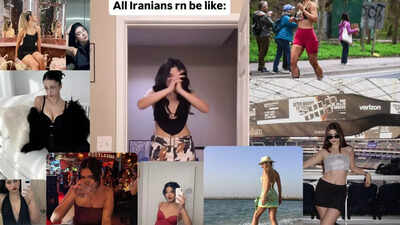
The YMCA dance, considered a gay anthem before it was co-opted by MAGA, appears to have found a new life with Iranians, in America and across the globe. As a recent account wrote: “Iranian American’s all across the country are hitting the Trump dance.
” This led Melissa Wong to reiterate: “Has anyone else noticed that the ‘Iranian women celebrating’ videos are all women that are dressed like h*****kers.”The tweet, like Dylan Thomas’s epochal words, did not go quietly into the night. It raged. Roughly 8,500 quote-tweets and more than 13,000 replies later, a meme dance had mutated into a referendum on authenticity, interventionism and the female body.
To understand why this moment detonated, one must first understand the climate in which it surfaced.
The viral clips emerged during the March 2026 US-Iran crisis, when President Trump’s military strikes reportedly eliminated senior regime figures and triggered Iranian retaliation. The escalation unfolded alongside the death of Ayatollah Ali Khamenei, a figure who for more than three decades embodied the Islamic Republic’s ideological rigidity.
His passing marked the end of an era defined by uncompromising positions on compulsory hijab and state-enforced morality.
Iran-Allied Fighters Attack Northern Israel As IDF Invades Lebanon After Hezbollah Strike
For some, the strikes and Khamenei’s death represented dangerous instability. For segments of the Iranian diaspora long opposed to the Islamic Republic, they felt like the first tremors of possible regime transformation. Celebration, in that context, was not frivolous spectacle. It was historical release layered with uncertainty, grief, anger and cautious hope.One widely circulated video showed a young Iranian American woman dancing provocatively to what online observers dubbed the “Trump dance,” a meme adaptation of YMCA choreography synonymous with campaign rallies.
She wore a crop top and shorts. She moved without visible inhibition. For critics like Wong, a libertarian anti-interventionist voice sceptical of US military action abroad, the imagery looked curated and unrepresentative.
Her suspicion was framed as a question of authenticity. Were these women reflective of typical Iranian society, or were they algorithm-friendly theatre?But authenticity, in this debate, quickly became a proxy for modesty.
Iranian women hit back
The replies were not conciliatory.
- @Hellokittyi_ wrote: “Both pics are me. You see, Melissa, unlike you, we had to fight for our basic rights, so we value our freedom.”
- @lili__far responded bluntly: “Shut the f** up b****! Regards, A proud Persian girl.”*
- @shirin_yfr added: “Women dressed however tf they want because they can :)”
- @moonalinn concluded with clipped certainty: “We call it ‘
freedom of choice ’. Now cry about it hun.”
The language was sharp, but beneath it lay composure. These were not women arguing about fashion. They were rejecting the premise that credibility must be stitched into a hemline.
For decades, the Islamic Republic embedded compulsory hijab into law. Since the early 1980s, public dress codes have been enforced by the morality police. Hair became ideological terrain. Sleeves became symbols of obedience.
Women were stopped in streets, reprimanded, fined, detained. The state’s claim was explicit: the female body reflected the moral order of the nation.
Ayatollah Ali Khamenei, who served as Supreme Leader from 1989 until his recent death, consistently framed hijab as a non-negotiable pillar of the republic’s identity. Even after the 2022 death of Mahsa Jina Amini ignited the “Woman, Life, Freedom” protests and forced visible recalibration in enforcement, the legal architecture remained intact.
Patrols shifted in visibility. Surveillance increased. The statutory requirement endured.That is the long shadow cast over these diaspora clips.Inside Iran, women have historically been reprimanded for insufficient coverage. Outside Iran, they are now reprimanded for insufficient modesty according to someone else’s cultural template. The geography shifts. The instinct to regulate persists.What makes this moment different is not the insult but the response to it.
The women in those videos are not seeking validation from Western liberalism or approval from conservative sensibilities. They are inhabiting a space denied to many at home. Celebration, for them, is layered. It is political. It is generational. It is memory set to music.With Khamenei gone, Iran stands at a symbolic inflection point. Institutions do not evaporate with a single departure, and laws do not dissolve with a single strike.
Yet symbols matter. The sight of diaspora women dancing openly, answering moral policing with derision rather than deference, signals a recalibration of confidence.What those viral clips ultimately revealed was not decadence, nor propaganda, nor some elaborate performance of Westernised liberation. They revealed memory. Memory of morality police vans idling at street corners. Memory of being stopped, corrected, warned.
Memory of hair treated as contraband and fabric treated as ideology. For decades, the female body in Iran was not simply personal space; it was public doctrine.
The state wrote its authority onto sleeves and scarves.So when diaspora women dance in crop tops and shorts to a kitschy anthem, they are not staging rebellion for the algorithm. They are inhabiting a freedom that many of their mothers negotiated cautiously and many of their peers at home still navigate carefully.
They are moving without the quiet calculation that once accompanied every step outside. The instinct to police them online echoes the older instinct of the morality patrol, only digitised.
Different uniforms, same impulse: measure, judge, regulate.What unsettles critics is not the choreography. It is the absence of fear. The beat of YMCA will fade. The meme will age. The geopolitical crisis will shift into another headline. But the deeper shift lies elsewhere. A generation that grew up under the gaze of the morality police has learned to return the gaze without flinching. Their bodies are no longer sites of state instruction or social suspicion. They are no longer canvases for someone else’s virtue.They are expressions of choice.
And once choice is lived rather than requested, it becomes very difficult to police again.