


People often get frustrated with the daily travelling they do to reach their desired destination. There is some good news for people who commute between Denmark and Germany. Millions of passengers who travel from Rodbyhavn and Puttgarden via ferry service, which takes them 45 minutes to reach, can relax now, as after more than a decade of planning, the dream to travel between Denmark and Germany is expected to turn in reality in 2029.
The construction of the world’s longest tunnel, i.e. Fehmarnbelt tunnel, is in progress, which began in the year 2020. The Fehmarnbelt Tunnel isn’t just long; it’s a deep-sea marvel. The structure will sit in a trench carved 40 meters beneath the Baltic Sea.
18 kilometres under the sea: Travel between Denmark and Germany in just 7 minutes by train
The tunnel, which will be 18 kilometres long, that makes it the one of Europe’s largest high-budget infrastructure projects with a construction budget of over 7 billion euros ($7.4 billion). After this project competition, passengers will easily reach their desired destination in very few minutes. According to technical specifications released by the project engineers at Femern A/S, passengers will now be able to cover this sea journey in just 7 minutes by train and 10 minutes by car.
The Fehmarnbelt tunnel project is managed by Femern A/S
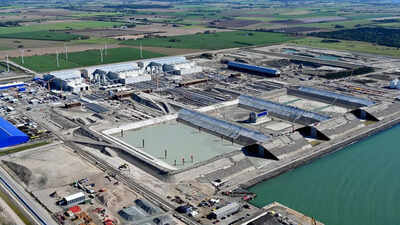
To manage a project of this scale, the task was handed to Femern A/S, the Danish state-owned company. The task was clear to build a 18 kilometers long sea-link between two-nations. The company has transformed the Danish town of Rødbyhavn into one of the largest construction sites in Northern Europe. According to Femern A/S, the link will comprise two-doubled lane motorways, which will be separated by a passageway and two electric rail tracks.
“Today, if you were to take a train trip from Copenhagen to Hamburg, it would take you around four and a half hours,” says Jens Ole Kaslund, technical director at Femern A/S, the state-owned Danish company in charge of the project. “When the tunnel is completed, the same journey will take two and a half hours.
Why not a traditional bored tunnel
Traditional bored tunnel work perfectly for deep rock, but the Danish and German seabed is occupied with soft ground. The engineering applied to this project says that assembling this longest tunnel piece-by-piece using 79 standard concrete blocks, with each element measuring 217 meters in length and weighing an incredible 73,000 tonnes, will allow the team to maintain a speed of 200 kilometres per hour for trains and 110 kilometres per hour for cars, respectively.
The 28-year plan to repay the $7.4 billion debt
The Fehmarnbelt Tunnel is not only a marvel of engineering but also a massive financial undertaking, with a total financial framework of EUR 7.4 billion based on prices in 2015. The financial burden of this massive undertaking rests squarely on the shoulders of Denmark, which has successfully secured the required loans through government guarantees. This massive financial undertaking has been made possible through substantial funding from the EU, as the tunnel forms part of the Scandinavian-Mediterranean corridor, which has been classified as a priority project.
To ensure the financial viability of this massive undertaking, the Danish government plans to employ a user-pays approach, where the required loans are refinanced through the imposition of motor vehicle tolls and railway charges in the future.
Economists and project managers at Femern A/S estimate that the required loans will be repaid within a period of 28 years after the opening of the tunnel, thus ensuring the financial viability of this massive undertaking, which forms the world’s longest immersed tunnel, a “green” tunnel for generations to come.