

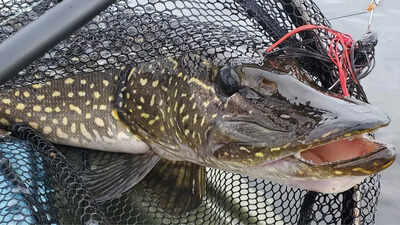
The Northern Pike (Esox lucius) belongs to the Kingdom Animalia. It is one of the largest freshwater predators found across temperate regions of the Northern Hemisphere, where it can grow longer than one meter and, in rare cases, weigh more than twenty-five kilograms. This powerful fish is known for its ambush hunting strategy, using sudden bursts of speed to capture prey with quick surprise attacks.The northern pike’s reproductive capabilities are impressive as well. According to the U.S. Fish and Wildlife Service, a single large female can produce as many as 500,000 eggs during a single spawn, which will stick to the shallow vegetation, allowing for the survival of eggs and embryos without any form of parental care. This type of reproduction (referred to as broadcast spawning) allows the northern pike to overcome high mortality rates and maintain its dominance in river or lake ecosystems.
Northern Pike’s specialised anatomy and habitat selection
The body of the Northern Pike fish is biologically designed to capture prey in a way that allows it to be one of the best predators living in freshwater lakes. According to the U.S. Fish & Wildlife Services, Northern Pike possess a unique body shape, somewhat like a ‘torpedo,’ with dorsal and ventral fins located very far towards the back of its body. As a result of the fin position, the dorsal and ventral fins act as a rear engine so that Northern Pike can accelerate quickly toward their prey when it is within a fraction of a second’s distance. This anatomical design allows Northern Pike to exist in clear, vegetated lakes and very slow-moving river water where they can lie motionless and be camouflaged by their olive-green and yellow-spotted bodies until a fish moves within range.In order for Northern Pike to continue to be apex predators, they are very specific about their preferred habitats. Northern Pike require ‘cool-water’ habitats that have significant submerged cover (i.e., logs or aquatic plants) for hunting cover and to protect their young from predators. Based on the official species profile by the US Fish & Wildlife Service, the number of Northern Pike in a particular body of water will be based on the number of these types of habitats available for use.
500,000 Eggs: Why quantity is a survival strategy
Northern Pike reproductive cycles are a giant gamble for the species as they rely on the sheer volume of offspring to ensure the survival of any future generations. Each Northern Pike uses a technique called ‘broadcast spawning,’ where they do not protect their eggs or fry. Instead, they simply lay large amounts of eggs (up to 500,000) in shallow water and let nature take its course. The fact that the parents do not provide any protection after the eggs are fertilized means that only a small fraction of those 500,000 potential ‘lives’ will live long enough to grow to be one metre in length.The timing of this event is just as important for the species as the reproductive technique. The Northern Pike will typically migrate to shallower waters shortly after the ice from the main lake melts. Because of this, the fry will hatch at a time when the other prey species will also be hatching, and therefore have a ready source of food. According to the U.S. Fish & Wildlife Services, the success of fry, combined with the mucous that covers their eggs and fry, allows them to ‘glue’ themselves to the vegetation in the marshes where they will develop, making it very difficult for the fry to be smothered by the silt and then die.
Geographical range of Northern Pike
The Northern Pike has an incredibly broad range, making them one of the most widely distributed freshwater fishes in the Northern Hemisphere. The Fish & Wildlife Service states that Northern Pike inhabit cold-temperate waters throughout North America, Europe, Asia, and Siberia. Throughout this massive geographic area, they prefer to inhabit clear, vegetated lakes and slow-moving, i.e., little or no current, rivers where they can conceal themselves from potential prey before attacking, i.e., ambush hunting. For maps and data specific to the broad distribution of Northern Pike, refer to the species profile at fws.gov.