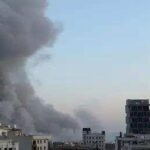


US Iran War: Kuwait shoots down 7 drones
Kuwait’s National Guard said it shot down seven drones at dawn, hours after the army reported intercepting hostile missile and drone activity. The developments come amid a wider surge in attacks across the Gulf, with the UAE, Saudi Arabia and Bahrain also reporting interceptions in recent hours.
Israel Iran War: Qatar intercepts missile attack
Qatar’s armed forces intercepted a missile targeting the country, its Ministry of Defence said, as a fresh wave of overnight attacks was reported across the Gulf region. Several countries in the region have reported missile and drone activity, signalling a widening security threat amid the ongoing conflict.
Israel Iran War: Explosions hit central Israel as Iran launches fresh missile barrage
Explosions were reported in central Israel’s Gush Dan region after Iran launched a fresh round of missile attacks, according to local media. Broadcaster Channel 12 said the Israeli military had issued alerts warning of incoming fire, with air defence systems intercepting at least one missile.
However, fragments from a cluster-style warhead appear to have struck parts of the area. In the city of Holon, reports suggest multiple vehicles were damaged, with some catching fire following the impact. There are no immediate details on casualties.
Iran War News: Saudi Arabia to host Arab and Islamic foreign ministers to discuss security
Saudi Arabia will host a consultative meeting of foreign ministers from a group of Arab and Islamic countries in Riyadh on Wednesday evening, as regional tensions continue to rise. According to the Saudi foreign Ministry, the talks will focus on coordination efforts and ways to support security and stability across the region, amid the ongoing Middle East conflict.
Iran News: China declines Hormuz role; Trump delays Beijing visit
China has indicated it will not assist Washington in reopening the strategically critical Strait of Hormuz, despite a direct request from US President Donald Trump, even as oil shipments through the chokepoint remain severely disrupted. At the same time, Trump’s long-anticipated visit to Beijing — expected to be a key moment in stabilising US-China ties — has been postponed.
For Beijing, the moment presents a complex opportunity. While publicly calling for de-escalation and positioning itself as a stabilising force, China has avoided direct involvement, even as it expands diplomatic outreach across the Middle East and delivers humanitarian aid to Iran. The longer the conflict continues, experts warn, the greater the risk that the United States could become overstretched — shifting military assets away from Asia and fuelling concerns among its regional allies about commitment and capacity.
Israel Iran War: Israeli strikes hit central Beirut, at least 6 dead
At least six people were killed and 24 others injured after Israeli airstrikes hit central Beirut early Wednesday, according to authorities in Lebanon, marking another deadly escalation in the widening regional conflict.
Lebanon’s health ministry described the toll as preliminary, adding that human remains were recovered from the strike sites and would require DNA testing for identification. The attacks targeted residential areas in the heart of Beirut, far from the southern suburbs that have seen repeated bombardment in recent days, raising concerns about the expanding scope of Israeli operations.
The strikes come amid intensifying hostilities between Israel and Iran-backed groups in Lebanon, particularly Hezbollah. Civilian areas have increasingly been caught in the crossfire, with mounting casualties and widespread damage reported across the capital.
Ahead of the strikes, the Israeli military issued an evacuation warning for residents in the southern city ofTyre, including nearby Palestinian refugee camps. Military spokespersonAvichay Adraeeurged civilians to leave immediately, stating that the army intended to target locations it claimed were linked to Hezbollah operations.
Iran war news: Foreign minister downplays impact of Larijani killing
Iran’s top diplomat has sought to project stability after the killing of senior security official Ali Larijani, insisting that the country’s political system remains intact despite mounting losses in the ongoing conflict.
Speaking to Al Jazeera, Abbas Araghchi said the assassination of key figures would not weaken the foundations of the Islamic Republic.
“I do not know why the Americans and the Israelis still have not understood this point,” Araghchi said, referring to both United States and Israel. “The Islamic Republic of Iran has a strong political structure with established political, economic, and social institutions.”
He emphasised that while individual leaders play important roles, the system itself is designed to endure beyond any single figure. “The presence or absence of a single individual does not affect this structure,” he said, adding that Iran’s governance model is built on deeply rooted institutions rather than personalities.
Araghchi acknowledged that figures like Larijani held influence, but maintained that their loss would not derail the state’s functioning or strategic direction. “Individuals are influential, and each person plays their role — some better, some worse — but what matters is that the political system in Iran is a very solid structure,” he added.
Iran news: Iranian leaders vow ‘national resolve’ after Larijani killing
Senior political figures in Iran have reacted sharply to the confirmed killing of top security official Ali Larijani and Basij commander Gholamreza Soleimani, framing their deaths as a rallying point for the country amid the escalating war.
Former presidential candidate Saeed Jalili described the killings as part of a “glorious line of sacrifice” tied to the ideals of the Islamic Revolution. According to Iranian media, Jalili said the deaths would strengthen national resolve and push Iran further along what he called a path toward defeating its adversaries. His remarks reflect a broader effort within Iran’s political establishment to project unity and defiance despite mounting military and leadership losses.
Veteran adviser Ali Akbar Velayati also condemned the killings, calling Larijani a “revolutionary” figure and accusing the United States and Israel of “criminal” actions. He warned that both countries had miscalculated the consequences of targeting senior Iranian leadership, signalling the likelihood of continued retaliation.
Meanwhile, the conflict’s spillover into Iraq intensified, with an attack reported on the Imam Ali base in the northeastern city of Kirkuk. Verified footage showed flames rising from the site following the strike. The base houses members of the Popular Mobilisation Forces(PMF), a state-linked umbrella group of largely Shia militias, several of which are aligned with Iran.
Israel Iran War: Drone and rocket attack targets US Embassy in Baghdad
Explosions were reported across Baghdad early Wednesday as a drone and rocket attack targeted the United States Embassy, marking another escalation in the widening regional conflict. Iraqi officials confirmed that the heavily fortified diplomatic compound came under direct attack, with at least one drone striking inside the premises.
According to security sources, multiple blasts were heard overnight, with air defence systems attempting to intercept incoming projectiles over the embassy zone. An AFP journalist on the ground reported hearing successive explosions, while witnesses described seeing flashes in the sky consistent with interception attempts.
Despite the initial blasts, some parts of the city appeared momentarily calm, with daily life continuing in nearby areas, it was reported.
A fire was later spotted along the edge of the embassy grounds, which officials said was caused by a drone impact. Hours after the first wave, another explosion was heard, with a security official confirming that a drone had directly hit the embassy compound.
Iran war news: Iran missile barrage kills 2 near Tel Aviv
A fresh missile barrage launched by Iran killed two people near Israel’s commercial hub Tel Aviv early Wednesday, as the conflict between Israel and Tehran continues to intensify. The attack triggered widespread air raid sirens across central Israel and caused damage to civilian infrastructure, including the temporary suspension of national rail services.
According to Israel’s emergency service, two people were found dead in Ramat Gan, where buildings were heavily damaged. Visuals from the site showed streets covered in debris, shattered glass, and emergency teams conducting search and rescue operations. In nearby Bnei Brak, one person was reported to have sustained minor injuries from shrapnel.
Authorities said multiple impact sites were recorded across the Tel Aviv region, with bomb disposal teams deployed to handle unexploded ordnance. The missile strike also disrupted transportation, after shrapnel hit infrastructure at Tel Aviv’s main railway station. Israel’s national railway company confirmed that services across the country were temporarily suspended as a precaution, although no casualties were reported at the station.
Israel Iran War News: US pounds Iran missile sites near Strait of Hormuz
The war between United States, Israel and Iran escalated sharply on Wednesday, with Washington launching some of its heaviest strikes yet on Iranian missile infrastructure near the strategically vital Strait of Hormuz. The move came as Tehran intensified missile attacks across the region and vowed to avenge the killing of its top security leadership.
According to US Central Command, multiple 5,000-pound bunker-buster bombs were used to hit hardened missile sites along Iran’s southern coast, targeting positions seen as a direct threat to international shipping routes. The Strait of Hormuz, through which nearly one-fifth of the world’s oil supply passes, has been largely disrupted by Iran, raising alarm over global energy markets and trade flows.
The strikes follow Israel’s targeted killing of senior Iranian figures, including Ali Larijani and Gholam Reza Soleimani. Iran’s Revolutionary Guard has vowed retaliation, describing Larijani’s death as a catalyst for a “national awakening.” Funeral processions for both leaders are expected to take place amid heightened tensions.
The conflict between Israel and Iran has escalated sharply, entering its 19th day with no signs of slowing down. In a major development, Israel confirmed it killed senior Iranian security official Ali Larijani and Revolutionary Guard commander Gholam Reza Soleimani in targeted overnight strikes. Both figures were central to Iran’s internal security structure and were closely linked to the crackdown on recent protests, making their deaths a significant strategic blow to Tehran.
Iran responded with intensified missile and drone attacks across the region, targeting Israeli territory as well as critical infrastructure in Gulf countries. The conflict has now expanded far beyond its original scope, pulling in multiple nations including Lebanon, Iraq, and key Gulf states. Israeli airstrikes have reached deeper into Beirut, striking residential neighbourhoods and causing civilian casualties. At the same time, Hezbollah has continued firing rockets into northern Israel, triggering further retaliation.
Meanwhile, the United States military remains actively involved, with its assets increasingly coming under attack. A drone strike targeted the US Embassy compound in Baghdad, underlining the growing vulnerability of American personnel. Saudi Arabia also reported intercepting a ballistic missile near a major air base hosting U.S. forces.
The humanitarian toll continues to rise sharply. Thousands have been killed or injured across Iran, Lebanon, and Israel, while large-scale displacement is underway, particularly in Lebanon. Concerns are also mounting over nuclear safety after reports that a projectile struck Iran’s Bushehr nuclear complex, though no damage has been officially confirmed.
With no clear path to de-escalation, the conflict is rapidly transforming into a prolonged regional war with serious global economic and security consequences.