

- News
- Science News
- 8 sky events in April 2026 you can’t miss: From a blazing comet to meteor storms
AA
Text Size
- Small
- Medium
- Large
1/9
8 sky events in April 2026 you can’t miss: From a blazing comet to meteor storms
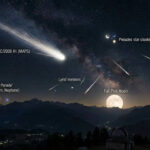
If you are into watching the stars, April 2026 will be an exciting month for you! It includes an amazing experience for all to see: the arrival of a ‘Celestial Theatre,’ including Comet C/2026 A1 (MAPS) from deep space; an event such as the Lyrid meteor shower from the Earth; and being able to observe a Planet Parade high above Earth (which will occur two hours before sunrise). The highlight will be on April 4, when Comet C/2026 A1 (MAPS) will make its close approach to our sun and may shine bright enough in the morning sky. All in all, if you are tracking the Pink Moon or catching the 2,700-year-old Lyrid meteor showers, April has at least 8 different ways to watch the universe in action.
2/9
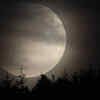
The full Pink Moon (April 1)
The first full moon of this spring will take place on 10:12 PM ET. Although this name implies a colour change for the moon, instead it reflects the seasonal blooming of Phlox subulata (moss pink) in North America. Astronomically, because the moon will be near its perigee position when it is full, this full moon will appear 15% brighter and somewhat larger than an average full moon, thus creating the myths surrounding these moons being classified by the media as ‘supermoons’.PC: Canva
3/9
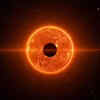
Mercury at greatest western elongation (April 3)
At this time, Mercury will reach maximum distance from the Sun, which will allow viewers to see it very low on the eastern horizon prior to sunrise. As Mercury is so close to the Sun in its orbit, it is usually not visible to observers from Earth because of the excessive solar glare; however, it is at the right angle to be seen from the Earth’s surface during this phase of Mercury’s orbit through the solar system. Scientists use these opportunities to research Mercury’s tenuous exosphere and surface reflectivity, as the planet’s maximum distance from the Sun’s glare provides a clearer ‘line-of-sight’ for space-based sensors and high-altitude telescopes.
4/9
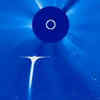
Comet C/2026 A1 (MAPS) Perihelion (April 4)
This comet is classified as a ‘sun-grazing’ comet and will pass within approximately 850,000 miles of the Sun at perihelion. Comets are made up of ice and dirt and, therefore, are referred to as dirty snowballs. Upon reaching perihelion, the addition of solar energy to the comet will cause the comet to sublimate into gas very quickly, thereby creating a glowing coma that will be surrounded by a very long tail. If the nucleus of this comet can withstand the effects of such a strong gravitational field, there is a possibility that this will become a ‘Great Comet’ of 2026, with forward-scattering of light potentially making its tail visible even during morning twilight.
PC: NASA Science
5/9
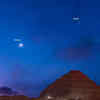
Pre-dawn Planet Parade – (April 16–23)
Mercury, Mars, Saturn, and the distant planet Neptune will form a rare visual alignment as they are clustered together in a 10-degree section of sky, which is termed a planetary conjunction due to this phenomenon being a line of sight. The three planets may appear close together; however, they are all millions of miles apart from one another. Research conducted in the area of planetary dynamics can show how these alignments can help provide calibration for wide-field telescopes and to better understand the ecliptic plane that holds the vast majority of all solar system objects.
PC: NASA
6/9
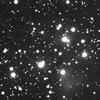
Moon, Venus, and the Pleiades Conjunction (April 18–19)
Mercury, Mars, Saturn, and the distant planet Neptune will form a rare visual alignment as they are clustered together in a 10-degree section of sky, which is termed a planetary conjunction due to this phenomenon being a line of sight. The three planets may appear close together; however, they are all millions of miles apart from one another. Research conducted in the area of planetary dynamics can show how these alignments can help provide calibration for wide-field telescopes and to better understand the ecliptic plane that holds the vast majority of all solar system objects.
PC: NASA

7/9
Lyrid Meteor Shower Peaks (April 22–23)
The Lyrid meteor shower is associated with the debris produced by comet C/1861 G1 Thatcher. The Earth’s passage through the debris trail creates 110,000 miles per hour dust that burns up in the atmosphere, creating a meteor shower of some of the oldest known meteor showers observationally; records of the Lyrid Shower date back 2,700 years. NASA regularly monitors the peaks and valleys of meteoroids, which allows the office of meteorology to make assessments related to satellite and International Space Station risks related to meteoroid impacts.
8/9
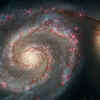
Galactic Sightings/Whirlpool Galaxy (All Month)
Messier 51 (The Whirlpool Galaxy) displays its best face-on orientation in the month of April. Sitting at a distance of 31 million light-years, it is actively engaged in a galactic collision with NGC 5195 (the smaller of the two galaxies). Astrophysicists use Messier 51 as a model case to study how star formation occurs in the spiral arms due to gravitational interaction.
PC: NASA
9/9
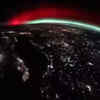
The ‘End’ of Northern Lights Season (Late April)
With daylight increasing in the Northern Hemisphere due to approaching summer solstice; as a result, the length of daylight (often referred to as ‘midnight sun’) will continue to prevent us from seeing the Northern Lights. Although solar activity (CMEs) still occurs and is currently impacting our atmosphere, the sky will be too bright for the human eye to discern the green and red ionised gases emitted during an aurora in the vicinity of the Arctic Circle. Therefore, this transitions to conclude the traditional ‘dark sky’ aurora observational season in the Arctic Circle.
Follow Us On Social Media