


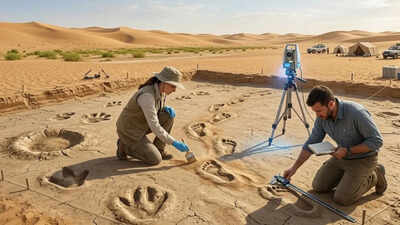
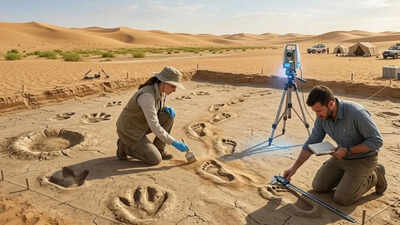
Archaeologists have identified 120,000-year-old human footprints at the ancient lake site of Alathar in the Nefud Desert, Saudi Arabia. Ancient human artefacts discovered in the Nefud Desert demonstrate a long history of human habitation in the region. According to the research published in Science Advances, the site includes 120,000-year-old human footprints found at Alathar (an ancient lake), providing the oldest dated example of Homo sapiens on the Arabian Peninsula, pushing back the timeline of human migration from Africa. During the Last Interglacial, before the area became arid, it was called ‘Green Arabia,’ complete with large lakes and abundant plant and animal life. Many of the 120,000-year-old footprints were discovered collaboratively by archaeologists from the Max Planck Institute and the Saudi Heritage Authority. These footprints provide evidence that early humans, who used the inland lake systems as excellent habitat areas and migration corridors, lived and migrated with prehistoric elephants and hippopotamus for about 15,000 years when climatic conditions allowed for good living and good migration.
The Alathar discovery: 120,000-year-old human footprints in Saudi Arabia
Researchers working at Alathar in the Nefud Desert have found ancient tracks of anatomically modern humans (Homo sapiens). According to the Science Advances (Research Journal), researchers from both the Max-Planck Institute and the Saudi Ministry of Culture utilised optically stimulated luminescence (OSL) dating to establish a 120,000-year-old chronology. It represents the first evidence for the presence of modern humans in this part of the world, effectively filling a significant spatial and temporal lacuna in hominin dispersal models.
The Green Arabia phenomenon
An article from Max Planck Institute shows that around 120,000 years ago, the Nefud Desert was a green and wet place, with many lakes and abundant grasslands. This time period is called the Last Interglacial period and was characterised by a wetter monsoon season, transforming central Arabia into Green Arabia. These environmental changes created new and suitable migration routes, allowing humans and megafauna to exploit inland lacustrine corridors across the peninsula.
Co-existing with prehistoric giants
Not only does the Alathar site have evidence of humans, but there are hundreds of tracks from other species as well, including ancient elephants, ancient horses, and giant camelids (now-extinct Pleistocene megafauna). The fact that the Alathar site is devoid of stone tools tells us that humans used the lake as a ‘temporary watering hole’; therefore, Alathar offers us an extraordinary opportunity to see how early humans were moving through an environment where they coexisted with enormous amounts of both Pleistocene and modern megafauna.
Challenging the ‘out of Africa’ model
This discovery changes the timelines we have for early dispersals of modern humans. According to the Saudi Ministry of Culture, if modern humans were present in the Arabian interior approximately 120,000 years ago, it suggests that Homo sapiens expanded out of Africa earlier and more frequently than once believed. Also, this exhibit proves that our forbearers not only travelled along the coasts but also could travel inland when there was enough water and food in a region to sustain human life.


