

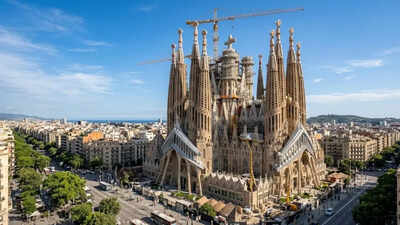
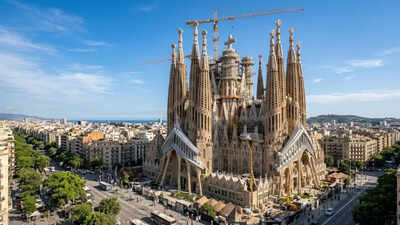
For over a century, the Basílica i Temple Expiatori de la Sagrada Família has shown us what is possible through (architectural) ambition and spiritual devotion. It has served as a monument in Barcelona’s skyline since the laying of the first stone back in 1882, having endured civil wars, the death of Antonio Gaudí, and a loss of Gaudí’s original plaster models and workshop archives throughout its construction, according to Ingenia. The temple’s status as ‘expiatory’ has meant it is funded completely through private donations and visitor revenues rather than government or Church funds. With the original craftsmen from the late 19th century now replaced by present-day use of 21st-century aeronautics and computer-aided technologies such as 3D printing, to complete construction in the near future, the project’s completion will have great symbolic significance as a historical connection between traditional and contemporary techniques for creating art.
World’s longest construction project in Barcelona
Originally designed as a simple Gothic-style cathedral by architect Francisco de Paula del Villar, construction began on the Sagrada Familia in 1882, as noted in Sagrada Familia. In 1883, however, architect Antonio Gaudí took over the project and proceeded to radically change both the original design and aesthetics into a unique and complex synthesis of Gothic-style and nature-inspired curvilinear design styles of art nouveau. Following the death of Antonio Gaudí in 1926 and the eventual destruction of many of the original plaster maquettes and scale models during the Spanish Civil War in 1936, the Sagrada Familia has had to change from its original intent to become a multi-generational restoration and completion effort using whatever pieces of Gaudí’s design could be found in the archived records.
How Rhino 3D is realising Gaudí’s mathematical vision
Today’s engineers have used advanced parametric design and computational engineering to help them realise Gaudí’s forms, which are constructed from double-curved ruled surfaces that do not use traditional right-angle construction but utilise more complex forms, such as hyperboloids and parabolas. To address the complexity of these structures, the design team uses new Rhino 3D software, as well as aeronautical engineering software, to simulate how the structures will experience wind and earthquake forces. They have also used 3D printing since 2001 to recreate the original plaster models damaged by vandals, enabling the architects to create and visualise the ‘silly, twisted towers’ at a level of detail that cannot be reproduced manually.
2026 is the most significant date in the Basilica’s history
The year 2026 is designated as the official target as the official completion date for the Tower of Jesus Christ, which will be the tallest of the basilica’s 18 towers, at 172.5 meters tall; thus, the Sagrada Família will be the tallest church in the world by 2026, the centenary of Antoni Gaudí’s passing; therefore, there will be significant significance of this completion date. While the main outline of the Sagrada Família will be completed by 2026, the iconographic programs and the sculptural narrative of the basilica, as well as the Glory Façade, may not be finished until the process is completed in the next decade.
Why Gaudí’s vision transcends religious boundaries
Gaudí based his designs on the principle that the work of humans should never outweigh that of nature – i.e., man should never create anything more beautiful than that which God has created. Both the naves of the interior are meant to resemble a stone forest, with their branching column1s supporting hyperboloid vaults and geometric diaphragms over them.The way these spaces interact with each other, as well as their uniqueness (which has led to UNESCO designating them as one of the world’s heritage sites), highlight Gaudí’s use of light and his application of complex mathematics to create an environment that embodies the spiritual essence of a place (the genius loci). This environment has created a lasting attraction for millions of visitors worldwide, regardless of their religious beliefs or lack thereof.