

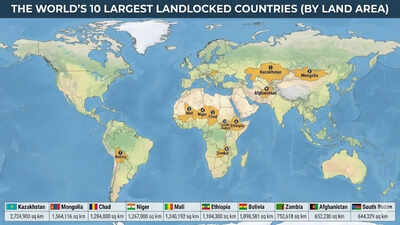
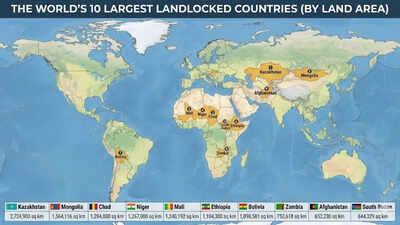
The world identifies countries based on their coastlines or proximity to oceans. But in some cases, countries have no proximity to the ocean at all, and such countries are called landlocked countries. In simpler words, countries with no access to the ocean are termed landlocked countries. There are about 32 landlocked developing countries as listed in the UNCTAD List of Landlocked Developing Countries.These countries play an important role in contributing to economic, cultural, and ecological development, despite not having any access to the ocean at all. Geography plays a vital role in shaping these countries’ economy and international relations. Given below is the list of the ten largest landlocked countries of the world.
World’s largest landlocked countries and what makes them unique
These states form part of those large nations that have no access to the oceans since they are landlocked. This geographical aspect enables the creation of varied landscapes, such as desert and mountain regions, due to their extensive size.
Kazakhstan (2,724,900 sq km)
Kazakhstan is considered the biggest landlocked nation on Earth. It is located in Central Asia and features many different terrains like steppes, deserts, and mountains. Even though Kazakhstan does not have access to any oceans, it borders the Caspian Sea, which contributes to its economy by supporting oil extraction and other industries.
Mongolia (1,564,116 sq km)
Mongolia is the world’s second-largest landlocked nation, located between Russia and China. Mongolia is famous for its extensive grassland and desert areas, such as the Gobi Desert. The nation’s population density is quite low, and it depends on mining and animal husbandry for economic development.
Chad (1,284,000 sq km)
Chad is one of the biggest countries by size that is landlocked in Africa, and it is situated at the central position of Africa. The country has geographical features ranging from deserts in the northern parts of the country to green vegetation in the southern regions.
Niger (1,267,000 sq km)
Niger is yet another landlocked country located in West Africa. Most parts of the country fall under the Sahara desert region, thus being one of the hottest countries on earth. However, despite the unfavourable conditions in the region, the Niger River is instrumental in agricultural development.
Mali (1,240,192 sq km)
The location of Mali is in West Africa. The country has desert covering most of its territory. The river that runs through Mali is called the Niger. Previously, the nation belonged to empires that made use of trade routes in the Sahara region.
Ethiopia (1,104,300 sq km)
Ethiopia is the most populous among the landlocked nations as well as among the oldest countries in Africa. Geography features the Ethiopian Highlands, plateaus and valleys. Although Ethiopia lost its shoreline during the 1990s, it still plays an essential role within the East African economy.
Bolivia (1,098,581 sq km)
Bolivia is one of only two countries in all of South America that do not have a coastline. The country has been without a coastline ever since it participated in the War of the Pacific, which took place in the 19th century.
Zambia (752,618 sq km)
Zambia is found in southern Africa. It is home to many rivers and waterfalls like Victoria Falls. Zambia, which is a landlocked country, owes its transport and hydroelectricity production to the rivers in it.
Afghanistan (652,230 sq km)
Afghanistan is an inland nation located in South-Central Asia. The landscape of Afghanistan consists of mountains and poor infrastructure, which has shaped its connections with neighboring areas.
South Sudan (644,329 sq km)
South Sudan is among the youngest nations in the world, found in East-Central Africa. The nation boasts many swamps and rivers, such as the Nile River, which play a critical role in agricultural production. Even though South Sudan is not near any seacoast, water plays a crucial role in its economy.