


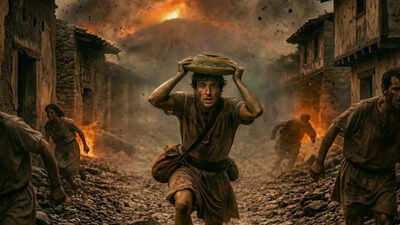
The ancient city of Pompeii has once again drawn global attention after archaeologists used artificial intelligence to reconstruct the face and final moments of a man who died during the AD 79 eruption of Mount Vesuvius.
The image shows a man crouched and shielding himself as volcanic debris falls around him. It is based on skeletal remains found outside the southern gates of the city, near the Porta Stabia area. Researchers say the reconstruction provides a clearer view of how victims may have looked during the final stages of the disaster. The discovery adds another layer to Pompeii’s ongoing archaeological record, which continues to reveal human stories preserved under ash for nearly 2,000 years.
The work was carried out in collaboration with the Pompeii Archaeological Park and academic partners in Italy.
Pompeii victim remains found with personal items near eruption escape pathway
The victim’s remains were discovered outside the city walls, close to the southern exit routes. Archaeologists identified the individual as an adult male who appeared to have been attempting to escape the eruption. The body was found beside a terracotta mortar. Researchers interpret this as an improvised shield used against falling volcanic material.
The man was also carrying several personal items, including an oil lamp, a small iron ring, and ten bronze coins.These objects suggest he was moving quickly and possibly trying to reach safety towards the coastline. The exact circumstances of death are linked to heavy volcanic debris that fell during the second day of the eruption.
Scientists use AI and bones to rebuild the face of a Pompeii eruption victim
The digital reconstruction was created using artificial intelligence combined with archaeological data and skeletal analysis.
The image shows the man bent forward, with an object held over his head for protection. As reported by AP News, the reconstruction was produced by the Pompeii Archaeological Park in cooperation with the University of Padua. It is based on detailed excavation records from areas outside the ancient city walls.Experts involved in the project state that the aim is to translate skeletal data into a realistic human representation.
The visual output reflects damage patterns on bones and surrounding artefacts found at the site. The result is not an artistic interpretation alone. It is grounded in physical evidence recovered during excavation.
AI reshapes how Pompeii’s buried history is studied and visualised
Pompeii remains one of the most studied archaeological sites in the world. The eruption of Mount Vesuvius buried the city in ash, preserving buildings, streets, and human remains in exceptional detail.
Researchers working on the AI project state that large archaeological datasets are becoming difficult to process manually. Artificial intelligence is now being used to assist in analysis and reconstruction work.Officials at the archaeological park have stated that AI may help manage and interpret complex excavation data more efficiently. The technology is also being used to create visual reconstructions for educational and research purposes.
Evidence of attempted escape from the city
The evidence indicates that the person was one of those who attempted to evacuate the city of Pompeii at the time of the eruption. From an archaeological perspective, the death took place near one of the escape paths leading to the sea. The use of protective tools indicates that the people were responding instantly to the falling ash from the volcano. This is indicated by historical records, such as the works of Pliny the Younger, who described how people used personal belongings for protection against the ash during the eruption.