

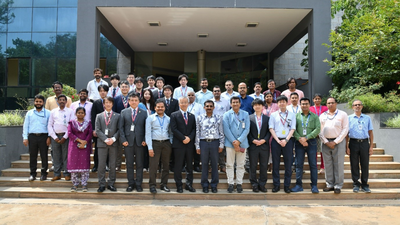
The ISRO team’s visit to Japan to evaluate the launch site preparations for Chandrayaan-5 is another milestone in terms of international cooperation for space exploration, especially between ISRO and the Japanese space agencies. The visit will be primarily aimed at evaluating the preparations of the launch facility, compatibility in technicalities, and joint mission planning for the upcoming Chandrayaan-5 mission. With increasing interest in India-Japan space collaboration, this launch site preparation of the Chandrayaan-5 mission stands out as an example of the impact of such collaborations on lunar exploration and missions.
ISRO-JAXA space cooperation in Chandrayaan-5 mission planning
There has been an increase in the cooperation between ISRO and Japan over the years, which has taken many forms in fields such as satellite technology, earth observations, and lunar exploration. The cooperation that could arise from Chandrayaan-5 would be consistent with the larger trend in the field of science between the two countries. On the Indian Space Research Organisation’s (ISRO) website, it is mentioned that:“ISRO continues to engage with international space agencies for mutual cooperation in space science, exploration and technology development.”This explains why the ISRO team’s visit to Japan can be considered to be part of discussions on launch capabilities for lunar missions.Japan too, through its space agency called JAXA, has encouraged cooperation among nations. It is mentioned on the Japan Aerospace Exploration Agency’s (JAXA) website that:“JAXA promotes international cooperation to advance space science and technology for the benefit of humankind.”It can be seen that there are shared objectives between both countries in this case.
Chandrayaan-5 launch site preparation and technical assessment
According to reports, there have been deliberations concerning the preparation at the launch pad for the Chandrayaan-5 in relation to the evaluation of the launch mechanism, the safety considerations, and the environmental conditions necessary to undertake deep space missions. In spite of the success of the Chandrayaan-3 mission, upcoming missions will need complex payloads and international cooperation.Amongst other factors, it is important to consider the launch vehicle compatibility and the ground support systems. Such technical considerations will ensure that future missions have a greater degree of precision.In the context of the strategic vision of ISRO, it is clear that efforts must be made to enhance the preparedness of India for upcoming missions. This comes within the framework of fostering collaboration between India and Japan in the area of lunar sciences.
India-Japan space collaboration in lunar exploration
There has been an increasing trend of cooperation between India and Japan in satellite missions, earth observation satellites, and space research. The talks about Chandrayaan-5 are an example of this trend continuing even further to explore the moon.There are several advantages of such collaboration, which include shared data, enhanced mission safety, and more economical technological development. There is an evident interest by both organizations to contribute to lunar research through collaboration rather than unilateral approach.The increased collaboration also allows for better capacity development.
Future of Chandrayaan-5 and global space partnerships
Chandrayaan-5’s future is not limited to one mission but embodies India’s greater objective in terms of interplanetary exploration. Apart from getting help from foreign entities like Japan, the Chandrayaan-5 could be equipped with more advanced devices, carry out extensive research on the moon, and improve its landing system.It has been seen that space exploration in the world has started focusing on collaborating with each other, and the collaboration between ISRO and Japan for space cooperation shows us the way forward.