


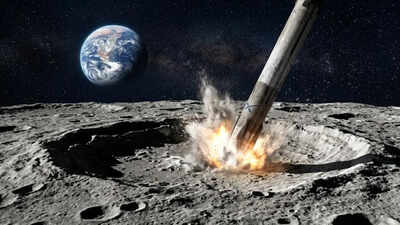
The Falcon 9 rocket will strike the moon on August 5, 2026
The Minor Planet Centre and orbital trackers have identified an object named 2025-010D.
This is actually the second stage of a Falcon 9 rocket that was part of the Blue Ghost Mission 1, launched on January 15, 2025. Once it delivered its payloads towards the Moon, this 13-meter-long stage ended up in a highly elliptical Earth-Moon orbit. The Earth, Moon, and Sun’s gravity played a part in changing its path over time. Eventually, these forces nudged it into a trajectory destined for a crash on the Moon. Based on Project Pluto’s orbital data, this impact is inevitable. This adds yet another piece of human-made hardware to the lunar surface, unintentionally becoming a permanent fixture there.
Scientific analysis of the Einstein crater impact site
The crash is expected near the rim of the Einstein crater, an important impact basin on the Moon’s western side. This spot catches scientific interest because it lies between the Moon’s near and far sides. Since sunlight will brighten this area during the event, scientists aim to use the Lunar Reconnaissance Orbiter (LRO) for detailed images of the new crater made by the rocket. These observations help planetary experts gauge lunar soil depth and study ejecta patterns, offering insights typically obtained through costly, planned impact missions.
IADC guidelines and the future of lunar environment protection
The upcoming impact reveals a major issue in cislunar space traffic management about what to do with rocket stages left in deep space or around the Moon. Unlike satellites that orbit close to Earth and are made to fall back and burn up, equipment sent toward the Moon often ends up in unpredictable ‘graveyard’ orbits. The Inter-Agency Space Debris Coordination Committee (IADC) suggests these stages should be disposed of in heliocentric orbits to prevent crashes. Yet, as more missions head to the Moon, incidents like this Falcon 9 crash highlight the urgent need for better end-of-life rules. These would help safeguard the lunar environment for future missions.