


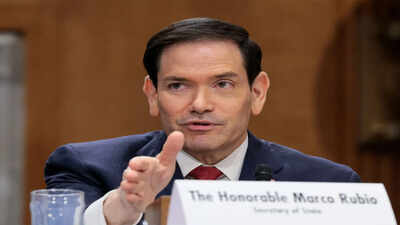
US: Rubio says Iran nuclear talks ‘highly technical’, may take months
US secretary of state Marco Rubio on Tuesday defended Washington’s military posture toward Iran, arguing that Tehran had been attempting to build up conventional weapons capabilities as a “shield” to protect its nuclear programme.Speaking before the US Senate Foreign Relations Committee, Rubio said Iran’s military capabilities had been significantly weakened following recent US military actions and suggested that its conventional forces were no longer a credible deterrent.“What they tried to do is they were going to try to build a conventional shield and hide behind that conventional shield,” Rubio told lawmakers.He further claimed that Iran’s naval strength had been severely degraded.
“What’s left of Iran’s navy is a ‘bunch of Boston Whalers with machine guns on them,’” he said.
Rubio added that US operations had also damaged Iran’s broader military infrastructure, including its drone programme, though he acknowledged that low-cost drone technology continues to pose a global security challenge.“This is a pervasive problem around the world. The economics of it are something we have to solve for,” he said, adding that Iran’s drone-building capability had been “eroded.”
He reiterated that Iran’s so-called “conventional shield” had been “substantially eroded” following recent strikes.Rubio’s remarks come amid continued tensions between Washington and Tehran and ongoing debate in the US Congress over the scope and cost of American military engagement in the region.
Nuclear talks to be ‘highly technical’
Rubio further said negotiations over Iran’s nuclear programme would be “highly technical” in nature and could take several months to conclude.Testifying before the US Senate, Rubio said the next phase of discussions would depend on Iran taking specific steps, including reopening the Strait of Hormuz under agreed conditions and addressing the status of its highly enriched uranium stockpile.“Phase 2 is they have to commit to very specific negotiations. On the disposition of the highly enriched uranium that still is buried deep in a mountain somewhere… They have to agree on negotiating severe and long-term limitations and/or cancellation of enrichment activity in their country,” Rubio told lawmakers.He added that the complexity of the issues meant the process could not be resolved quickly. “Obviously, these are highly technical matters, so I don’t think you could work those out in five days. That would require a team of experts to meet over a 30-, 60-, 90-day period and work out the details, but they have to commit to their willingness to do that,” he added.
Strait of Hormuz at the centre of negotiations
Rubio said Iran would first need to ensure the Strait of Hormuz is open for international shipping under agreed conditions.He said Tehran must declare the waterway open, ensure it remains free of tolls, and take steps such as removing naval mines and refraining from targeting commercial vessels.“Reopening the straits means the following: ships can sail through international waters the way they can through other chokepoints around the world without being fired upon, without paying a toll,” he told senators.He also clarified that the United States has not offered sanctions relief in exchange for reopening the strait.
Any easing of sanctions, he said, would remain strictly conditional.“Any sanctions relief is condition-based, which means it has to be in return for the reason why those sanctions were put in place in the first place, which is their nuclear program,” Rubio said.
Economic pressure and blockade claims
The US secretary of state further said that restrictions on Iranian ports were causing significant economic losses. He claimed the US blockade of Iranian ports was costing Tehran “hundreds of millions” of dollars in lost revenue each day.Rubio also said Iran still retains a large number of drones, but argued that their effectiveness is increasingly limited.
Iran leadership and internal situation
Responding to questions on Iran’s leadership, Rubio said there were indications that Supreme Leader Ayatollah Mojtaba Khamenei was becoming more active in decision-making after being injured earlier in the conflict.“We haven’t seen him publicly, and I would imagine, given what’s happened to multiple leaders in that system, being very public is probably not something that’s recommended for them internally,” Rubio told lawmakers.“But that said, I think there are indications out there that he is increasingly engaging at some level, although all of his communications have been in writing and through intermediaries.”The comments come amid speculation over the status of Khamenei, who has not been seen in public since sustaining serious injuries on February 28, raising questions about his health and role within Iran’s leadership structure.
US policy on Taiwan unchanged
Rubio also used his testimony to reaffirm US policy on Taiwan, saying there had been no change in Washington’s position. “The most important thing to understand is we want to see the status quo preserved as-is at this moment. That’s our policy,” he said.“It’s a very, as you know, a very delicate relationship to balance. But our policy on Taiwan is not changing,” he added.His remarks came amid concerns in Taipei following recent US-China diplomatic engagements.
Why is Rubio testifying
The hearing also took place as the Trump administration seeks congressional approval for significant changes in federal spending. Lawmakers are reviewing a proposed 30% cut to the foreign affairs budget alongside a 50% increase in military spending, Reuters reported.Rubio is expected to testify over two days on the State Department’s budget request.Earlier proposals from President Donald Trump included a 10% cut in non-defence spending for the 2027 fiscal year and a major increase in defence allocation to $1.5 trillion, including pay raises for military personnel.The plan also proposes cuts across several federal agencies, including reductions for agriculture, health, and environmental programmes, the outlet reported.The final budget will require congressional approval, where disagreements over spending priorities have previously led to government shutdowns.