

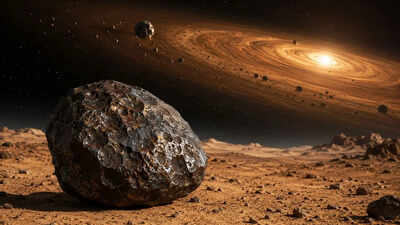
A meteorite picked up from the sands of the Sahara has begun to complicate the quiet assumptions scientists often make about the early solar system. It is not the sort of object that draws attention at first glance, just a dark fragment of rock with odd mineral flecks caught under a microscope.
Yet inside it sits chemistry that does not quite sit comfortably with what is known about how rocky planets usually come together. The sample, labelled NWA 12774, has been dated back to the earliest days of planetary formation, when the Sun itself was still surrounded by debris and half-formed worlds. What stands out is not its age but what it seems to imply: that something larger, long gone, may have once existed and later been torn apart.
The idea is not settled, but it has not been dismissed either.
Why the NWA 12774 angrite meteorite stands out among the oldest volcanic rocks in the solar system
As reported in the study published in ScienceDirect, titled ‘High-pressure clinopyroxene in Northwest Africa 12774 and new geobarometric evidence for a planetary embryo-sized angrite parent body’, NWA 12774 belongs to a rare group of meteorites known as angrites, fragments that come from some of the oldest volcanic material ever found. They are scattered through museum drawers and research collections in very small numbers, and most have been studied only in passing because they are so scarce.
This particular specimen, found in 2019, looks unremarkable until it is placed under cross-polarised light. Then the internal structure begins to show unusual mineral patterns, including crystals that do not match the expected chemistry of typical early asteroids. It is not just composition that raises questions, but how those minerals appear to have formed under conditions of extreme pressure.
New findings challenge what scientists thought about small asteroid formation
Within the rock, scientists identified clinopyroxene crystals unusually rich in aluminium.
That detail matters because it points to formation under pressures far higher than what a small asteroid could generate.The estimate lands at around 17.5 kilobars, a figure that sounds abstract until it is compared with familiar extremes on Earth. It exceeds the pressure at the bottom of the Mariana Trench by a wide margin. That level of force would normally be associated with much larger planetary bodies, not small scattered fragments drifting through space.As Bell, one of the researchers involved in the study, put it: “The materials that formed the angrite parent body are fundamentally different from the ingredients of Earth and Mars,” Bell said in a statement. “These meteorites preserved evidence of a completely different pathway through which early planets developed.”
How pressure clues point to a moon-sized parent body
What follows from that pressure reading is the uncomfortable suggestion that the parent body of NWA 12774 may have been far bigger than previously assumed.
Instead of a small asteroid, the conditions point towards something closer in scale to a planetary embryo, possibly even approaching lunar size.The same crystals that hint at deep pressure also appear strangely well-preserved, with sharp edges that would normally soften if they had spent long periods buried deep inside a molten interior. That detail pushes the interpretation in another direction. It suggests formation at relatively shallow depths, which only makes sense if the object itself was large enough to generate internal pressure without completely melting its structure.Under those assumptions, the lost body could have reached a radius of more than 1,000 miles. Not a full planet by modern standards, but large enough to sit awkwardly between asteroid and world.“It’s incredible to think there was once a world this large,” Bell said in the statement. “We only know it existed because a few fragments of it happened to land on Earth.”
The problem of overlooked fragments in meteorite collections
Part of what makes NWA 12774 awkward to interpret is not just what it shows, but what it suggests might still be overlooked.
Angrites are rare, and only a handful of known samples exist among tens of thousands of meteorites collected worldwide.That imbalance leaves room for uncertainty. If one fragment can point towards a missing planetary body, others might quietly sit in storage collections without having been examined in the same way. It is not a dramatic claim, just a practical one about how much material has not been fully re-analysed.There is also the broader point that early planetary formation was not a clean sequence of stable steps. It was messy, with bodies forming, colliding, cooling, and breaking apart in cycles that are still only partly reconstructed. NWA 12774 fits into that unfinished picture without fully resolving it.
What remains unresolved
The meteorite does not offer a complete narrative. It does not point to a clearly defined lost planet or a final explanation of how it disappeared. Instead it adds another layer of uncertainty to a period that is already poorly preserved in physical evidence.For now, it sits as a small fragment with an oversized implication, waiting for comparison with other samples that may or may not exist in plain sight.