


By: Anushka Verma
Updated: November 1, 2025
Adobe, the software powerhouse that has shaped the creative industry for decades, is entering a transformative new chapter. With its latest unveiling of agentic AI, Adobe is redefining what it means to create. No longer are tools limited to simple command-response interactions; they now understand context, intent, and creativity.
This evolution—driven by Project Moonlight and intelligent assistants built directly into apps like Photoshop, Express, and Premiere Pro—signals a powerful shift toward what Adobe calls “collaborative creativity.” The company envisions a world where creators talk to their tools, brainstorm ideas conversationally, and watch intelligent assistants turn imagination into reality—without losing control over their craft.
Adobe’s newest generation of agentic AI assistants aims to do what no other creative platform has achieved: unite conversation, creativity, and control under one ecosystem. It’s an AI that doesn’t just generate—it thinks with you.
The Vision Behind Agentic AI
At the heart of this innovation is Adobe’s belief that creativity is not just about producing beautiful content—it’s about managing the entire journey from concept to publication.
Ely Greenfield, Chief Technology Officer and Senior Vice President of Creative Products at Adobe, recently stated that conversational interfaces are reshaping the creative landscape. “Creating content isn’t just about making something beautiful—it’s about managing the whole process,” he explained. “Our goal is to build AI that amplifies creativity rather than automates it.”
The term “agentic AI” captures this philosophy perfectly. Unlike traditional AI models that execute isolated prompts, agentic AI understands goals, remembers user context, and adapts to evolving creative directions. It serves as a digital teammate—capable of performing tasks, anticipating needs, and collaborating seamlessly across apps and platforms.
In short, Adobe’s vision is not to replace the artist but to augment them. This philosophy positions the company at the center of a new creative era—one that merges human emotion with machine precision.
From Prompt to Partnership: How Agentic AI Works
Imagine designing a product poster in Photoshop. Instead of manually adjusting layers, fonts, and colors, you simply say:
“Create a minimalist layout with a white background and soft shadows, similar to my last design.”
Within seconds, the AI assistant interprets the intent, pulls from your previous projects, and constructs a layout matching your aesthetic. You can then ask:
“Make the logo slightly larger and move it 10 pixels to the right.”
The assistant does so instantly—without requiring you to navigate menus or adjust parameters manually.
This is not an ordinary chatbot interaction. Agentic AI understands your creative history, brand palette, design tone, and even preferred typography styles.
Adobe is building a system that remembers your personal workflow and connects that intelligence across its entire Creative Cloud ecosystem. Whether you start a project in Express and finish it in Photoshop or switch to Premiere to make a video version—the AI will carry your context with it.
Photoshop and Express: Where It Begins
Two of Adobe’s most widely used creative platforms—Photoshop and Express—are the first to experience the transformative power of agentic AI.
In Adobe Express, which is currently in public beta, users can now describe what they want to create through simple natural language prompts. For instance:
“Design an Instagram post for a Diwali sale using my brand colors.”
The AI instantly generates multiple templates that reflect your brand style. You can refine the output further—changing the text, color tones, or imagery—without restarting the entire process.
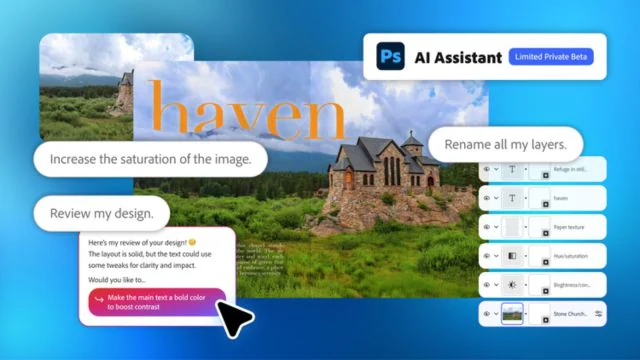
Meanwhile, the Photoshop AI Assistant—in private beta—enables professionals to have real-time conversations with the AI. You can ask it to generate new assets, guide you through complex workflows, or make intricate edits.
For designers and editors, this means less time spent on repetitive actions and more time focusing on creative decisions. Instead of navigating layers, menus, and adjustment panels, creators can talk directly to Photoshop—and watch it understand.
This shift from mechanical operation to conversational creation could change how millions of designers work daily.
Project Moonlight: The Personal Orchestration Assistant
At the center of Adobe’s new ecosystem lies Project Moonlight, its most ambitious AI initiative yet. Described internally as a “personal orchestration assistant,” Moonlight bridges all Adobe apps—Photoshop, Express, Premiere, Lightroom, and more—into a single, intelligent network.
Think of it as the conductor of Adobe’s creative orchestra. Each application remains an expert in its field—Photoshop for imagery, Premiere for video, Illustrator for vector design—but Moonlight ensures that all of them speak to each other.
Moonlight’s context-aware intelligence allows it to understand not only what you are creating but why you are creating it. It learns your tone, creative preferences, and even the platforms where your content performs best.
For example, a fashion designer working across social media campaigns could ask Moonlight to:
“Generate a short promo video based on my latest product photos and optimize it for Instagram and YouTube.”
Moonlight would then coordinate Photoshop (for visual assets), Premiere (for video editing), and Express (for final publishing) — all through one conversational thread.
This integration is where Adobe’s vision truly shines. Creativity becomes fluid—no longer constrained by app boundaries.

AI That Understands You
Adobe’s new AI systems are not limited to responding—they learn. By analyzing your past projects, style patterns, and performance metrics, the system builds an internal model of your preferences.
This “creative memory” allows the AI to make smarter recommendations over time. It may suggest color palettes that match your brand, typography that fits your tone, or even layout adjustments based on prior success analytics.
Greenfield describes it as “AI that grows with you.” Instead of static presets, creators get evolving partners that refine themselves through each collaboration.
This evolution transforms AI from a reactive engine to an intuitive, proactive companion.
Beyond Chatbots: True Conversational Intelligence
Adobe emphasizes that these assistants are not chatbots. Unlike simple text-based AI systems that provide predefined answers, Adobe’s assistants possess contextual depth.
They recognize visual, textual, and creative cues simultaneously. For instance, if you tell the Photoshop Assistant, “Enhance the brightness around the subject,” it doesn’t just apply a blanket filter. It isolates the subject, preserves tone balance, and refines contrast intelligently.
This capability, according to Adobe engineers, represents the next step in “multimodal reasoning”—where AI interprets language and visuals together.
As creators switch between manual editing and AI-driven adjustments, the system ensures perfect coherence. You can command, converse, or directly manipulate the canvas—and the AI keeps track of every detail.
It’s like having a human assistant who not only listens but truly understands the language of creativity.
The Economic Power of Agentic AI
Adobe’s integration of agentic AI is not just a creative milestone—it’s a massive economic move. Analysts estimate that the new AI-driven Creative Cloud ecosystem could add over $20 billion in cumulative market value over the next five years.
By embedding AI assistants within the core workflow, Adobe ensures that users remain within its ecosystem longer, reducing churn while expanding monetization through personalized subscription tiers.
Moreover, by democratizing advanced design capabilities, Adobe is opening doors for small businesses, marketers, and independent creators who previously lacked professional design experience.
Now, a small startup owner can generate brand visuals, edit promotional videos, and publish marketing content—all through a few conversations with Adobe’s AI tools.
This inclusivity widens Adobe’s audience and cements its dominance in the growing creative economy.
Extending Creativity Beyond Creative Cloud
One of Adobe’s most visionary moves is expanding its agentic AI beyond its desktop suite. In the near future, users will be able to start creative projects directly from popular chatbot platforms or messaging apps.
For example, you could open a chat window, type:
“Create a wedding invitation in pastel tones with floral design,”
and the system would generate the artwork instantly. You could then fine-tune it conversationally, before exporting it to Adobe Express for final touches.
This level of integration ensures that creativity never feels restricted to specific software or devices. You can ideate on your phone, refine on your tablet, and finalize on your desktop—without breaking the creative thread.
Ethics, Control, and Human Agency
While agentic AI offers immense potential, Adobe is equally focused on maintaining ethical boundaries and user control.
The company has repeatedly emphasized that creators remain “in the driver’s seat.” AI acts as a facilitator, not a substitute. Every edit, generation, or recommendation can be reviewed, modified, or rejected by the user.
This transparency builds trust—something that has been missing from many AI ecosystems. Adobe’s Content Credentials initiative, which tags AI-generated content with digital origin data, continues to ensure accountability and authenticity.
By merging ethics with innovation, Adobe sets a standard for responsible AI adoption in the creative world.
The Road Ahead: The Hybrid Era of Creation
As we look toward the next decade, one thing becomes clear: creativity will no longer be a solo act. It will be a partnership—between human imagination and machine intelligence.
Adobe’s agentic AI is not the end of human creativity; it’s the next stage of it. By making tools more conversational, intuitive, and adaptive, Adobe is freeing creators from the friction of software complexity.
In a world where content production is accelerating faster than ever, this harmony between conversation and creation could redefine productivity for millions of professionals.
The question is no longer “Can AI create?” It’s “Can AI create with you?”
Adobe’s answer, through Project Moonlight and its expanding AI assistant family, is a resounding yes.
Final Thoughts: Creativity, Reimagined
Adobe’s $20B agentic AI revolution represents more than just technological progress—it embodies a philosophical shift. Creativity is no longer about tools; it’s about experiences. It’s about enabling every individual—from seasoned designer to first-time user—to turn imagination into impact.
By integrating intelligence that listens, learns, and collaborates, Adobe has blurred the line between human and machine creativity.
The company’s vision—AI as a creative teammate, not a creative replacement—sets a new global standard. Whether you’re crafting a cinematic poster, editing a music video, or designing social media visuals, Adobe’s agentic AI ensures that your tools understand your intent, your voice, and your story.
As Ely Greenfield perfectly puts it,
“Our vision for agentic AI is about building capable teammates that work with you—so you can stay focused on your ideas, not the process.”
And in that single sentence lies the future of creativity: human imagination, amplified by intelligent collaboration.


