



by Anushka Verma | Updated : 15 November 2025
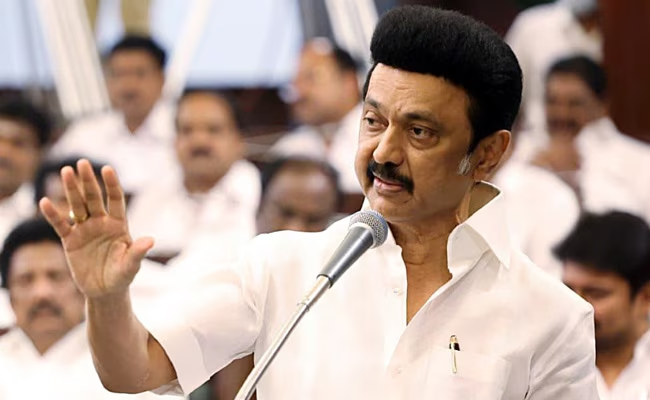
The political atmosphere across India has once again been electrified by the results of the Bihar Assembly Elections 2025. And amid the buzz, reactions, and instant analyses, one voice from the South has emerged with exceptional sharpness and clarity — that of Tamil Nadu Chief Minister M. K. Stalin. His post-election statement, released just hours after the INDIA bloc’s defeat in Bihar, was not just a comment; it was a coded message, a diagnosis, and a roadmap for political reality in India today.
This comprehensive analysis explores the deeper layers of Stalin’s remarks, the underlying message to the Congress, and what Bihar’s verdict reveals about India’s shifting political landscape. Written from the lens of a political analyst with five years of newsroom experience, this article breaks down the story behind the story — the real message hidden between the lines.
A Defeat That Echoed Across the Opposition
The Bihar verdict wasn’t just about the NDA’s numerical victory; it was a psychological setback for the INDIA bloc, which had hoped to use Bihar as a foundation for momentum ahead of their 2026 electoral calendar. Instead, the results exposed gaps — in communication, coordination, ground strategy, and narrative ownership.
Congress, contesting 61 seats, was reduced to a shocking six wins, the lowest in the party’s history in Bihar. For a party already battling a crisis of identity and direction, the numbers stung sharply.
And that is where Stalin stepped in.
Stalin’s Statement: Diplomatic Outside, Surgical Inside
His congratulatory message for Nitish Kumar was courteous, but the subtext carried a subtle but unmistakable warning to the Congress:
“Election outcomes reflect welfare delivery, social and ideological coalitions, clear political messaging and dedicated management until the last vote is polled.”
To many observers in Chennai and Delhi, this was not merely analysis — it was advice delivered diplomatically, targeted directly at the Congress leadership.
Stalin congratulated Nitish Kumar for his “decisive victory”, and praised Tejashwi Yadav for his “tireless campaign” — but the weight of his message was directed elsewhere.
Why Stalin’s Words Matter More Than Ever
Stalin is not just another politician commenting on elections. As a senior architect of the INDIA bloc and one of the most influential regional leaders, his assessment carries weight. The DMK has long understood the value of welfare, grassroots communication, and ideological clarity — tools that have consistently delivered electoral success in Tamil Nadu.
By highlighting these elements, Stalin was subtly asking:
- Why did Congress’s messaging fail?
- Why was organisational presence so weak?
- Why was coalition discipline missing?
- Why did welfare credibility not translate into votes?
It was a reminder that elections in India are no longer won by slogans crafted in Delhi; they are won by credibility built on the ground.
THE CORE MESSAGE: CLARITY IS THE NEW CURRENCY OF INDIAN POLITICS
In a political era where voters are overwhelmed by noise, clarity has become a premium currency. Confusing signals, fractured messaging, and contradictory statements weaken voter trust. And in Bihar, this lack of coherent narrative cost the INDIA bloc and particularly the Congress dearly.
Stalin’s emphasis on “clear political messaging” wasn’t random. It addressed Congress’s long-standing issue: the gap between what it says and what people hear.
The Congress campaign in Bihar was riddled with:
- Uncoordinated statements
- Mixed ideological signals
- Over-dependence on central leaders
- Weak district-level communication
In contrast, the NDA kept its messaging simple, repetitive, and targeted. Clarity beats cleverness — and voters rewarded the side that communicated with precision.
WELFARE DELIVERY: STALIN’S POLITICAL DNA AND BIHAR’S NEW REALITY
Stalin’s remark about “welfare delivery” was rooted in his own governance experience in Tamil Nadu, where:
- Women-centric cash support
- Free bus travel
- Public health schemes
- Subsidised food
- Education support
have created a deeply rooted welfare ecosystem.
For Stalin, welfare is not an election tool — it is political grammar. And he was subtly reminding the Congress that welfare is not about announcements; it is about implementation, consistency, and impact.
In Bihar, the INDIA bloc attempted to project welfare narratives but lacked:
- Evidence on the ground
- Organisational follow-through
- Personal credibility among voters
Meanwhile, Nitish Kumar’s welfare track record — particularly in health, education, and women’s empowerment — continues to anchor his political relevance even after two decades.
THE ELECTION COMMISSION CONTROVERSY: STALIN’S SHARPEST ATTACK
Stalin didn’t hold back on targeting the Election Commission either. His words were blunt, alarming, and politically loaded:
“The result does not whitewash the misdeeds and reckless actions of the Election Commission.”
This was not a casual allegation. It was a strategic post-election positioning to ensure that questions regarding institutional bias remain alive in public discourse.
Stalin accused the EC of misconduct and claimed its reputation was “at its lowest point”. By doing so, he reinforced a narrative that regional parties have long hinted at — that democratic institutions must remain neutral if the credibility of elections is to be preserved.
This criticism also subtly united the Opposition around a shared concern, even amid electoral disappointment.
CONGRESS’S BIGGEST WEAKNESS EXPOSED: ORGANISATION
The Bihar results exposed something experts have been saying for years: Congress lacks organisation on the ground.
While Tejashwi Yadav fought vigorously, conducted rallies, walked streets, and mobilised cadres, the Congress suffered from:
- Weak booth management
- Poor ground presence
- Amateur campaign execution
- Minimal district-level leadership
- Over-reliance on coalition partners
Stalin’s message about “dedicated management until the last vote is polled” was a coded reference to Congress’s structural weakness.
THE INDIA BLOC’S FUTURE: UNITED IN THEORY, FRACTURED IN PRACTICE
Stalin’s statement also hinted at the internal contradictions of the INDIA bloc:
- Ideological diversity without ideological clarity
- National ambitions clashing with regional interests
- No unified communication strategy
- Inconsistent positioning against the NDA
- Lack of executive leadership
The Bihar loss, Stalin suggested, should serve as “a lesson for everyone.”
But the lesson is not about losing an election — it is about learning that unity without clarity is meaningless.

NITISH KUMAR’S ROLE: EXPERIENCE STILL MATTERS
Nitish Kumar’s victory showcased something Indian politics often forgets: experience, credibility, and consistency still matter.
Despite political switches and alliances, Nitish remains:
- A known quantity
- A governance-focused leader
- A champion of policy continuity
- A figure acceptable across caste segments
Stalin’s congratulatory tone acknowledged this. Nitish did not win because of rhetoric; he won because of work.
TEJASHWI YADAV: THE FIGHT WAS REAL, BUT NOT ENOUGH
Stalin praised Tejashwi Yadav’s “tireless campaign”. And indeed, Tejashwi was the most energetic campaigner in Bihar across parties. His rallies were huge, his messaging was sharp, and his youth appeal was undeniable.
But he faced three obstacles:
- Organisational weakness of allies
- Limited resources compared to NDA
- Fragmented caste equations
Stalin’s applause for Tejashwi was genuine — but also an indirect admission that Tejashwi fought primarily alone.
BIHAR’S VOTER BEHAVIOR: A SHIFT TOWARD GOVERNANCE-BASED DECISIONS
The results reflect a shift in Bihar’s political mood. Voters are increasingly:
- Choosing stability
- Prioritising welfare schemes
- Rewarding proven administrators
- Rejecting confusing alliances
This is why Stalin stressed “welfare-driven credibility” — a phrase loaded with political meaning.
THE SOUTH’S MESSAGE TO THE NORTH: POLITICS HAS EVOLVED
Stalin’s voice also reflects the growing confidence of southern regional parties in shaping national narratives. DMK’s electoral success in Tamil Nadu gives Stalin the credibility to lecture the Congress on strategy — and his message is simple:
- Welfare wins
- Clarity wins
- Groundwork wins
- Discipline wins
The north can learn from the south — this is the underlying message.
2026 Elections: A Warning Bell
The INDIA bloc’s struggles in Bihar foreshadow challenges for 2026. Unless the alliance:
- Fixes leadership issues
- Strengthens communication
- Builds organisational infrastructure
- Establishes ideological clarity
It risks repeating the same mistakes.
CONCLUSION: THE REAL PRICE OF VICTORY
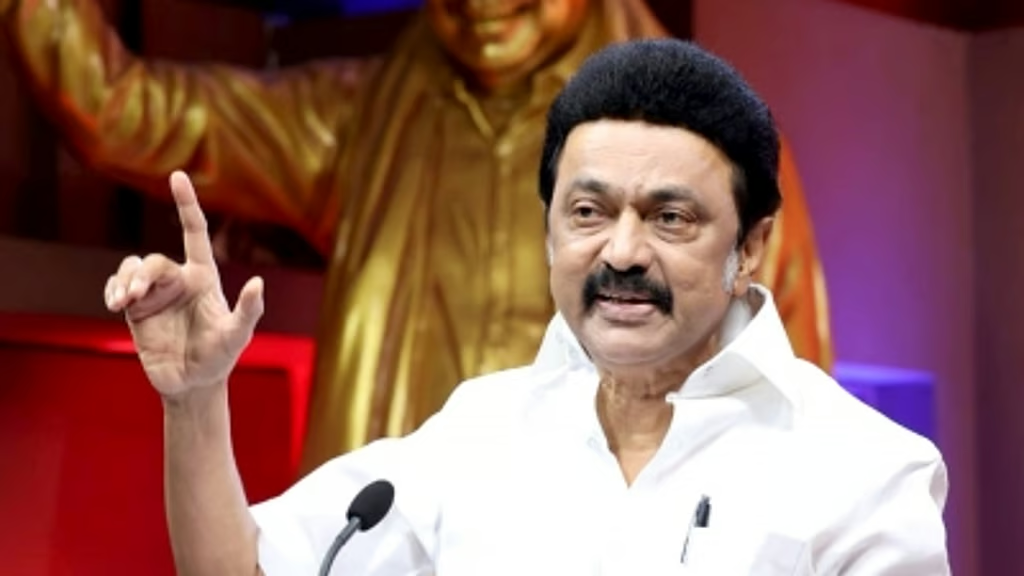
Stalin’s message on Bihar was not an analysis — it was a warning. A political truth. A reminder that elections are not won by slogans but by systems.
And the price of winning elections is not rhetoric; it is:
- Clarity of message
- Credibility of welfare
- Consistency of ground effort
- Cohesion within alliances
- Confidence in democratic institutions
This election was a defeat for the INDIA bloc, but also an opportunity — if they choose to learn.
The verdict is clear:
In modern Indian politics, the winners are those who stay rooted, communicate clearly, and work relentlessly.
And that was the real price Stalin wanted the Congress to understand.