



By Anushka Verma | Updated: November 3, 2025
Summary Table
| Key Detail | Information |
|---|---|
| Company | Amazon |
| Layoffs Announced | 14,000 employees globally |
| Reason | Corporate restructuring & AI-driven automation |
| Impact in India | Around 1,000 employees affected |
| AI Adoption Areas | Warehousing, logistics, customer support, marketing automation |
| Industry Trend | Big Tech firms globally reducing workforce due to AI integration |
| Date Announced | Late October 2025 |
| Future Outlook | Increased reliance on generative AI and robotics across Amazon operations |
Introduction: A turning point for the digital workforce
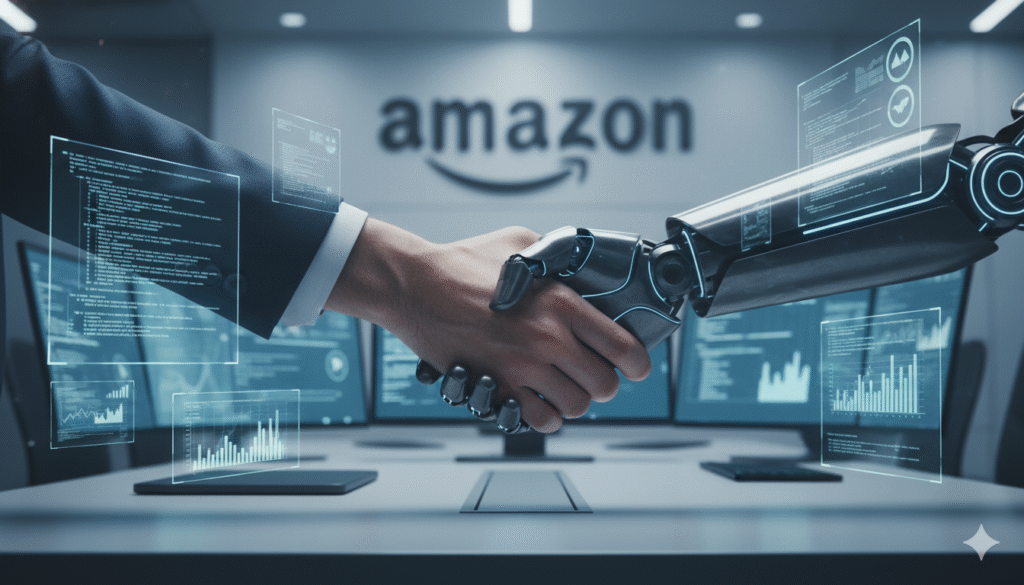
Amazon’s latest decision to lay off 14,000 employees worldwide — including about 1,000 in India — has once again ignited global debate over the growing influence of artificial intelligence (AI) in shaping the future of human employment.
While the company describes this move as part of a “strategic restructuring,” internal sources and analysts reveal that AI and automation now lie at the heart of Amazon’s operational realignment. The very tools designed to enhance efficiency are increasingly replacing the very people who once built and ran those systems.
This marks not just another round of corporate downsizing but a critical inflection point — a moment where the boundaries between human intelligence and machine capabilities are being redefined.
The Amazon layoffs: A closer look
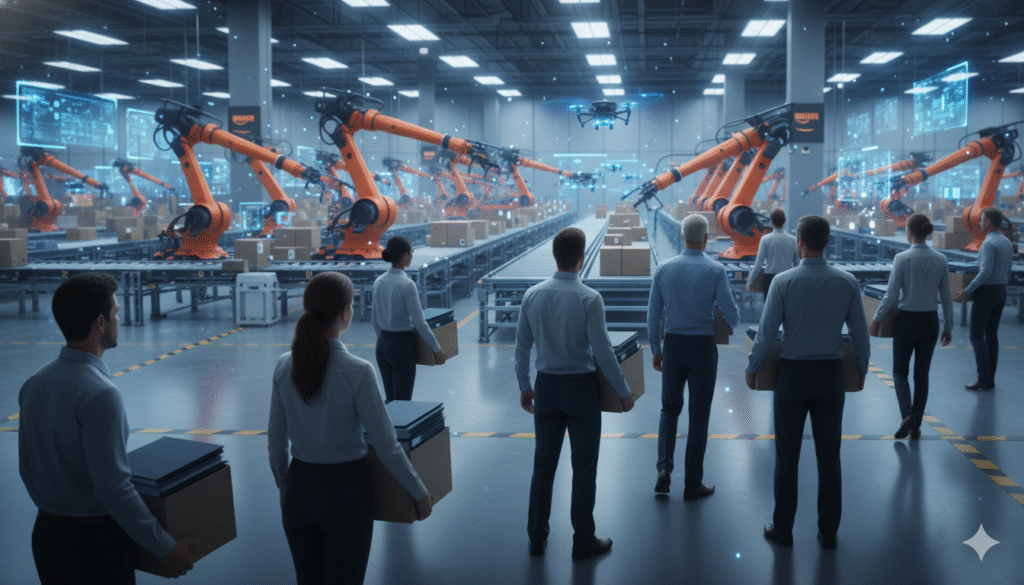
According to company insiders, the layoffs are primarily focused on corporate divisions, logistics teams, and certain customer support operations. The company’s new internal automation systems — built using large language models and predictive analytics — are taking over repetitive and data-heavy tasks at unprecedented speed.
Amazon has been aggressively investing in AI over the past few years. From its Alexa voice assistant to AI-driven delivery networks, and more recently, automated inventory management, the e-commerce giant has been positioning AI at the center of its global strategy.
However, as technology advanced, the overlap between human roles and machine functions became evident — leading to what experts call “AI displacement”, where machines don’t just assist humans but begin to outperform them in cost, speed, and precision.
The AI effect: How technology is reshaping jobs
Artificial Intelligence was once seen as a supportive tool — something that could help workers complete tasks faster. But with the rise of generative AI, machine learning, and robotic process automation (RPA), its capabilities have grown exponentially.
Today, AI systems can:
- Generate marketing campaigns autonomously
- Analyze customer data for targeted sales
- Write and optimize product descriptions
- Handle 24/7 chatbot support
- Predict inventory shortages before they occur
These technologies directly impact thousands of roles in content moderation, customer service, supply chain management, and data entry — roles that have long employed millions globally.
For Amazon, which operates across dozens of countries and manages hundreds of millions of customer interactions daily, AI-based systems offer not just speed but scalability without fatigue — something no human team can match.
India’s position: Between opportunity and vulnerability
India, one of Amazon’s largest international markets and a major operational hub, finds itself in a delicate position. Approximately 1,000 Indian employees are expected to be affected in this round of layoffs, mostly from tech support, logistics analytics, and content management teams.
While Amazon continues to expand its physical presence in India through new warehouses and local delivery services, its back-end operations are undergoing a quiet revolution.
Several employees from the Hyderabad and Bengaluru offices have shared concerns about being replaced by AI-driven workflow systems that handle previously manual processes such as catalog management, product listing optimization, and data cleansing.
However, India’s growing AI talent pool also opens up opportunities. The government’s Digital India and AI Mission 2030 initiatives are aimed at re-skilling workers for the AI age.
Industry experts believe that while traditional roles may shrink, AI-centric job creation — in fields like prompt engineering, data training, model evaluation, and AI maintenance — could balance the employment equation in the long run.
Corporate restructuring or AI-driven evolution?
Amazon’s official statement described the layoffs as part of a “broader cost optimization effort”. But internal reports suggest that a significant portion of the affected roles have been rendered redundant by automation.
For instance:
- Chatbots powered by Amazon Bedrock AI have replaced hundreds of customer service roles.
- Predictive warehouse management algorithms now perform human planning tasks more efficiently.
- AI-driven marketing tools handle ad placements and performance tracking that used to require entire digital teams.
These changes, while improving profit margins, also raise ethical questions about how fast companies should automate and what safety nets should exist for displaced employees.
AI adoption across industries: The domino effect
Amazon is not alone. Over the past year, several major tech companies — including Google, Meta, and IBM — have restructured their workforces, attributing many of these changes to advances in AI integration.
A report by PwC suggests that by 2030, up to 30% of jobs worldwide could be automated. While some roles will evolve rather than vanish, others may disappear entirely, particularly in data processing, administration, and customer interaction sectors.
In India, automation is already visible in:
- Banking – Chatbots replacing human query desks.
- Retail – AI analyzing customer behavior for recommendations.
- Healthcare – Diagnostic AI models reducing manual paperwork.
- Education – Adaptive learning systems replacing human evaluators.
This trend reflects a broader shift from labor-intensive operations to algorithm-driven ecosystems, reshaping employment landscapes across industries.
Voices from the inside: Workers react
Many current and former Amazon employees have expressed deep concern about the future of their careers. In online forums and employee networks, sentiments range from frustration to resignation.
One Hyderabad-based operations analyst, speaking anonymously, said:
“We were training the AI tools to make our jobs easier, but eventually those tools started doing everything themselves. It’s ironic — we built what replaced us.”
Others, however, acknowledge that this change was inevitable. A data scientist from Bengaluru remarked:
“The company is transforming. AI is not the enemy — it’s just evolving faster than we expected. The challenge is keeping up.”
The emotional and psychological impact of AI-driven layoffs is also becoming a major HR concern. Corporate psychologists warn of rising “automation anxiety” — a growing fear among employees that their contributions will soon be deemed obsolete.
Economic implications: Efficiency vs employment
From a business perspective, Amazon’s move is economically rational. Automation promises higher accuracy, lower error margins, and consistent performance — all crucial for a company managing billions in global transactions.
But the social cost cannot be ignored. Layoffs affect not only individuals but also families, local economies, and entire professional ecosystems.
Economists argue that while AI improves productivity metrics, it risks widening the income inequality gap — rewarding high-skill AI experts while displacing middle-income workers.
In India, where youth unemployment remains a pressing challenge, such layoffs could intensify job insecurity unless matched by aggressive re-skilling programs and public-private collaborations in digital education.
Expert opinions: Is AI a job killer or job creator?
The debate around AI and employment is complex.
According to Dr. Ritu Bansal, a labor economist at Delhi School of Economics:
“Every industrial revolution has displaced some jobs but created others. The AI wave will be similar — the difference is speed. The pace of change today is far faster than our re-skilling systems can handle.”
Meanwhile, Rajiv Mehta, founder of a tech consultancy firm, believes companies must adopt responsible automation:
“AI should augment human decision-making, not replace it entirely. The smartest companies will keep humans in the loop — especially in roles requiring empathy, ethics, and creative judgment.”
This sentiment echoes the “human-AI collaboration model” — where machines handle mechanical work, and humans focus on creativity, leadership, and innovation. But whether corporations will adopt such balance remains uncertain.
A deeper look at Amazon’s AI ecosystem
To understand Amazon’s transformation, one must look at the AI infrastructure that now powers its ecosystem:
- Amazon Bedrock & Titan Models – Generative AI foundation models used for customer communication and marketing.
- AWS AI Services – Cloud-based automation tools driving logistics and analytics.
- Amazon Robotics – Warehouse robots capable of managing shelves, picking, and packaging.
- AI-powered Advertising – Machine learning algorithms optimizing global ad campaigns.
- Predictive Maintenance – AI monitoring supply chain and machinery health to prevent downtime.
Together, these technologies not only enhance Amazon’s operational capabilities but also reduce dependency on human labor — creating a long-term efficiency curve but short-term human displacement.
Government and policy response
The Indian government, while expressing concern over AI-driven job shifts, sees this as a call to action.
Programs like Skill India Digital and AI for All are now being updated to include AI ethics, data literacy, and automation awareness modules.
The Ministry of Electronics and IT (MeitY) has also initiated dialogues with tech companies to ensure ethical deployment of AI — focusing on retraining employees instead of sudden terminations.
Experts suggest that corporate accountability policies should require firms to offer transition training programs before implementing large-scale AI automation.
The human cost: Beyond numbers
Behind every corporate statistic lies a personal story. The sudden layoffs have left many employees feeling betrayed and uncertain.
Some have begun freelancing or exploring opportunities in the booming AI upskilling industry, while others struggle to adapt to the new technological landscape.
Psychologists warn that job displacement due to AI often leads to identity crises, as individuals question their relevance in a machine-dominated world. The shift from “human contribution” to “system efficiency” is emotionally taxing — especially for long-time corporate employees.
The road ahead: Adapting to an AI-powered future
AI is not going away. In fact, it’s accelerating.
By 2030, experts predict that AI will add $15 trillion to the global economy — but how much of that will translate into human prosperity depends on how we adapt today.
For workers, this means lifelong learning is no longer optional.
For companies, ethical automation and inclusive technology policies are no longer corporate luxuries — they are necessities.
For governments, the task is to build frameworks that protect human dignity while embracing technological progress.
Conclusion: A defining moment for humanity and technology
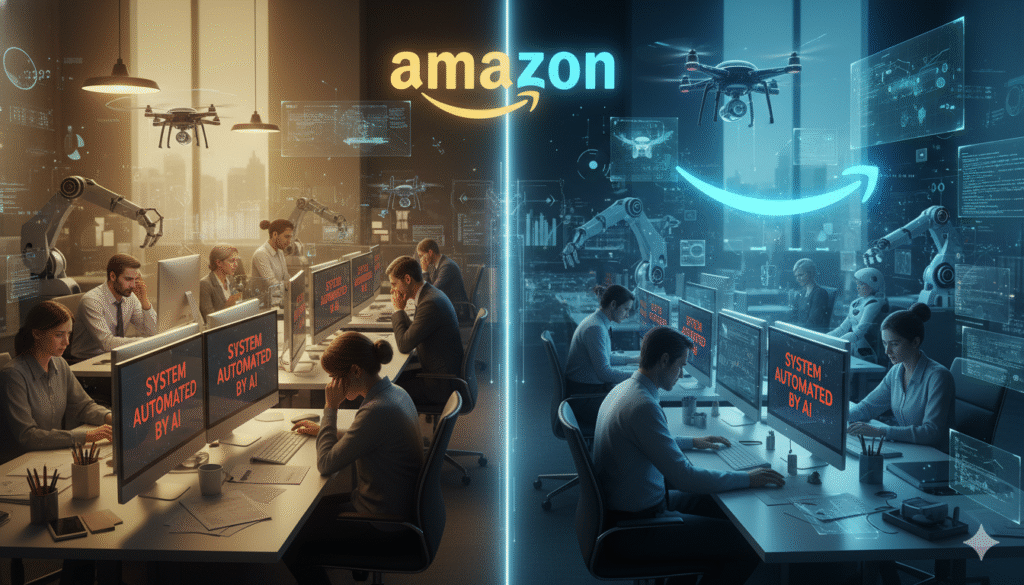
Amazon’s 14,000 layoffs may mark just the beginning of a much larger shift — one that transcends industries and borders. Artificial Intelligence, once a futuristic concept, has now become a powerful disruptor of the global job market.
Whether AI ultimately becomes a tool of empowerment or a force of displacement depends on how responsibly it is harnessed. As machines grow smarter, the challenge for humanity is to grow wiser.
The world stands at the crossroads of progress and preservation — and the decisions made today will define not just the future of work, but the very essence of what it means to be human.