



By Anushka Verma | November 4, 2025
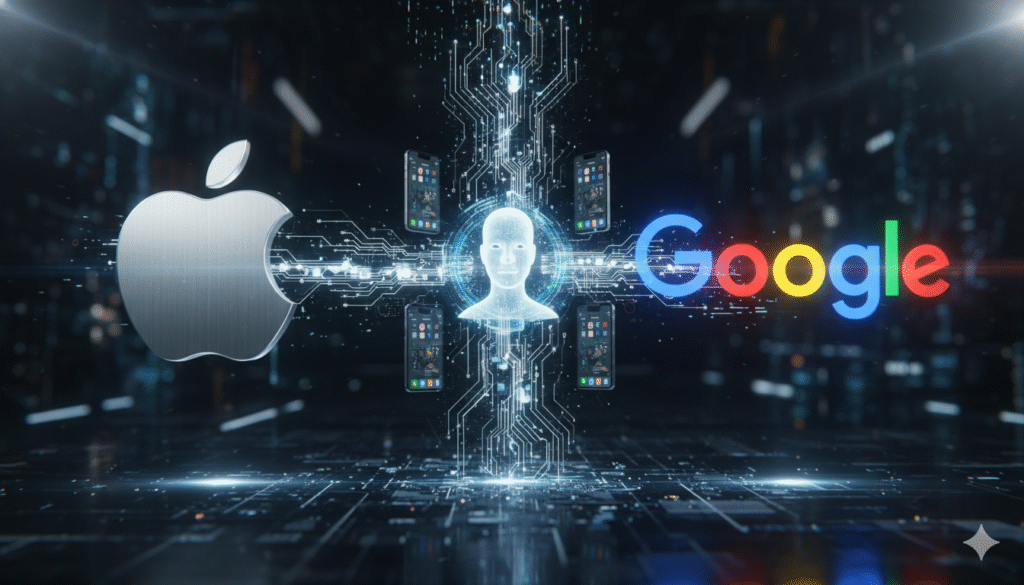
Apple is reportedly preparing to transform Siri into a truly intelligent AI assistant — and for that, it’s turning to an unlikely partner: Google. According to recent reports, the Cupertino-based tech giant will depend on a customized version of Google’s Gemini AI model to power the next-generation version of Siri.
This move marks one of the most significant collaborations between two of the world’s biggest rivals in technology. Apple, known for its self-reliant approach, is now leaning on Google’s deep expertise in large language models to bring Siri into the modern AI era.
The revamped Siri is expected to roll out alongside future versions of iOS, bringing features like AI-driven web search, contextual conversations, and multimodal input recognition — combining text, image, and voice.
Apple’s AI Ambition: Catching Up in the Generative Race
Apple has always been a perfectionist — waiting for technology to mature before adopting it. But in the world of generative AI, that patience has turned into a disadvantage.
While Google’s Gemini, OpenAI’s ChatGPT, and Anthropic’s Claude have evolved into intelligent conversational systems, Siri has remained mostly functional but not futuristic. Users still rely on it for alarms, messages, or directions — not for reasoning, summarizing, or problem-solving.
Internally, Apple executives have recognized that AI is not just a software upgrade — it’s the foundation of the next decade of computing. Generative AI, capable of understanding context and emotion, will redefine how users interact with devices.
This realization reportedly pushed Apple to accelerate its work on Project Blackbird — an internal initiative to build a smarter, AI-driven Siri. And rather than starting from scratch, Apple decided to partner with Google to use a refined version of its Gemini model.
A Strategic Alliance: Why Apple Chose Google
The collaboration may sound unusual, given that Apple and Google are direct competitors across multiple domains — mobile OS, cloud storage, browsers, and even maps. Yet, this partnership is not without precedent.
Apple has long relied on Google’s search engine as the default search provider on Safari, a deal that earns Apple billions annually. Now, the companies seem to be extending that relationship into the AI era.
According to insiders, Apple approached Google earlier this year for access to a custom-tuned Gemini model that could run within Apple’s closed ecosystem. Unlike Google’s public Gemini deployment, Apple’s version is expected to be modified for enhanced privacy, device-level processing, and Siri-specific optimization.
Why Gemini Makes Sense for Apple:
- Multimodal Power: Gemini can understand text, voice, and images in real time.
- Performance Efficiency: It’s optimized for edge computing, crucial for iPhones and iPads.
- Flexible Integration: Gemini supports modular training and can work with Apple’s Neural Engine.
- Security Compliance: It allows customization to meet Apple’s strict data privacy standards.
Apple reportedly tested multiple models — including OpenAI’s GPT and Anthropic’s Claude — before deciding that Gemini offered the most flexibility for hybrid on-device and cloud-based intelligence.
Inside Gemini: The Engine Behind the New Siri
Google’s Gemini, launched in late 2024, represents a major leap from its earlier Bard AI project. Built on DeepMind’s multimodal foundation, Gemini can handle language reasoning, mathematical logic, code generation, and visual interpretation simultaneously.
For Apple, this capability opens doors to a new Siri that can not only answer questions but also understand situations. Imagine Siri recognizing a photo you show, generating context-based information, or offering suggestions without requiring multiple prompts.
Gemini’s Strengths That Attracted Apple:
- Real-Time Reasoning: Gemini can analyze context dynamically, a key element for fluid conversations.
- Adaptive Learning: It remembers session context, allowing multi-turn dialogues like ChatGPT.
- Efficient Architecture: Gemini is designed to run lighter versions (Gemini Nano) on smartphones.
- Privacy Customization: It supports limited learning without compromising user identity.
Apple’s customized Gemini will reportedly function in two modes:
- On-Device Mode: Handles personal and sensitive data locally.
- Cloud Mode: Manages broader queries requiring generative reasoning.
This dual-structure ensures speed, reliability, and adherence to Apple’s privacy ethos.
Siri’s Long Journey: From Voice Assistant to AI Companion
When Apple first unveiled Siri in 2011 with the iPhone 4S, it was hailed as a revolutionary feature — a voice assistant that could understand natural language. Over time, though, Siri lagged behind as rivals like Alexa and Google Assistant advanced in functionality and intelligence.
Apple maintained incremental updates — improving speech recognition, adding language support, and integrating Siri with HomeKit and Shortcuts. But what users wanted was a smart, conversational AI, not just a command executor.
With this AI revamp, Apple seems ready to fulfill that promise. The new Siri aims to blend intelligence, personality, and contextual awareness — learning user behavior, adapting tone, and even generating creative responses.
What the New Siri Can Do
The redesigned Siri will not only respond to voice but will understand intent. For instance, if you ask:
“Siri, I’m planning a weekend trip. Can you suggest something relaxing nearby?”
The assistant won’t just open Maps — it will analyze your calendar, past travel preferences, local weather, and even recommend personalized itineraries.
Expected Core Features
- AI-Powered Web Search: Siri will generate concise answers from live internet data, eliminating the need to browse multiple sites.
- Context Retention: Unlike older Siri versions, the new system remembers conversation history and user intent.
- Visual Recognition: Users can show images or objects to Siri for real-time identification and suggestions.
- Task Automation: Enhanced integration with Shortcuts and third-party apps for complete workflow control.
- Personalized Tone: Adaptive responses that match user emotion or urgency.
- Offline AI Capabilities: Basic reasoning, summarization, and translation even without internet connectivity.
Apple wants Siri to evolve into something between an assistant and a companion — subtle, intelligent, and emotionally aware.
Integration with iPhone 15 and Future iOS Updates
Although the iPhone 15 series, launched in 2024, missed the new AI-powered Siri, it’s expected to gain the update through upcoming iOS releases.
The current iPhone 15 lineup remains compatible thanks to its A16 Bionic chip, which includes a Neural Engine capable of handling on-device machine learning tasks efficiently.
| iPhone Model | Launch Price (India) | Compatibility with New Siri |
|---|---|---|
| iPhone 15 | ₹79,900 | Supported via update |
| iPhone 15 Plus | ₹89,900 | Supported |
| iPhone 15 Pro | ₹1,34,900 | Fully optimized |
| iPhone 15 Pro Max | ₹1,59,900 | Best performance |
| iPhone 16 (upcoming) | TBD | Native AI integration |
Apple insiders suggest the new Siri will arrive with iOS 19 in mid-2026, though early developer previews may begin in late 2025.
The integration will extend beyond the iPhone — reaching iPads, MacBooks (with M-series chips), and even the Apple Vision Pro headset. Siri will act as the AI brain across all Apple platforms, connecting productivity, entertainment, and smart home experiences.

AI Search vs ChatGPT: Apple’s Balancing Strategy
Interestingly, Apple was earlier rumored to integrate ChatGPT directly into iOS. While those talks did occur, the company now appears to be pursuing a hybrid model.
Under this strategy:
- Gemini will power Siri’s everyday intelligence and system-level functions.
- ChatGPT may remain an optional add-on through Apple’s productivity or creativity tools.
This dual approach helps Apple avoid overdependence on a single AI provider while retaining flexibility. It also aligns with Apple’s broader philosophy — controlling user experience while outsourcing only the technical framework.
From a business perspective, this decision allows Apple to leverage AI as a premium service, possibly through iCloud+ or Apple One subscription tiers.
Privacy: Apple’s Defining Edge
While AI brings intelligence, it also raises concerns about data collection and user tracking. Apple’s brand identity rests on privacy, and any AI partnership must uphold that foundation.
Reports indicate that Apple’s deal with Google involves strict privacy firewalls — ensuring no user data is shared with Google servers. Instead, Apple’s version of Gemini will function inside its Private Compute Cloud, maintaining encryption and anonymization.
Sensitive queries — like messages, health data, or financial information — will stay fully on-device. Broader searches or AI reasoning tasks will use anonymized routing through Apple servers before reaching the Gemini model.
This approach gives Apple a unique edge: delivering cutting-edge AI without compromising user trust.
Impact on the iPhone Market
The iPhone 15 lineup, while successful, has faced criticism for not including AI features comparable to Pixel or Galaxy devices. The upcoming Siri revamp could change that narrative dramatically.
Analysts predict that once Apple demonstrates the full capabilities of its Gemini-powered Siri, it could trigger a new upgrade cycle, especially among users holding older iPhones.
Moreover, Apple might position the AI-enhanced iPhone 16 as the beginning of a “smart companion” era — similar to how Face ID and Touch ID once redefined user experience.
From pricing to performance, AI will likely become Apple’s main differentiator in the years ahead.
The Larger Picture: Apple’s AI Roadmap
Apple’s collaboration with Google does not mean it’s abandoning its in-house AI ambitions. Reports suggest that the company is simultaneously working on a proprietary Ajax LLM (Large Language Model), which may eventually replace Gemini once matured.
The long-term plan is to establish a fully independent Apple AI framework — trained on Apple devices, deployed through private computation, and fine-tuned for each user individually.
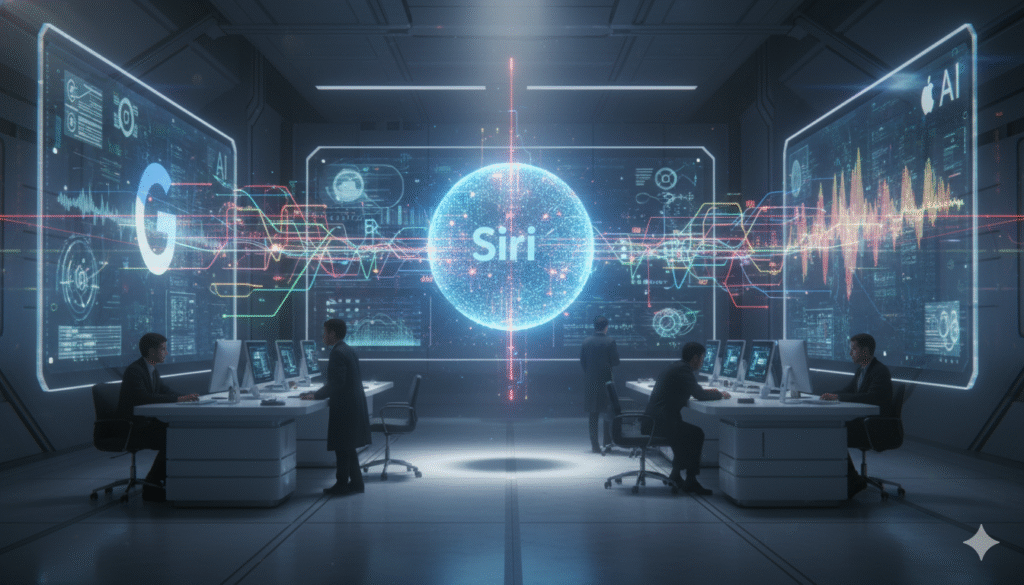
Until that ecosystem is ready, the Gemini collaboration acts as a bridge, ensuring Apple doesn’t fall behind in the fast-evolving AI revolution.
Final Thoughts
Apple’s decision to lean on Google’s Gemini AI for the new Siri marks a rare but strategic turning point. It shows that the company is willing to prioritize functionality over pride — embracing collaboration to deliver innovation.
By blending Google’s advanced AI architecture with Apple’s hardware efficiency and privacy standards, the next Siri could redefine what a digital assistant truly means.
From smarter conversations to contextual intelligence, from visual understanding to emotional tone adaptation — Siri’s 2026 version might be the assistant that Apple users have long dreamed of.
As the lines blur between competition and collaboration, one thing is clear: the future of AI won’t be about who builds it alone — but who integrates it best.
And in that game, Apple is finally stepping back into the spotlight

