



Written by: Anushka Verma
Published: November 28, 2025
Introduction: The Anticipated Paradigm Shift
The smartphone industry stands on the precipice of a significant transformation, one that has been brewing since the advent of the foldable form factor. For years, Samsung, Huawei, and a host of other manufacturers have been iterating and refining the concept of a device that can seamlessly transition from a compact phone to a miniature tablet. Yet, a conspicuous absence has been felt in this innovative space: Apple. That wait, it seems, is nearing its end. Rumors, analyst reports, and supply chain leaks are converging to paint a vivid picture of Apple’s first foray into the foldable market, a device poised not just to enter the arena but to redefine it. This isn’t merely about Apple launching a foldable phone; it’s about Apple’s philosophy of “it just works” being applied to one of the most complex consumer electronics categories. The impending launch of the Foldable iPhone, often dubbed the “iPhone Fold” or “iPhone Flip” in speculative circles, represents a pivotal moment that promises to challenge Samsung’s dominance and set a new benchmark for design, durability, and user experience. This article delves deep into the wealth of information available, piecing together the potential features, revolutionary design choices, and the market strategy that could make Apple’s foldable device the most talked-about tech product of 2026.
The Design Philosophy: An Ultra-Thin, Futuristic Masterpiece
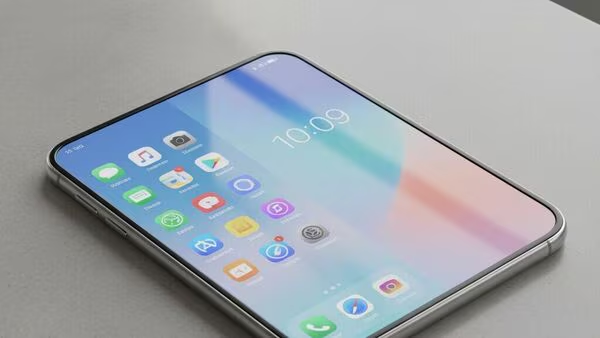
Apple has always been revered for its design-centric approach, and with its foldable iPhone, the company appears to be doubling down on its core principle of simplicity and elegance. The primary goal, as echoed by numerous industry insiders, is to create an “ultra-slim” profile that distinguishes it from the often chunky predecessors in the foldable market. According to reports from Korean news aggregator yeux1122, Apple is making fundamental changes at the component level, including the Display Driver IC (DDI), to achieve this slimmer form factor. The DDI is a critical component that acts as the intermediary between the device’s processor and its display, controlling how pixels are illuminated. By re-engineering this chip, Apple can potentially reduce the bezels and the overall thickness of the display assembly, contributing significantly to the device’s slender silhouette.
The form factor itself is expected to follow the “book-style” or horizontal folding mechanism, similar to the Samsung Galaxy Z Fold series, rather than the clamshell style of the Z Flip. This choice aligns with Apple’s historical preference for larger screen real estate, as seen in the iPad and iPhone Pro Max variants. However, Apple is not just copying an existing design; it is refining it. Renowned analysts and tipsters with a proven track record, such as Ming-Chi Kuo and Jeff Pu, suggest that the device will feature a main internal display of approximately 7.8 inches when unfolded. This positions it perfectly as a hybrid device—a phone that transforms into a small tablet, ideal for productivity tasks, media consumption, and immersive gaming. On the outside, a cover display of around 5.5 inches is expected, ensuring that essential tasks can be handled without the need to open the device every time. This cover screen is strategically sized to be usable yet not so large as to negate the utility of the main display, maintaining a compact form factor when folded.
Engineering Durability: The Liquid Metal Hinge Revolution
The Achilles’ heel of foldable smartphones has consistently been their durability, particularly concerning the hinge mechanism and the inherent crease of the flexible display. Early generations of foldables were plagued with issues ranging from dust intrusion to complete screen failure along the fold. While current models have improved significantly, the problem persists in the minds of many consumers. Apple, known for its meticulous engineering and reluctance to release half-baked technology, is reportedly addressing this challenge with a groundbreaking solution: a hinge constructed from Liquid Metal.
Liquid Metal is a proprietary amorphous zirconium-based alloy known for its exceptional strength, durability, and resistance to wear and tear. This is not a new material for Apple; the company has a long-standing exclusive license to use it in consumer electronics and has previously employed it for small components like the SIM ejector tool. Its application in a foldable phone’s hinge is a masterstroke. Traditional hinges are composed of multiple interlocking parts, which can be prone to failure and create gaps that allow debris to enter. A Liquid Metal hinge, potentially through a precision casting process, could be a single, incredibly robust and flexible unit. This would minimize moving parts, reduce potential failure points, and create a smoother folding action. The material’s properties would ensure the hinge can withstand hundreds of thousands of folds without significant degradation, directly addressing the primary consumer anxiety surrounding foldable devices. This focus on a “disappearing” hinge mechanism that is both robust and seamless could be one of the most significant differentiators for Apple’s entry into the market.
The Pursuit of Slimness: Potentially the Thinnest Foldable on the Market
The numbers surrounding the device’s proposed dimensions are nothing short of astonishing and underscore Apple’s commitment to setting a new design standard. If the current rumors hold true, Apple’s foldable iPhone could claim the title of the thinnest foldable smartphone in the world upon its release. Reports indicate that in its unfolded, tablet-like state, the device could measure a mere 4.5 millimeters at its thinnest point. To put that into perspective, the current flagship iPhone 16 Pro Max has a thickness of approximately 8.25 mm. When folded, the device is expected to measure between 9.0 mm and 9.5 mm, which is still remarkably slim for a device housing two displays and a complex hinge mechanism.
Achieving this ultra-thin profile requires a holistic rethinking of the device’s internal architecture. It’s not just about a slimmer hinge or display; it involves a complete re-engineering of the internal logic board, battery cells, and camera modules. Apple may employ a new, more densely packed logic board design and potentially use thinner, more flexible battery cells distributed on either side of the hinge to maximize space. This relentless pursuit of thinness, however, leads to one of the most speculated and controversial design decisions Apple might make.

A Security Trade-off: The Potential Shift from Face ID to Touch ID
In a move that would mark a significant departure from its recent design language, Apple is reportedly considering replacing the advanced Face ID facial recognition system with a Touch ID fingerprint sensor integrated into the power button. The rationale behind this potential change is directly linked to the device’s ultra-thin profile. The TrueDepth camera system that powers Face ID is a complex array of sensors, including a dot projector, flood illuminator, and infrared camera, which requires a certain amount of vertical space (the infamous “notch” or “Dynamic Island”) on the front of the device. Accommodating this system on an ultra-thin, flexible display presents immense engineering challenges, potentially compromising the design or the durability of the screen.
The solution, therefore, might be to revert to Touch ID. By embedding a high-resolution, capacitive sensor into the power button, Apple can eliminate the need for the TrueDepth system on the main and cover displays, saving crucial internal space and contributing to the sleek, bezel-minimized design. While some users may see this as a step backward from the seamless authentication of Face ID, modern in-display or side-button Touch ID sensors are incredibly fast and secure. This decision would not be without precedent in the Apple ecosystem; the iPad Air and iPad Mini have successfully used a Touch ID sensor integrated into the power button. If this change is implemented, it would represent a fascinating case of Apple prioritizing form factor and structural integrity over a beloved feature, a calculated trade-off to achieve its overarching design vision for the foldable iPhone.
Material Matters: The Titanium Chassis for a Premium Feel
Apple’s dedication to premium materials is well-documented, and for a product category as aspirational and high-margin as a foldable phone, the company is expected to pull out all the stops. Following its successful implementation in the iPhone 15 Pro and iPhone 16 Pro series, a titanium chassis is heavily rumored for the foldable iPhone. Titanium offers an exceptional strength-to-weight ratio; it is significantly stronger and more scratch-resistant than stainless steel while being notably lighter. This makes it an ideal material for a foldable device, which needs to be robust enough to protect its delicate internal components while remaining comfortable to hold and carry, especially in its unfolded state.
The use of titanium would not only enhance the device’s durability but also solidify its premium positioning. The cold, brushed-metal feel of titanium provides a distinct and luxurious tactile experience that differentiates it from aluminum or stainless steel frames used by competitors. This material choice, combined with Apple’s signature color finishes, would ensure the foldable iPhone feels every bit as premium as its price tag suggests, appealing to the high-end consumer segment that Apple dominates.
Market Position: Potential Price, Launch Date, and the Competitive Landscape
The most burning questions for any potential buyer are “When will it launch?” and “How much will it cost?” While Apple has maintained its characteristic silence, the consensus among analysts like Ming-Chi Kuo and Jeff Pu points towards a launch window in late 2025 or, more likely, early 2026. This timeline allows Apple to observe the market, refine its technology, and ensure a flawless launch for such a critical product.
On the price front, expectations are set for a premium positioning. Early estimates suggest a starting price of around $2,000 USD. In Indian Rupees, this could translate to a range of approximately ₹1,65,000 to ₹1,80,000, depending on import duties and taxes. This places it squarely in the ultra-premium segment, competing directly with the top-tier models of the Samsung Galaxy Z Fold series.
To understand its potential impact, here is a comparative analysis based on current rumors and existing competitors:
| Feature | Apple Foldable iPhone (Rumored) | Samsung Galaxy Z Fold6 (Current Benchmark) | Google Pixel Fold 2 (Expected) |
|---|---|---|---|
| Form Factor | Book-style, Horizontal Fold | Book-style, Horizontal Fold | Book-style, Horizontal Fold |
| Main Display | ~7.8-inch Flexible OLED | ~7.6-inch Dynamic AMOLED 2X | ~7.6-inch OLED |
| Cover Display | ~5.5-inch OLED | ~6.3-inch HD+ Dynamic AMOLED 2X | ~5.8-inch OLED |
| Thickness (Folded) | 9.0 – 9.5 mm | 12.1 mm | ~12.0 mm (est.) |
| Thickness (Unfolded) | ~4.5 mm | 5.6 mm | ~5.8 mm (est.) |
| Hinge Technology | Liquid Metal | Dual Rail, Sweeping Mechanism (Durability Focus) | Custom Hinge |
| Biometric Security | Touch ID (Side Button) Rumored | Under-Display Fingerprint Sensor | Under-Display Fingerprint Sensor |
| Chassis Material | Titanium (Rumored) | Armor Aluminum, Titanium (S24 Ultra) | Aluminum |
| Estimated Price | $2000+ USD | $1899 USD | $1799 USD (est.) |
| Expected Launch | Early 2026 | Mid-2024 | Late 2024 / 2025 |
As the table illustrates, Apple’s rumored device aims to compete not by matching features, but by redefining the physical parameters of a foldable, particularly in thinness and material choice. The potential shift to Touch ID is a clear differentiator, and the Liquid Metal hinge could be a game-changer in terms of perceived and actual durability.
Conclusion: More Than a Phone, a Statement
The arrival of Apple’s foldable iPhone is shaping up to be one of the most significant events in the tech world of this decade. It is not merely the addition of another model to Apple’s lineup; it is a statement of intent. By focusing on an ultra-thin, incredibly durable design powered by innovative materials like Liquid Metal and titanium, Apple is signaling that it has learned from the shortcomings of early foldables and is ready to deliver a product that meets its legendary standards for quality and user experience. The potential compromises, such as the shift from Face ID to Touch ID, highlight the difficult engineering choices required to realize this vision.
When it finally launches, the Apple Foldable iPhone will not just be competing with Samsung; it will be challenging the entire industry to elevate its game. It will test consumer willingness to pay a premium for a device that promises to be both a technological marvel and a design icon. For the legions of Apple faithful and tech enthusiasts worldwide, this device represents the future of mobile computing—a future that is flexible, powerful, and unmistakably Apple. The countdown to a new era in smartphone design has officially begun.


