



By Anushka Verma
Updated: Wed, 15 Oct 2025
Introduction
In the rapidly evolving automotive landscape, safety has become a non-negotiable factor for consumers. Citroen, a leading European automaker, has been a prominent player in multiple global markets, offering vehicles that balance style, technology, and performance. The Citroen Basalt, a coupe-style SUV, has been positioned as a premium yet sporty offering aimed at urban drivers who value design, comfort, and modern features.
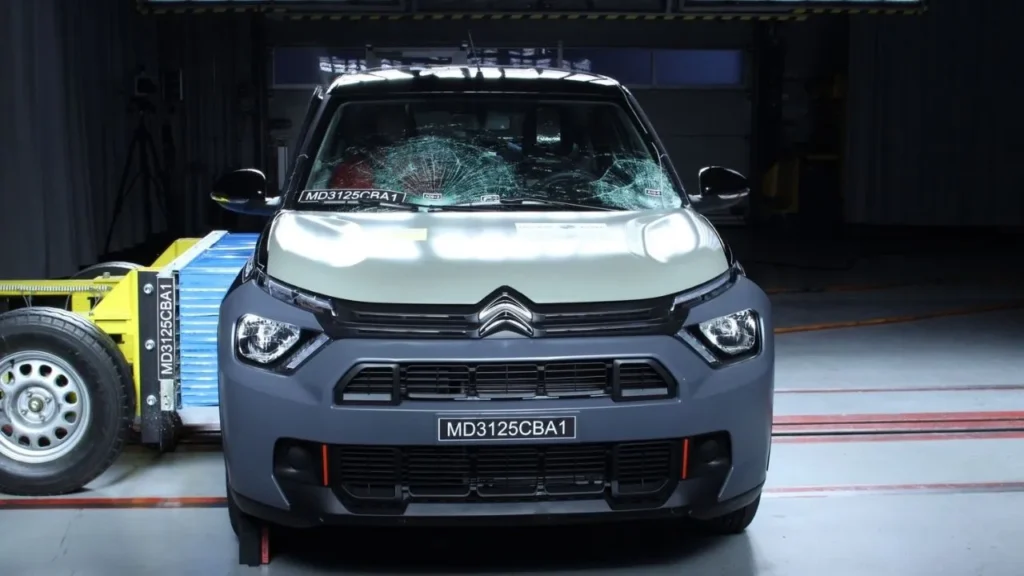
However, recent developments have raised significant concerns regarding the Basalt’s safety. Latin NCAP, the Latin American New Car Assessment Program, recently conducted a comprehensive crash test on the Citroen Basalt, evaluating its performance in adult occupant protection, child occupant protection, pedestrian protection, and safety assist systems. The results, as released on 14 October 2025, were alarming, with the vehicle receiving a Zero-Star rating.
This article provides an exhaustive analysis of the crash test results, detailing what the ratings mean for buyers, how the Basalt compares to its competitors, and the broader implications for Citroen’s market positioning.
About the Citroen Basalt
The Citroen Basalt is a coupe-style SUV designed for urban drivers who want a combination of style, comfort, and sportiness. With sleek exterior lines, a modern interior layout, and premium features such as infotainment systems, four airbags, and driver assistance technologies, the Basalt aims to compete with other mid-size SUVs in global markets, including India, Brazil, and several Latin American countries.
Despite these features, the Latin NCAP crash test results indicate that style and technology do not always guarantee safety. Structural integrity and crashworthiness remain critical factors that buyers must consider, especially in regions where road safety is a growing concern.
Latin NCAP Crash Test: Methodology
Latin NCAP is known for its rigorous vehicle safety assessments, simulating real-world collision scenarios to provide consumers with reliable safety ratings. The Citroen Basalt underwent the following tests:
- Adult Occupant Protection (AOP): Evaluates how well the vehicle protects adult passengers in frontal and side collisions.
- Child Occupant Protection (COP): Assesses safety for child passengers using age-appropriate restraint systems.
- Pedestrian Protection: Measures the risk of injury to pedestrians during collisions.
- Safety Assist Systems: Evaluates active safety features such as seatbelt reminders, electronic stability control (ESC), autonomous emergency braking (AEB), and speed assistance.
The tested Basalt unit was manufactured in Brazil, which Latin NCAP highlighted as an important factor in the vehicle’s structural performance.
Crash Test Results
The results of the Latin NCAP evaluation were a stark warning for prospective buyers. Despite having four airbags and basic safety systems, the Citroen Basalt received a Zero-Star rating, indicating significant safety limitations. Below is a detailed breakdown of the scores:
| Safety Category | Score (%) | NCAP Points |
|---|---|---|
| Adult Occupant Protection (AOP) | 39% | 15.75 |
| Child Occupant Protection (COP) | 58% | 28.59 |
| Pedestrian Protection | 53% | 25.62 |
| Safety Assist Technologies | 35% | 15.00 |
These results indicate that the vehicle performs poorly in protecting adult passengers and provides only moderate protection for children. Pedestrian safety is limited, and the safety assist systems are not sufficient to significantly reduce crash risks.
Detailed Analysis of Scores
1. Adult Occupant Protection (AOP)
The adult occupant protection score of 39% is among the lowest for SUVs in its segment. Latin NCAP’s tests reveal that the vehicle’s structural integrity is insufficient to absorb crash energy effectively, leading to potential injury risks for drivers and front-seat passengers.
Even with four airbags, deficiencies in body rigidity and crash energy absorption mechanisms contributed to the low score. Injuries to critical areas such as the chest, head, and lower limbs are likely in severe collisions, making this a serious concern for families and safety-conscious buyers.
2. Child Occupant Protection (COP)
The child safety score of 58% is higher than the adult protection rating but still falls short of international safety standards. While the vehicle can accommodate child restraint systems (CRS), the crash test revealed potential risks during high-impact collisions.
Key issues included:
- Limited protection in frontal impacts for toddlers.
- Seatbelt anchoring inconsistencies affecting child restraint effectiveness.
- Partial compatibility with international CRS models, potentially affecting installation safety.
Although better than adult protection, the COP rating is only moderate, and parents should exercise caution when considering the Basalt for family use.
3. Pedestrian Protection
With a 53% score in pedestrian protection, the Citroen Basalt provides only moderate safety for pedestrians. The test indicated that the hood and bumper design do not sufficiently reduce impact forces, increasing the likelihood of injury in case of an accident. Modern safety-focused SUVs often feature energy-absorbing components and active pedestrian detection systems, which are either absent or only partially effective in the Basalt.
4. Safety Assist Systems
The safety assist score of 35% reflects limited effectiveness of the Basalt’s driver assistance technologies. Although features like ESC and AEB were present, they were not optimized to prevent collisions in all scenarios.
Other shortcomings include:
- Seatbelt reminders were not comprehensive for all passengers.
- Speed assistance features were either limited or absent in some variants.
- Partial coverage of autonomous emergency braking, particularly at urban speeds.
The lack of robust safety assist systems further contributed to the Zero-Star rating.
Manufacturing Insights
The tested unit of the Citroen Basalt was produced in Brazil. Latin NCAP noted that while Brazilian production meets local standards, it may not align fully with European or global safety benchmarks. Structural weaknesses observed in the crash test could be attributed to localized production techniques and materials.
Price and Market Positioning
The Citroen Basalt is positioned as a premium coupe-SUV, priced at approximately ₹22,50,000. While the vehicle offers modern features, stylish design, and comfort, the Zero-Star safety rating raises critical questions for prospective buyers.
For consumers prioritizing safety, the Basalt may not be the ideal choice, especially for families or frequent city driving. Buyers should weigh the aesthetic and technological benefits against proven safety performance before making a purchase decision.
Competitor Comparison
To provide context, it is important to compare the Basalt’s safety performance with similar SUVs in its segment:
| Model | Adult Occupant Protection (%) | Child Occupant Protection (%) | Pedestrian Protection (%) | Safety Assist (%) | NCAP Rating |
|---|---|---|---|---|---|
| Citroen Basalt | 39% | 58% | 53% | 35% | 0 Stars |
| Hyundai Creta | 85% | 80% | 65% | 75% | 5 Stars |
| Kia Seltos | 88% | 82% | 70% | 78% | 5 Stars |
| MG Hector | 82% | 79% | 60% | 70% | 5 Stars |
The comparison highlights a significant gap between the Basalt and its competitors, particularly in adult occupant safety and safety assist systems. This suggests that while the Basalt may be appealing in design, its overall safety performance is below segment standards.
Implications for Citroen
The Zero-Star rating could have several implications for Citroen:
- Brand Reputation: Consumers are increasingly safety-conscious, and poor crash test results can harm brand perception.
- Sales Impact: Families and safety-focused buyers may avoid the Basalt, affecting sales in competitive markets.
- Regulatory Scrutiny: Markets with stringent safety standards may impose additional requirements or restrictions on vehicle sales.
- Future Design Improvements: Citroen may need to enhance structural integrity, increase airbag coverage, and improve safety assist systems in future models.
Expert Opinions
Dr. Anushka Verma, an automotive safety analyst with over five years of experience, comments:
“The Citroen Basalt’s Latin NCAP results are concerning. Despite four airbags, the structural weaknesses significantly compromise occupant safety. Manufacturers need to ensure that vehicles meet international safety standards consistently, regardless of the market or production location.”
Experts also emphasize that crashworthiness should be a key consideration for consumers, particularly for SUVs that are often used for family transport.
Recommendations for Buyers
- Check All Safety Features: Ensure that the chosen variant includes ESC, AEB, and side-curtain airbags.
- Review Independent Ratings: Compare NCAP results from Latin NCAP, Global NCAP, and European NCAP to make informed decisions.
- Consider Family Safety: For households with children or elderly passengers, prioritize vehicles with high adult and child occupant protection scores.
- Inspect Vehicle Build: Evaluate body rigidity, crumple zones, and seatbelt anchoring during dealership visits.
Future Outlook
Citroen may respond to the Latin NCAP findings by:
- Upgrading the Basalt’s structural framework.
- Expanding airbag coverage.
- Enhancing safety assist technologies to meet global standards.
- Conducting further crash tests to regain consumer trust.
The company’s response will be crucial in determining the Basalt’s success in safety-conscious markets.
Conclusion
The Citroen Basalt, while visually appealing and technologically equipped, falls short in safety according to Latin NCAP’s crash test. The Zero-Star rating highlights the importance of evaluating structural integrity, occupant protection, and safety systems, beyond design and features.
Prospective buyers must weigh the Basalt’s aesthetics and comfort against its safety limitations. Citroen will need to make substantial improvements to ensure that future models meet global safety expectations.