

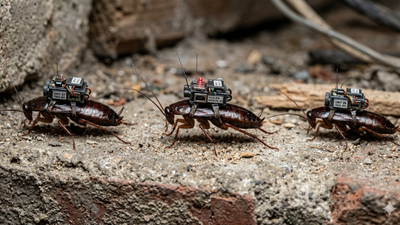
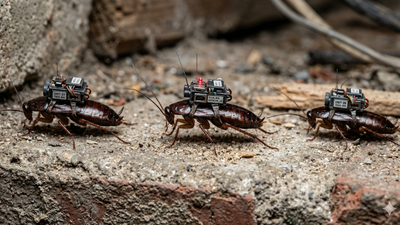
Although the concept seems like something from science fiction, science is rapidly adopting it. Researchers have started creating ‘cyborg cockroaches,’ which are live insects equipped with tiny electronic ‘backpacks’ that allow them to navigate areas that are too small or hazardous for humans. The potential application of this discovery in pipeline inspection, where these insects can carry tiny rigs to find leaks, is what makes it so fascinating. Cockroaches may soon turn into unlikely heroes in industrial safety and infrastructure monitoring thanks to their innate agility and the addition of intelligent sensors.
How ‘Cyborg Cockroaches’ work in pipeline inspection
Combining biology and technology is a simple but effective idea behind this invention. Scientists attach lightweight electronic systems to cockroaches. These systems often have sensors, cameras, and communication devices. By connecting to the insect’s nervous system, these systems let researchers control its movement from a distance.A study on autonomous cockroach bio-robots published on PubMed claims that the insect can crawl in dark, tight pipelines while sending data in real time. This is possible by fitting a micro-camera and onboard sensors. Because of this, they are ideal for inspecting pipelines where visibility is poor and access is difficult.Unlike traditional robots, cockroaches naturally adapt to uneven surfaces, tight turns, and narrow spaces. Their ability to carry small payloads while maintaining mobility gives them an edge over conventional inspection tools.
Why cockroaches are ideal for leak detection
Despite their lack of popularity, cockroaches have evolved into extremely effective survivors. These characteristics are now being used by scientists for useful purposes.According to research, when compared to artificial robots of comparable size, cockroach-based bio-robots provide “better flexibility, larger payload, and stronger endurance.” When navigating long, winding pipelines that may contain corrosion, debris, or structural irregularities, these characteristics are essential.They can also reach places that even the most sophisticated mechanical robots find difficult to access due to their small size. Additionally, research from the University of California has demonstrated that cockroaches can move quickly while squeezing through incredibly small spaces, which served as an inspiration for earlier robotic designs.
The technology behind the ‘miniature rig’
These cyborg insects carry “miniature rigs,” which are basically small sensor packages. These could consist of:
- Micro-cameras for visual examination
- Gas or thermal sensors to find leaks
- Data transmission modules for communication
In some systems, advanced navigational tools like distance sensors and inertial measurement units (IMUs) help track In some systems advanced tools like distance sensors and inertial measurement units help track orientation and movement. These tools are really helpful.Also, researchers published a study on ScienceDirect about navigation systems. These systems help insects avoid obstacles and recognise when humans are around, in emergencies.The same technology used for insects can also be used for pipeline environments. It is really important to detect anomalies in pipeline environments. The technology can be adjusted for this use. Orientation and movement.
Future potential of bio-robotics in industry
Beyond pipelines, cyborg cockroaches have far-reaching consequences. These hybrid systems have the potential to completely change how we handle dangerous situations, from environmental monitoring to search and rescue operations.According to a research team at Osaka University, these systems successfully navigate tough terrain by combining millions of years of evolution with technology. Their ability to function in places that are difficult for humans or machines opens up new possibilities for various industries, such as urban infrastructure and oil and gas.As the technology improves, swarms of these bio-robots might work together to cover large areas efficiently and provide real-time data with little risk and cost. In the end, the common cockroach, often seen as a pest, may soon play an important role in maintaining vital infrastructure. Researchers are changing our understanding of what robots can do by blending engineering with nature, rather than just addressing technical issues.