


By: Anushka Verma | Updated: November 13, 2025
INTRODUCTION
Delhi continues to remain in a heightened security zone after the November 10 Red Fort blast that took the lives of at least 13 people and left many more injured. The investigation, which began with scattered fragments of a destroyed Hyundai i20, has now transformed into a massive multi-agency operation involving Delhi Police Special Cell, NIA support units, bomb squads, forensic labs, and even international observers. What began as a tragic explosion near a historical monument has expanded into a complex web of hidden vehicles, forensic breakthroughs, questionable university accreditation, and suspected terror modules spread across institutional and urban spaces.
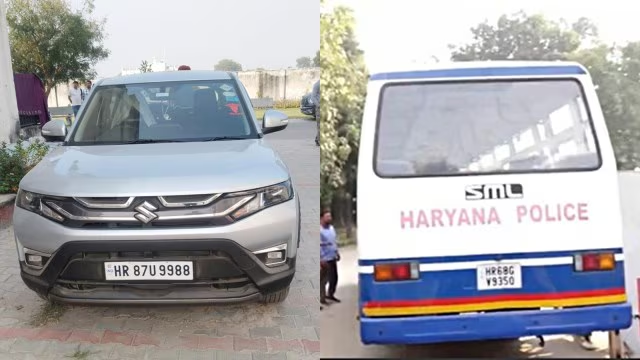
The latest discovery of a Brezza car inside the Al-Falah University campus, allegedly owned by the identified accused Dr. Umar Nabi Bhat, has added a new dimension to the unfolding narrative. Bomb squads were rushed to the site to examine the vehicle, raising fears that the blast near Red Fort might not have been an isolated incident, but part of a larger sequence that is only now coming to light.
To help readers understand the case comprehensively, here is a complete, detailed, in-depth newsroom-style investigative article covering everything from forensic trails to diplomatic responses.
TABLE OF KEY INVESTIGATION DETAILS
| Category | Information |
|---|---|
| Incident | Explosion near Red Fort, Delhi |
| Date of Blast | November 10, 2025 |
| Fatalities | At least 13 |
| Prime Accused | Dr. Umar Nabi Bhat |
| Occupation | Assistant Professor, Al-Falah University |
| Vehicles Linked | Hyundai i20 (exploded), Brezza, Ford EcoSport |
| Latest Development | Bomb squad reaches university after Brezza recovery |
| Forensic Breakthrough | DNA confirms Umar was driving the i20 |
| Agency Action | NAAC issues show-cause notice to Al-Falah University |
| International Reaction | US praises India’s investigation approach |
DELHI RED FORT BLAST: THE INVESTIGATION THAT KEEPS WIDENING
The deadly explosion near the Red Fort on November 10 was initially seen as yet another tragic moment in Delhi’s long list of security challenges. But as hours turned into days, investigators uncovered layers of evidence that transformed the case from a singular blast to a multi-vehicle, multi-location, multi-personnel investigation that has now gripped the nation.
When the silver Hyundai i20 detonated, it left behind barely recognisable fragments. Forensic experts recovered melted metal, carbonised seat frames, glass shards fused with explosive residue, and scattered human remains. The immediate question was: Who was behind the wheel? The answer came only after high-level DNA analysis confirmed that the driver was none other than Dr. Umar Nabi Bhat, an assistant professor at Al-Falah University.
The involvement of a university faculty member in such a high-intensity terror incident shocked security agencies, academia, and citizens alike. The case drew rapid responses because it indicated a new pattern—radical elements infiltrating academic spaces or using the guise of academia to plan high-risk operations.
What made the case even more complex was the discovery of multiple vehicles connected to Umar. After establishing his identity in the i20 blast, police traced a Ford EcoSport registered under his name. And then came the most dramatic moment: a Brezza found inside the Al-Falah University campus, prompting immediate bomb squad deployment.
The Brezza discovery sent shockwaves through both the university and the investigative teams. The car’s location—deep within the campus—raised serious questions. How long had it been parked there? Who allowed it inside? Was the security protocol compromised, or were insiders involved? Investigators quickly sealed the area, conducted chemical vapor scans, and examined the car with high-precision detectors.
Bomb squad officers confirmed that the car required deeper forensic dismantling, and therefore it was transported to a secure facility. Delhi Police sources stated that the Brezza is “critical evidence” and may reveal movement patterns, explosives transportation, communication logs, or hidden storage compartments.
Simultaneously, NAAC issued a show-cause notice to Al-Falah University for allegedly claiming incorrect accreditation on its website. Although unrelated at first glance, this event raised further suspicion about the internal governance of the institution and whether lapses in oversight might have helped someone like Umar operate undetected.
Witnesses from the campus have described Umar as a quiet, introverted academic who rarely mingled. Some students recalled seeing him leaving campus late at night. Investigators are now analysing CCTV footage from the past six months to identify visitors, vehicle entry logs, and unusual nighttime activity.
EMERGING PATTERN: MULTIPLE VEHICLES, MULTIPLE LOCATIONS, ONE CENTRAL ACCUSED
The blast at Red Fort was not just the detonation of a car—it appears to be the epicentre of a larger operation. Umar’s possession of multiple vehicles suggests logistical sophistication. Terror modules often use multiple vehicles for transportation, safe storage, or to mislead surveillance. The presence of a Brezza inside the university and a Ford EcoSport registered to him outside Delhi points toward a wider operational base.
Forensic officers have found traces of metal fragments in the i20 consistent with a shaped explosive. This type of explosive is not commonly accessible, indicating possible international sourcing, domestic illicit manufacturing, or structured training.
A major question investigators are working on is whether Umar was working alone. The logistics—from sourcing materials to parking vehicles at distant locations—suggest the involvement of more individuals. Police are currently interrogating university staff, local contacts, and individuals who were in touch with Umar over the past two years.
FORENSIC BREAKTHROUGH: DNA CONFIRMATION THAT CHANGED THE DIRECTION
The DNA match confirming Umar’s presence in the blast was the turning point. Forensic scientists faced burnt biological traces, forcing them to use advanced mitochondrial sequencing. The results established that Umar wasn’t supervising the blast from afar—he was physically driving the explosive-packed car near Red Fort.
Investigators believe this indicates two possibilities:
- Umar might have planned a suicide attack, or
- The blast may have been triggered prematurely.
If it was a suicide attack, the implications are grave—this means academic spaces may be vulnerable recruitment grounds. If the explosion was accidental, investigators fear a larger planned attack could have been in motion.
UNIVERSITY UNDER SCRUTINY: NAAC SHOW-CAUSE NOTICE ADDS NEW ANGLE
The NAAC’s show-cause notice to Al-Falah University for allegedly displaying false accreditation information triggered yet another wave of inquiry. Investigators are now examining internal documents, staff backgrounds, and digital forensics from the university’s website and internal networks.
While NAAC’s notice is an academic matter, its timing—during an active terror investigation—has raised concerns about administrative transparency within the institution. Police are looking into whether any lapses enabled Umar to evade red flags, travel frequently, access restricted areas, or store materials on campus.
INTERNATIONAL REACTION: US COMMENDS INDIA’S PROFESSIONAL HANDLING
The United States publicly praised India’s response to the Red Fort blast, calling the investigative approach “measured, cautious, and professional.” US Secretary of State Marco Rubio noted that India handled the situation with restraint despite the gravity of the attack. He stressed that the blast involved “a car loaded with highly explosive materials,” confirming international acknowledgement of the terror angle.
This support may open avenues for international forensic collaboration, especially in tracking cross-border digital communications, financial transactions, and encrypted channels that terror modules frequently use.
POLICE ALERT: DELHI ON TIGHTENED SECURITY GRID
Following these developments, Delhi Police has strengthened alerts across the city. Vehicle checks have increased, drone surveillance has been deployed in sensitive zones, and agencies are coordinating to trace potential accomplices. Officers are mapping Umar’s financial transactions, classroom interactions, travel history, and digital devices.
Investigators suspect the existence of sleeper cells potentially linked to Umar’s network. The search for such associates has expanded to multiple states.
FULL INVESTIGATION WIDENS: A CASE FAR FROM OVER
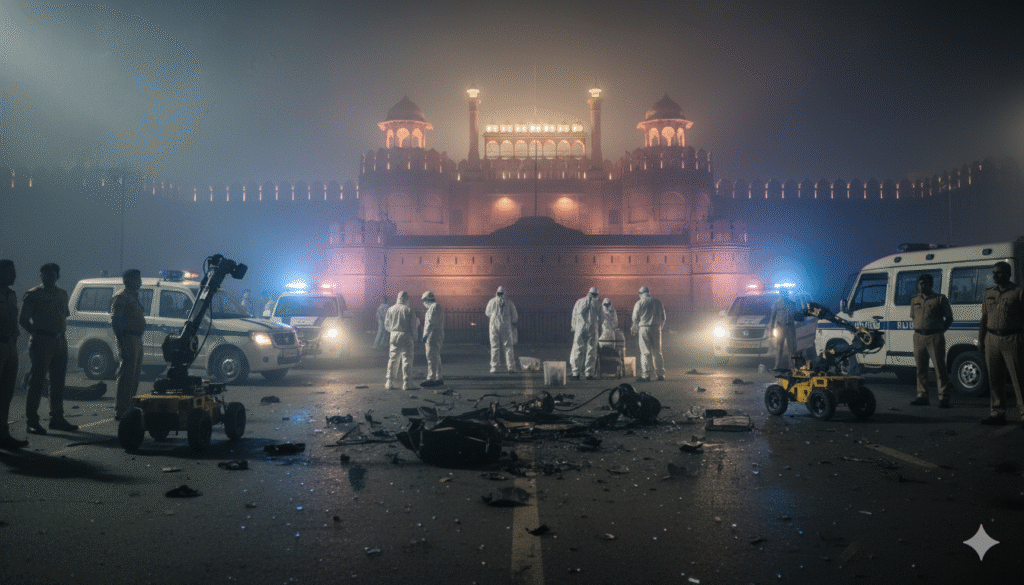
The Red Fort blast case has now grown beyond a single explosion. It involves questions about university oversight, multi-vehicle coordination, academic radicalisation, forensic anomalies, and international terror linkages.
The discovery of the Brezza car inside Al-Falah University may be the biggest clue yet—one that could unravel a wider operation. For now, Delhi waits, watches, and hopes that investigators will uncover the truth before another tragedy unfolds.