


By Anushka Verma | Updated: November 1, 2025
🧭 At a Glance
| Key Details | Information |
|---|---|
| Platform Launched | Grokipedia (AI-powered encyclopedia by xAI) |
| Founder | Elon Musk |
| Estimated Net Worth | $500.1 Billion (as of 4:15 PM ET, Forbes Index) |
| Controversy | Wikipedia Co-founder Jimmy Wales criticizes AI-driven accuracy |
| Main Concern | AI hallucinations and misinformation in research tools |
| Event | CNBC Technology Executive Council Summit, New York City |
| Wikipedia Annual Cost | $175 Million |
| Global AI Spending (2026 projection) | $550 Billion |
| Author of this Article | Anushka Verma |
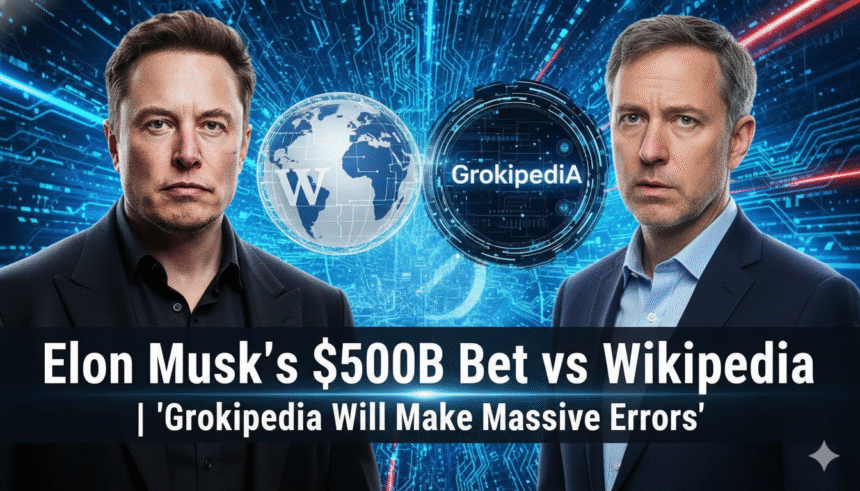
In the digital age where truth competes with technology, a new debate has taken the internet by storm. Elon Musk, the world’s richest man with a net worth of $500.1 billion, has launched Grokipedia, a new AI-powered platform that aims to redefine how information is created and consumed online. But his bold attempt to rival Wikipedia has sparked strong criticism from Jimmy Wales, the very man who built the world’s largest free encyclopedia.
The controversy began after Musk’s AI startup, xAI, unveiled Grokipedia, calling it the next revolution in digital knowledge. The platform promises to be a faster, more comprehensive, and “unfiltered” alternative to Wikipedia — using artificial intelligence to generate and update articles automatically. But not everyone is impressed, especially not Wikipedia’s founder.
“Grokipedia Will Make Massive Errors,” Warns Wikipedia Founder Jimmy Wales
At the CNBC Technology Executive Council Summit held in New York City on October 28, Wikipedia co-founder Jimmy Wales publicly questioned the reliability of AI-generated knowledge bases. Speaking bluntly, he said:
“The LLMs he [Musk] is using to write it are going to make massive errors. We know ChatGPT and all the other LLMs are not good enough to write wiki entries.”
Wales’ remarks reflect a growing anxiety within the knowledge ecosystem — that AI may be rewriting the internet faster than humans can verify it.
According to him, no matter how advanced AI models become, they lack the deep contextual understanding and editorial discipline that make human-curated knowledge reliable.
“I’m not optimistic he will create anything very useful right now,” Wales added, casting doubt on Musk’s claim that Grokipedia will outperform Wikipedia “by several orders of magnitude.”

The Clash Between Community and Code
The conflict between Wikipedia and Grokipedia isn’t just about technology — it’s philosophical. Wikipedia is built on collective human editing, where volunteers verify facts, cite sources, and debate neutrality. Grokipedia, by contrast, relies on machine intelligence, where an algorithm generates and summarizes information from existing sources.
This difference strikes at the core of what defines “truth” online. While AI promises speed and scale, human editors bring judgment, skepticism, and context.
Wales highlighted that Wikipedia’s strict editorial policies — often criticized as “mainstream-biased” — are what keep it trustworthy.
“He is mistaken about that. His complaints about Wiki are that we focus on mainstream sources, and I am completely unapologetic about that,” Wales said.
With a touch of sarcasm, he added:
“We don’t treat random crackpots the same as The New England Journal of Medicine, and that doesn’t make us woke. It’s a paradox — we are so radical we quote The New York Times.”
AI Hallucinations and the Reliability Problem
The rise of large language models (LLMs) like ChatGPT, Claude, and Gemini has transformed how people search for and consume information. Yet, these systems suffer from a critical flaw known as hallucination — the tendency to generate convincing but entirely false information.
Wales pointed to a recent example from Germany, where a Wiki community member discovered fabricated citations in a research paper. The author later admitted that the references had been produced by ChatGPT.
This, Wales argued, is exactly why Wikipedia’s model of human moderation must not be replaced by AI automation.
“It’s really important for us and the Wiki community to respond to criticism like that by doubling down on being neutral and being really careful about sources,” Wales said.
“We shouldn’t be ‘Wokepedia.’ That’s not who we should be or what people want from us. It would undermine trust.”
The irony, however, is that AI companies have trained their LLMs using Wikipedia’s own content — the same dataset now being used to create competing AI platforms.
Wikipedia’s Costs vs. AI’s Billions
According to Wales, Wikipedia spends around $175 million annually to maintain its servers, infrastructure, and operations. Compared to big tech companies like Google, Microsoft, and Amazon — which are investing hundreds of billions of dollars into AI development — that figure seems modest. Yet, Wales believes this lean model gives Wikipedia an edge in independence and neutrality.
He noted that while companies like Musk’s xAI, OpenAI, and Anthropic pour billions into “building intelligence,” Wikipedia remains focused on curating knowledge — a distinction he says the public must understand.
Meanwhile, analysts predict that global AI infrastructure spending could reach $550 billion by 2026, as tech giants race to dominate the AI market. Musk’s Grokipedia is seen as part of that race — an effort to create not just another app, but an AI-driven layer of the internet itself.
The Hidden Dangers of AI Research Tools
Since early 2025, several major AI players — including OpenAI, Google, and Anthropic — have rolled out AI-powered research assistants designed to analyze and summarize large datasets. But as these systems gain popularity, experts are sounding alarms about their potential to distort facts.
Wales emphasized that AI-driven research tools are prone to confirmation bias, data hallucinations, and false citations, all of which can be disastrous in academic or medical contexts.
When users ask these AI systems for deep explanations or references, they often produce plausible-sounding results that are factually incorrect or nonexistent. In a world increasingly dependent on digital tools for education and journalism, such errors could have global implications for misinformation.

Wikipedia’s Own Use of AI — With Caution
Interestingly, while Wales remains skeptical of AI’s reliability, he isn’t entirely dismissive of the technology. He revealed that Wikipedia has been experimenting with AI internally, using it to identify missing information, detect vandalism, and assist editors in expanding content.
“Maybe it helps us do our work faster,” Wales said. “That feedback loop could be very useful if we develop our own LLM — but the costs are too high right now.”
Instead of building its own LLM, Wikipedia is testing external models in controlled environments, ensuring that AI supports editors rather than replaces them. This cautious approach aligns with its mission to remain a human-centered knowledge ecosystem.
AI Eating Its Own Tail — How Wikipedia Feeds Its Rivals
A striking irony in this debate is that AI companies rely heavily on Wikipedia’s data to train their models — the very models now competing to replace it.
According to reports, Wikipedia content has been extensively scraped by multiple LLM developers, sometimes without explicit consent or compensation.
Earlier this month, the Wikimedia Foundation published a blog post detailing how it detected unusual spikes in traffic from Brazil between May and June 2025. Upon closer inspection, the foundation discovered that these “users” were actually bots disguised as humans, designed to bypass detection while scraping content.
To combat this, Wikipedia is now enforcing new policies and access frameworks for third parties, ensuring that its content is used responsibly. The foundation also plans to license certain datasets to AI firms under stricter terms, protecting its intellectual property while maintaining open access for educational purposes.
Reaching the Next Generation
Despite the ongoing AI disruption, Wikipedia isn’t sitting still. The platform is now working to reach younger audiences through modern platforms like YouTube, TikTok, Roblox, and Instagram.
This move aims to keep Wikipedia relevant in an era when short-form content dominates attention and AI chatbots often deliver answers before users even click a search result.
By bringing factual, citation-backed content to social media, Wikipedia hopes to restore trust and visibility among Gen Z and Gen Alpha — users who increasingly rely on visual and conversational interfaces for learning.
A Broader Question: Can AI Ever Be Trusted with Truth?
The confrontation between Jimmy Wales and Elon Musk symbolizes a larger global question — who gets to define truth in the AI era?
For centuries, humans have relied on peer-reviewed systems of knowledge validation. AI, however, relies on pattern recognition — it learns what information looks like, not necessarily what it means. This distinction is critical.
While Musk envisions Grokipedia as an “uncensored, intelligent” platform for free knowledge, critics argue that freedom without verification leads to chaos. AI systems can amplify fringe theories, distort history, and even fabricate evidence, all while sounding convincingly authoritative.
Musk’s defenders, however, counter that traditional platforms like Wikipedia have their own biases, often leaning toward mainstream Western sources. They argue that AI, if developed responsibly, could democratize knowledge further by including underrepresented perspectives.
The Economic Stakes Behind the Ideological Battle
This debate is not merely philosophical — it’s financial.
Musk’s AI venture, xAI, represents a growing ecosystem of AI-driven products integrated with X (Twitter) and Tesla’s data infrastructure. If Grokipedia succeeds, it could redefine how information is monetized, replacing ads and donations with AI-powered subscriptions and enterprise APIs.
In contrast, Wikipedia continues to operate as a nonprofit, sustained by donations from millions of users worldwide. Its financial modesty, Wales says, is the secret to its neutrality.
“We don’t have investors to please or political agendas to follow,” he noted. “Our only mission is to provide free, accurate knowledge to everyone.”
But as AI companies build massive content empires using data scraped from Wikipedia, many experts believe the nonprofit model may need a legal and financial upgrade to survive in the AI age.
Public Reaction and Expert Opinions
Following Wales’ comments, social media lit up with contrasting opinions.
Tech enthusiasts loyal to Musk hailed Grokipedia as a “bold innovation,” while academics and journalists sided with Wales, praising his commitment to accuracy over speed.
Dr. Radhika Sharma, a data ethics researcher at IIT Delhi, explained the dilemma:
“AI models don’t know truth; they predict probability. When you replace editorial judgment with probability, you get confident nonsense.”
Meanwhile, others believe collaboration — not confrontation — is the solution.
Dr. Neeraj Kapoor, a cognitive computing expert, suggested that Wikipedia and Grokipedia could coexist, with AI assisting editors while humans ensure factual verification.
“Instead of viewing AI as an enemy, we should see it as a co-pilot,” Kapoor said. “The future of knowledge lies in hybrid intelligence.”
Conclusion: The Future of Knowledge in an AI-Driven World
As the dust settles on this digital duel, one thing is clear — the battle between Wikipedia and Grokipedia is not just about technology; it’s about trust.
Elon Musk’s $500.1 billion vision may push the boundaries of automation, but as Jimmy Wales reminds the world, accuracy, neutrality, and human ethics remain irreplaceable foundations of knowledge.
Whether Grokipedia becomes a revolution or a cautionary tale will depend on whether AI can learn not just to write — but to understand.
In the meantime, as AI-generated answers flood search engines and social media, users face a new responsibility: to question, verify, and think critically.
Because in the age of artificial intelligence, the real intelligence is the human one that asks — is this true?