


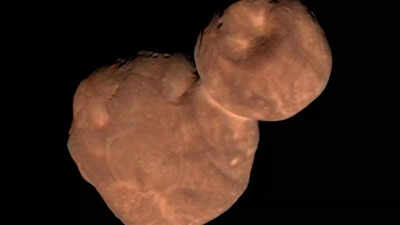
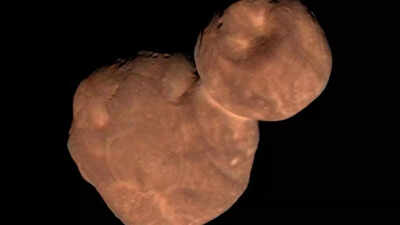
Ever wondered how those weird, floating “snowmen” way out in the deep freeze of the Kuiper Belt beyond Neptune’s orbit manage to stick around? These oddly shaped, double-lobed rocks called contact binaries, like the famous Arrokoth look fragile, yet they’ve survived billions of years without crumbling apart. Astronomers have been searching for an answer for ages.Enter Jackson Barnes, a sharp graduate student at Michigan State University. He built the first computer simulation proving these quirky planetesimals form naturally from swirling pebble clouds collapsing under their own gravity. No magic needed, just physics doing its thing in the cosmic dust. Mystery solved.
How gravity created ‘snowman’ worlds in space
Beyond the Asteroid Belt lies a frozen wonder: the Kuiper Belt, a large ring of icy remnants from our solar system’s birth. Among many are “snowman” planetesimals, fragile, double-lobed contact binaries like Arrokoth. These peculiar shapes, conjoined together like cosmic snowballs, have bewildered astronomers. How do they endure billions of years without disintegrating? For years, the mystery sustained. Then, Jackson Barnes, a graduate student at Michigan State University, cracked it. His pioneering computer simulation revealed these objects form naturally from pebble clouds in the early solar system. Gravity causes the clouds to collapse, naturally birthing these lumpy, binary structures with no collisions required. This breakthrough rewrites our understanding of planetary formation. It shows gentle gravitational processes can sculpt resilient survivors in the frigid void, hinting at similar worlds orbiting other stars. The Kuiper Belt’s secrets keep unfolding, one simulation at a time.
Michigan State University breakthrough; Jackson Barnes leads the charge
Researchers at Michigan State University (MSU) have unveiled the simple yet elegant phenomenon behind it: gravitational collapse. Graduate student Jackson Barnes developed the first computer simulation demonstrating how these two-lobed ‘contact binaries’ arise naturally from pebble clouds.Older models treated colliding planetesimals as fluid-like blobs that merged into smooth spheres, failing to recreate contact binaries. Barnes, leveraging high-performance computing, simulated objects retaining their structural integrity and settling gently upon contact.
Expert insights from professor Seth Jacobson
“If we think 10% of planetesimal objects are contact binaries, the process that forms them can’t be rare,” said MSU’s Assistant Professor of Earth and Environmental Science, Seth Jacobson, senior author on the paper. “Gravitational collapse fits nicely with what we’ve observed.”
Science behind the floating ‘Snowmen’: Understanding gravitational collapse defining the process
As the Dictionary of Astrobiology describes, gravitational collapse is “the collapse of a region of material under its own gravity, for example, of the dense core of an interstellar cloud on its way to becoming a star.” It occurs when local self-gravity overwhelms restoring forces like thermal gas pressure or turbulence.In protoplanetary disks, millimetre-sized pebbles in a pebble cloud concentrate via streaming instability. Self-gravity then triggers collapse, birthing planetesimals. Barnes’s model captures this delicately.
Real-world observations: Arrokoth and new horizons
Contact binaries gained fame in January 2019 when NASA’s New Horizons spacecraft flew past one in the Kuiper Belt. Dubbed ‘Ultima Thule’ (later officially Arrokoth), its bilobed ‘snowman’ shape stunned scientists. Scattered throughout the Kuiper Belt, these globules neither shatter on impact nor collapse alone, hinting at gentle formation.
Details of the groundbreaking simulations publication in monthly notices
Writing in the Monthly Notices of the Royal Astronomical Society, Barnes and colleagues detail 54 simulations of an initial pebble cloud containing 105105 particles, each about 2 km (1.25 miles) in radius. This low-resolution setup mirrors reality, where true pebble clouds likely held 10241024 millimetre-sized particles.
Key findings: orbital dance to spiralling
The team found that, in some cases, two small planetesimals from the pebble cloud entered mutual orbit. They spiralled inwards gradually, reaching velocities of 5 metres per second or less before touching. Forming the double-lobed shape, Upon contact, particles settled realistically, merging into a double-lobed planetesimal or ‘contact binary’. “Some of the contact binaries in our model bear a striking resemblance to Arrokoth,” Barnes remarked.Prior gravitational collapse simulations ignored particle-contact physics, predicting collisions between smaller planetesimals would yield a single, spherical object. Barnes’s innovation modelling how pebbles rest and adhere explains intact ‘snowmen’ shapes.
Implications for solar system origins
This work comes as a transformational view of planetesimal formation. Contact binaries, comprising 10% of Kuiper Belt objects, suggest gravitational collapse in pebble clouds is common, producing ‘rubble piles’ that survive eons. It aligns with Arrokoth’s low-density, loosely bound structure observed by New Horizons.Similar shapes appear among near Earth asteroids, implying this process operated Solar System-wide. Future missions could test these predictions.
Future simulations and observations
Higher-resolution pebble cloud models, powered by advancing computing, promise deeper insights. Telescopes like the James Webb Space Telescope may spot more contact binaries in distant discs in coming days.Jackson Barnes’s simulation not only solves the ‘snowmen’ puzzle but redefines how planetesimals and ultimately planets emerge from cosmic dust.