


By Anushka Verma | Updated: November 3, 2025
Introduction
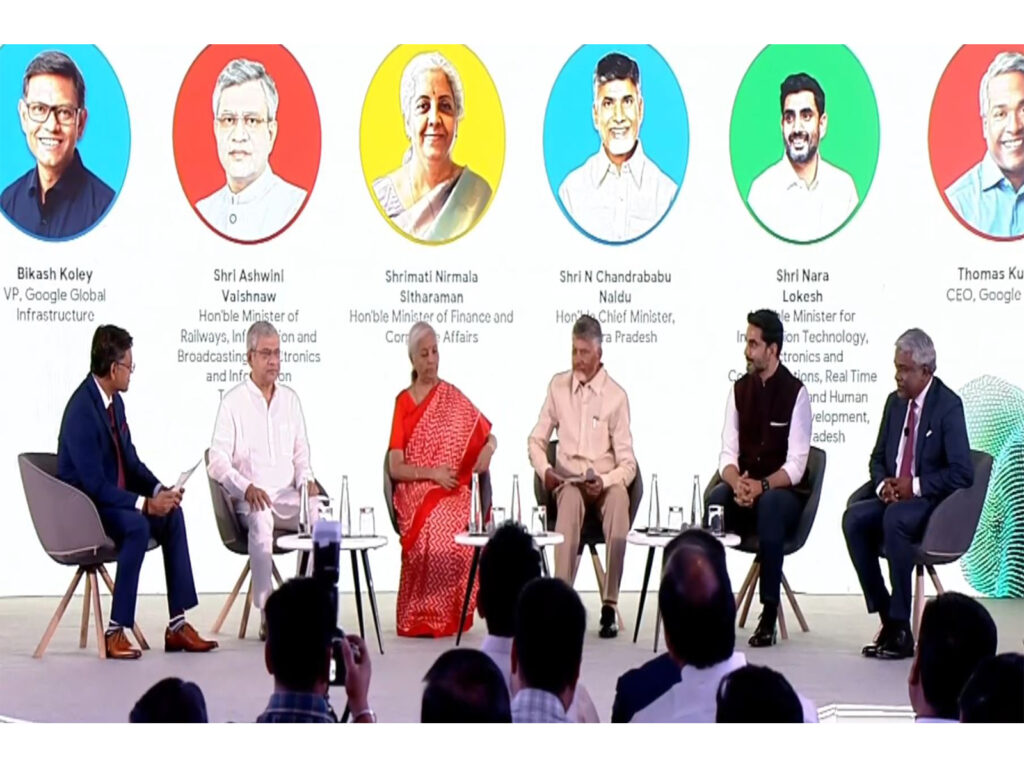
In a landmark development that could redefine India’s place in the global artificial intelligence (AI) landscape, Google has announced a massive $15 billion investment to establish a state-of-the-art AI Data Centre in Visakhapatnam, Andhra Pradesh. The move, announced during Google’s flagship event ‘Bharat AI Shakti’ in New Delhi, marks the largest single investment the tech giant has ever made in India.
The ambitious project will be executed in partnership with the Adani Group and Airtel, encompassing advanced data infrastructure, renewable energy systems, and an international subsea internet gateway. More than a business announcement, this investment reflects a major strategic and geopolitical commitment—coming at a time when India–US relations face increasing complexity over data, trade, and technology issues.
The $15 Billion Commitment
Google’s $15 billion investment, planned over five years (2025–2030), is a multifaceted project that extends beyond data storage. It integrates AI research, sustainability, education, and local empowerment.
| Investment Segment | Estimated Value (USD) | Purpose |
|---|---|---|
| AI Data Centre Construction | $6.5 billion | Building core compute and data infrastructure in Visakhapatnam |
| Subsea Internet Gateway | $2 billion | Creating an international subsea cable landing station for faster global connectivity |
| Renewable Energy Infrastructure | $1.8 billion | Powering data centres with clean solar and wind energy |
| AI Research & Development | $1.5 billion | Establishing research labs and partnerships with Indian universities |
| Skill Development & Training | $0.7 billion | Training students and professionals in AI, ML, and data science |
| Miscellaneous & Logistics | $2.5 billion | Regulatory, logistics, and operational setup |
For India, the scale of this investment is unprecedented. It signals not only Google’s faith in India’s technological ecosystem but also a recognition that India’s next growth engine will be AI-driven innovation.
Why Visakhapatnam Was Chosen
Google’s decision to establish its AI hub in Visakhapatnam (Vizag) is deeply strategic. Andhra Pradesh, led by Chief Minister N. Chandrababu Naidu, has long positioned itself as a hub for innovation, e-governance, and digital transformation.
Visakhapatnam offers a rare blend of advantages: coastal access for subsea connectivity, abundant renewable energy, and logistical efficiency through its port and industrial corridors.
Key Factors Behind the Choice:
- Coastal Location: Ideal for the new international subsea internet gateway connecting India with Southeast Asia, Japan, and the U.S.
- Renewable Energy Access: Andhra Pradesh’s green corridors ensure sustainable power supply for Google’s carbon-neutral goals.
- Connectivity & Logistics: Proximity to Hyderabad and Bengaluru strengthens operational coordination.
- Policy Stability: The Andhra Pradesh IT Vision 2030 promotes AI, cloud computing, and sustainable data infrastructure.
Naidu, during his address at the Bharat AI Shakti event, described the move as “a historic moment that will make Visakhapatnam the AI capital of South Asia.”

Google’s Global AI Vision and India’s Role
This project places India at the core of Google’s global AI expansion strategy. After building major AI hubs in the U.S., Singapore, and the Netherlands, the Visakhapatnam data centre becomes Google’s fourth global AI anchor—and the first in South Asia.
Google CEO Sundar Pichai called this a “long-term partnership with India’s digital transformation,” emphasizing that India represents a unique combination of scale, skill, and democratic digital governance.
“This investment is not just about infrastructure,” said Pichai. “It’s about enabling AI for everyone—responsibly, inclusively, and sustainably.”
The move also aligns with India’s evolving Digital Personal Data Protection Act (2023), which offers clarity and confidence for global companies operating within Indian data sovereignty norms.
Geopolitical Context and Strategic Significance
The announcement comes at a time when global technology alliances are being reshaped.
Tensions between the United States and China over AI supremacy, semiconductor supply chains, and data control have accelerated the search for neutral, democratic, and skilled markets—and India fits that bill perfectly.
Amidst strained India–US ties over trade and localization policies, this massive investment sends a clear signal: the U.S. technology ecosystem still sees India as a trusted and vital partner.
Google’s presence in Andhra Pradesh can serve as a strategic counterweight to Chinese tech dominance in Asia, helping diversify supply chains and fortify India’s role as a key AI development zone.
Economic Impact on Andhra Pradesh and Beyond
The expected economic ripple effects are monumental. The AI hub will not only create tens of thousands of direct jobs but will also stimulate entire ecosystems—spanning construction, logistics, education, housing, and local entrepreneurship.
| Economic Indicator | Projected Impact (2025–2030) |
|---|---|
| Direct Employment | 20,000+ skilled jobs |
| Indirect Employment | 50,000+ support and service jobs |
| Regional GDP Growth | +2.4% annually |
| IT Exports Growth | +35% |
| New AI Startups | 200+ projected by 2030 |
Additionally, Google’s “AI Shiksha Bharat” initiative will train one million young Indians in AI fundamentals, machine learning, and responsible innovation—bridging the gap between education and employability.
Infrastructure and Sustainability
Google’s data centres worldwide are benchmarks in green technology, and the Visakhapatnam facility is set to be one of Asia’s most sustainable.
The company has committed to a carbon-neutral operation by 2028 and full carbon-free energy use by 2030, integrating cutting-edge environmental systems such as:
- AI-based cooling that optimizes temperature control, reducing power consumption by up to 30%.
- Solar and wind integration, generating over 60% of total energy from renewable sources.
- Closed-loop water recycling systems for cooling and maintenance.
- Green architecture to minimize environmental footprint.
These features make it not just an AI hub, but a model for green industrial infrastructure in the developing world.
Empowering Local Talent
The Google AI hub will be deeply intertwined with local academic and research institutions.
Partnerships with IIT Hyderabad, IIIT Sri City, and Andhra University are already under discussion for collaborative programs, internships, and research projects in AI ethics, natural language processing, robotics, and generative AI.
Google will also establish three AI Academies across Visakhapatnam, Vijayawada, and Tirupati. These will offer globally recognized certifications in data science and AI engineering.
A highlight initiative, the “Women in AI Fellowship”, will promote female representation in AI and data science, targeting 40% participation by 2028.
The Partnership Model: Google, Adani, and Airtel
The project is structured as a tri-partner collaboration:
| Partner | Role | Core Deliverables |
|---|---|---|
| Technology & R&D | Core AI infrastructure, software systems, training initiatives | |
| Adani Group | Infrastructure & Energy | Construction, green energy systems, logistics |
| Airtel | Network & Cloud | Fiber network backbone, subsea gateway operations, 5G integration |
This partnership brings together global technology, Indian infrastructure expertise, and national connectivity, creating a self-reliant and efficient model for future AI expansions across Asia.
Data Sovereignty and Ethical AI
Massive data centres also bring regulatory and ethical challenges. With the new Digital Personal Data Protection Act now in force, India has established a clear legal framework for handling digital information responsibly.
Google has publicly endorsed these laws and confirmed that its Visakhapatnam data operations will fully comply with Indian data residency requirements.
According to Sanjay Gupta, Google India’s Country Head:
“This is not only about AI innovation but AI integrity. Every model deployed from India will follow the highest standards of fairness, transparency, and accountability.”
The hub will likely serve as a testing ground for Google’s Responsible AI Framework, blending technology with social accountability—a key theme in India’s AI policy narrative.
Boost to India’s AI Ecosystem
India’s AI market is currently valued at $7.8 billion (2024) and is expected to touch $32 billion by 2030, with a 28% annual growth rate. The Google AI hub is expected to accelerate this growth dramatically.
It will help Indian startups access world-class compute power and data ecosystems, enabling them to compete globally in AI-driven sectors such as healthcare, agriculture, fintech, and education.
| Sector | AI Applications Enabled by the Hub |
|---|---|
| Healthcare | Predictive diagnostics, AI imaging, telemedicine |
| Agriculture | Crop analytics, weather prediction, precision farming |
| Finance | Smart lending, fraud prevention, algorithmic trading |
| Education | Personalized learning, AI tutors, multilingual translation |
| Manufacturing | Robotics, automation, predictive maintenance |
The availability of local AI infrastructure will also reduce dependency on foreign cloud platforms and encourage “Make AI in India” initiatives.
Policy and Political Implications
The Google project represents a significant win for both Andhra Pradesh and the Government of India.
For Chief Minister Naidu, known as India’s original “IT visionary” since the 1990s, this is a reaffirmation of his commitment to technological progress.
At the national level, the Government of India sees this as validation of its Digital India and AI Mission 2030 policies. The Ministry of Electronics and Information Technology (MeitY) is already considering AI innovation tax breaks, R&D grants, and cloud infrastructure credits to attract further global players.
This investment may also trigger competitive action from other states such as Karnataka, Telangana, and Tamil Nadu—each keen to position themselves as the next AI hub.
Challenges and Roadblocks
Despite the optimism, several structural challenges need careful navigation:
- Energy Security: AI hubs consume massive electricity; consistent renewable supply is critical.
- Data Localization Costs: Complying with India’s evolving regulations can increase operational complexity.
- Talent Shortage: While India has abundant engineers, AI-specific skills remain limited.
- Global Tensions: Fluctuating U.S.–India trade relations could influence technology exports or data flows.
Google plans to address these through local supply chains, academic upskilling, and public–private policy dialogues to ensure long-term operational stability.
Market Response and Global Perception
The global market has reacted positively. Following the announcement:
- Alphabet Inc. (Google) shares rose 2.3% on NASDAQ.
- Adani Enterprises gained 5.6% on the BSE.
- Airtel saw a 3.2% rise, reflecting confidence in the long-term digital growth narrative.
Tech analysts across publications like Bloomberg, Financial Times, and The Economist hailed the project as a “turning point for India’s data economy.”
It underscores that India is not just a user of AI technologies, but fast becoming a creator and exporter of them.
Opportunities for India’s Youth
Perhaps the most transformative impact will be on India’s youth. The Visakhapatnam AI hub will open unprecedented avenues for students, engineers, and entrepreneurs.
By 2030, the Indian AI sector could employ over 1.2 million professionals, creating a new class of AI-enabled workers with global competitiveness. Educational institutions are already integrating AI, ethics, and generative tools into their curricula, preparing students for the evolving digital economy.
For millions of young Indians, Google’s investment symbolizes more than employment—it represents empowerment through knowledge.
A Defining Step Toward India’s AI Decade
The $15 billion Google AI Hub marks the beginning of what many are calling India’s AI Decade.
It fuses economic growth with digital sovereignty, innovation with inclusivity, and ambition with sustainability.
If implemented effectively, this initiative could transform India from being the world’s back-office to becoming the brain of the global digital economy.
As Anushka Verma writes:
“Visakhapatnam’s Google AI Hub is more than just a building of servers—it’s the lighthouse of a new era, signaling that India’s next great export will be intelligence itself.”
Conclusion
Google’s $15 billion AI Hub in Andhra Pradesh is a defining moment in India’s technological evolution. It unites innovation, investment, and intent into a singular national milestone.
With its blend of infrastructure, talent, and policy support, India is poised to become a central force in the global AI revolution. And at the heart of that transformation lies a coastal city—Visakhapatnam, ready to shine as the nerve center of India’s AI-powered future.