


By Anushka Verma Updated: October 30, 2025
Introduction: India’s Tax Reform Turning into a Consumption Story
A visible wave of optimism is sweeping through India’s markets. From falling prices on essential goods to booming festive sales, the government’s GST 2.0 reforms, implemented on September 22, 2025, have started to reshape the consumer economy.
According to Finance Minister Nirmala Sitharaman, the recent GST price cuts have been fully passed on to consumers, leading to a surge in household spending that could soon lift India’s GDP numbers for FY 2025–26.
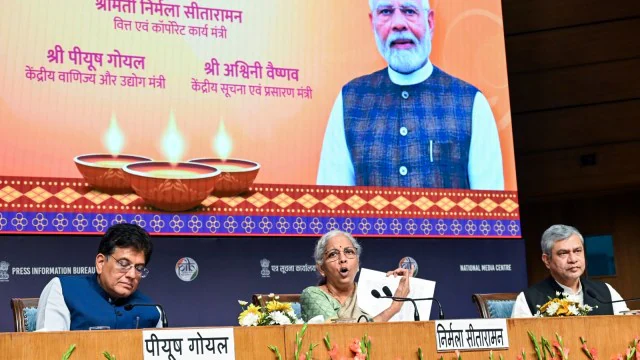
In a joint press conference titled “GST Bachat Utsav” held in New Delhi, Sitharaman was accompanied by Commerce and Industry Minister Piyush Goyal and Railways & I&B Minister Ashwini Vaishnaw. Together, they presented a clear message: lower taxes are translating into higher consumption, increased investment, and stronger growth momentum.
“Better collections mean greater fiscal room to give back to people. The GST reforms are not a one-season event; they are a structural shift to make India’s economy more responsive, transparent, and consumer-friendly,” Sitharaman said.
GST 2.0: Simplification with a Purpose
At the heart of the reform is a simplification of India’s indirect tax structure. The earlier four-tier GST rate system — 5%, 12%, 18%, and 28% — has been replaced by a cleaner two-slab structure: a merit rate of 5% and a standard rate of 18%. Additionally, a special 40% demerit rate applies only to sin and luxury goods such as tobacco and high-end vehicles.
This move, announced by Prime Minister Narendra Modi during his Independence Day address and approved by the GST Council on September 3, was aimed at reducing classification disputes, simplifying compliance, and encouraging both producers and consumers to participate more actively in the tax system.
| Old GST Rate | New GST Rate (Post-September 22) | Category |
|---|---|---|
| 18% | 5% | Shampoo, Talcum Powder, Face Powder |
| 12% | 5% | Kitchen Utensils, Household Steel Goods |
| 18% | 12% | Electronics (TVs, Smartphones, Home Appliances) |
| 28% | 18% | Automobiles, Two-wheelers, Passenger Cars |
| 18% | 5% | Toys, Solar Cookers, Umbrellas |
According to the Finance Minister, this new system reflects not just tax rationalisation but also a shift toward consumer welfare and affordability.
“This is not just a course correction. It is a conscious and cooperative decision of the Centre and states to give back to the people,” Sitharaman said.
Visible Drop in Prices: Beyond Expectations
The Ministry of Finance released granular data to demonstrate that most industries not only complied with the new GST rates but also passed on more than the expected price benefit to consumers.
| Product Category | Expected Price Reduction (%) | Actual Price Reduction (%) |
|---|---|---|
| Shampoo | 11.02% | 12.36% |
| Talcum Powder | 11.02% | 11.77% |
| Face Powder | 11.02% | 12.22% |
| Clinical Diapers | 6.25% | 10.38% |
| Household Utensils | 6.25% | 10.24% |
| Toys (Tricycles, etc.) | 6.25% | 8.93% |
| Solar Cookers | 6.25% | 6.96% |
| Umbrellas | 6.25% | 9.19% |
The government is closely monitoring 54 daily-use products, ranging from cement and milk to kitchen goods and cosmetics. Sitharaman stated that in 53 of these categories, the price cuts have been fully passed on. The only partial exception was Portland Pozzolana Cement (PPC), where the reduction was “less than expected” for certain high-end brands.
“Except for 1–2 brands of Portland cement, all major cement producers have cut prices. Similarly, milk and related items have seen rate reductions across the board,” Sitharaman said.
Consumption on the Rise: Festive Sales Tell the Story
The timing of GST 2.0 couldn’t have been better. Introduced just before Navratri and Diwali, the tax cuts aligned perfectly with India’s busiest consumption season.
Minister Ashwini Vaishnaw highlighted record-breaking sales figures during Navratri, particularly in electronics and consumer goods.
“Data from retail chains shows sales have jumped 20–25% compared with Navratri last year. Food prices are easing, electronics demand is up, and manufacturing is expanding rapidly,” he said.
He added that food prices have seen deflation for four consecutive months, helped partly by GST-related reforms. Electronics manufacturing, a major employment generator, is now growing at double-digit CAGR, directly employing around 25 lakh workers.
India has even overtaken its neighbour in smartphone exports to the United States, marking a milestone in the country’s Make-in-India push.
Impact on GDP: A Consumption-Led Growth Story
Minister Vaishnaw explained how rising consumption could significantly influence India’s GDP trajectory.
Last year, India’s GDP stood at ₹335 lakh crore, with ₹202 lakh crore driven by consumption and ₹98 lakh crore by investments. With consumption projected to rise by more than 10% in nominal terms this year, the additional spending could amount to ₹20 lakh crore over last year.
This surge in consumption is expected to stimulate fresh investments, further strengthening the economic cycle.
“Consumption naturally grows with income, but GST 2.0 reforms have accelerated it. The result will be higher investment, more jobs, and a multiplier effect across sectors,” Vaishnaw said.
While Finance Minister Sitharaman declined to forecast an exact GDP growth figure, she reiterated that the trend in consumption and investment is unmistakably upward. The government’s official growth estimate for FY 2025–26 remains 6.3–6.8%, though several analysts believe it could cross the upper range if consumption momentum continues.
Automobile, FMCG, and Electronics Sectors See Direct Gains
Industry data supports the government’s optimism. According to SIAM (Society of Indian Automobile Manufacturers), three-wheeler sales grew 5.5% year-on-year in September to 84,077 units, while two-wheeler sales surged to 21.6 lakh units, up 6.7% year-on-year.
Passenger vehicle dispatches touched 3.72 lakh units (a 4.4% YoY increase), and tractor sales more than doubled compared to the previous month, reaching 1.46 lakh units.
In the FMCG sector, companies have reported steady growth in both volume and value, with lower shelf prices driving demand in rural and urban markets alike.
“From shampoos to kitchen goods, consumers are clearly responding to lower prices. This is exactly the kind of virtuous cycle we intended,” said Piyush Goyal.
Industry Compliance and Monitoring Mechanism
The government has set up price monitoring units under the Central GST formations to ensure that tax benefits are indeed passed to end consumers.
“We are continuously gathering inputs from our zonal offices. In all 54 tracked items, not one has failed to reflect the GST benefit,” Sitharaman said.
If any retailer or e-commerce platform fails to comply, the Consumer Affairs Department has the authority to take immediate action.
Goyal added that most companies have gone beyond compliance — offering cash bonuses, discounts, and loyalty rewards on top of tax cuts — a move that has boosted both sales volumes and brand goodwill.
Political and Policy Context
When asked about opposition criticism that GST 2.0 was merely a “course correction,” Sitharaman strongly rejected the claim.
“The Opposition neither brought GST nor dared to attempt it. What we’re doing today is a conscious evolution of the tax system — a reflection of cooperative federalism and fiscal prudence,” she said.
She also clarified that GST 2.0 reforms were not linked to ongoing India–US trade negotiations, noting that the reform framework had been under development for nearly 18 months.
“This was waiting to happen. Several Groups of Ministers have been working on it since last year, and it was approved after extensive consultation with states,” she said.
Centre and States Share Revenue Responsibility
On concerns about potential revenue losses for states, Sitharaman emphasised that both Centre and states are equal partners in the GST framework.
“If there is a dip in collections, it impacts the Centre too. We are equally invested in ensuring that GST revenues remain strong,” she said.
With gross GST collections now nearing ₹2 lakh crore per month, the government believes it has the fiscal space to sustain these reforms without risking fiscal stability.
Reforms Beyond Tax Rates: Process Simplification and Clarity
Apart from rate cuts, GST 2.0 also introduces simplified registration processes, reduced paperwork, and clarified product classifications — a move aimed at ending frequent legal disputes and compliance confusion.
“Many classification issues that led to court cases and taxpayer uncertainty have been resolved. The new structure is cleaner, faster, and easier to navigate,” Sitharaman said.
Launched at the start of Navratri, the government believes the reform timing was strategic — ensuring that consumers benefit ahead of the festive season, creating a psychological boost to spending.
Expert View: Economists See a Structural Shift
Economists are viewing GST 2.0 as one of the most consumer-impactful reforms since the rollout of the original GST in 2017.
Dr. Anil Mehta, an economist at ICRIER, noted:
“What’s notable this time is the scale of pass-through to consumers. When you combine simplified slabs, reduced rates, and stronger compliance, the system becomes self-reinforcing. More consumption drives more tax revenue despite lower rates.”
Market analysts also suggest that the investment-to-consumption linkage may become stronger, especially in manufacturing, construction, and retail trade.
The reforms, they say, could help India maintain its position as the world’s fastest-growing large economy even amid global slowdowns.
Consumer Sentiment on the Ground
Retailers across major cities — Delhi, Mumbai, and Bengaluru — report that consumer footfall and sales volumes have increased substantially since September.
From affordable FMCG brands to mid-range smartphones, price-sensitive consumers have reacted positively. Many retail chains have launched “GST Price Cut” campaigns, directly showing the pre- and post-GST pricing on shelves.
“Customers can literally see the difference — shampoos that cost ₹120 are now ₹105, kitchen sets ₹850 instead of ₹950. It’s tangible savings,” said a Delhi-based store manager.
A Reform Designed for the Long Term
While festive consumption provided the immediate boost, the government maintains that GST 2.0 is not a seasonal measure but part of a long-term fiscal and structural plan.
With higher tax compliance, growing formalisation of businesses, and expanding electronic invoicing, the government expects steady revenue inflows even at lower tax rates.
Sitharaman concluded the press conference with a confident note:
“India’s consumption story is strengthening. When consumers benefit, businesses invest, and when businesses invest, the economy grows. GST 2.0 is proof of that cycle in motion.”
Conclusion: A Turning Point for India’s Economic Momentum
As India enters the second half of FY 2025–26, all eyes are on how the consumption surge translates into broader GDP growth. Early signs are positive — higher sales, lower prices, strong manufacturing data, and an upbeat consumer mood.
GST 2.0 has done what few fiscal measures have managed in recent years: build trust between taxpayers, states, and the Centre. If current trends continue, the reform may well become one of the defining catalysts of India’s next phase of economic expansion.