


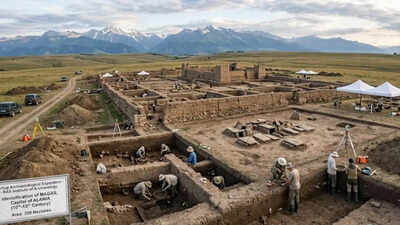
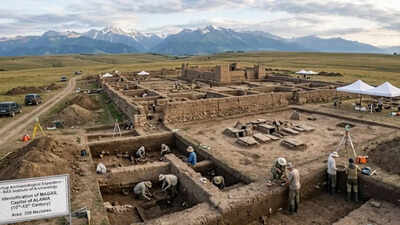
Archaeologists have identified a site at the Mayrtup burial ground in Chechnya, thought to be the lost medieval city of Magas. The ruins extend over 350 hectares and were the political centre for the Alanian Kingdom – an Iranian-speaking Alanian state that controlled the population of the area now known as the North Caucasus – and its capital.Magas has remained one of the greatest archaeological mysteries of Eurasia for many years, until recently when rescue excavations unearthed extensive fortifications and structural remains, houses, and many artefacts dating back to the 6th-century. As Magas was located on key routes of trade in the medieval period, many Archaeologists and Medievalists will be excited by the information they can now glean about the politics of the surrounding region before the city was destroyed during the invasions carried out by the Mongol Empire, led by Batu Khan in 1239.
The 350-hectare medieval city of Magas has been uncovered
According to The Archaeologist, excavations at the Mayrtup site define the archaeological landscape of the Caucasus, having yielded a site of approximately 350 hectares, far larger than any other known medieval settlement in the area. In addition to defining the site’s boundaries, these excavations by the Russian Academy of Sciences uncovered a fortified city, which consists of a citadel in the centre and a large variety of defensive and residential areas around the perimeter. Scholars have concluded that the size of the Mayrtup ruins and their geographic layout correspond to how the Arab historians described the Alanian capital of Magas (the city of coins), where Alanian rulers had resided for some period of time, indicating that Magas was highly fortified, densely populated, and a place of great political and military power.
Magas as a gateway for Caucasian commerce
Magas was the political and administrative centre of Alania, an ancient, Iranian – speaking nomadic state that eventually became a rich and powerful medieval kingdom. The strategic location of Magas allowed for the regulation of commerce through the Caucasus. Since numerous artefacts – including jewellery and costume accessories – dating from the 6th century AD have been recovered from this site, according to Ancient Origins. It is believed that the population had a very complex social structure, with strong economic ties to both the Byzantine Empire and the Silk Road trade routes. The Alans were famous for their cavalry, and Magas served as the primary headquarters of the Alans’ military and diplomatic activities.
Evidence of the Mongolian invasion at Mayrtup
Evidence from history and archaeology indicates the once – thriving city of Magas fell in 1239, after being invaded by Mongol forces during their expansion. The siege led by Batu Khan lasted for many months before finally breaking through and eventually destroying the city. The new Mayrtup excavations are uncovering several degrees of destruction and domestic pits from the 10th to 13th centuries, stratigraphically aligned with the 13th-century Mongol conquest. Furthermore, the site has provided a unique physical record of the last stand of the Alans against the Golden Horde.
Geophysical surveys reveal the scale of Magas
Geophysical surveys and rescue excavations have been utilised to map the large area of the site. In addition to uncovering evidence of a major defensive fortification, the discovery of 6th-century AD burial complexes at Mayrtup 7 is yielding a large amount of bioarchaeological data. The results of these excavated burials are leading researchers to reconstruct the daily lives, diet, and health of the inhabitants of Magas. Finally, carbon dating of the organic remains discovered within the defensive walls demonstrates the continuous habitation of Magas from the early and middle ages to the present.