


By Anushka Verma | Updated : November 10, 2025
Introduction: Honda’s Bold New Step into the Compact EV Segment
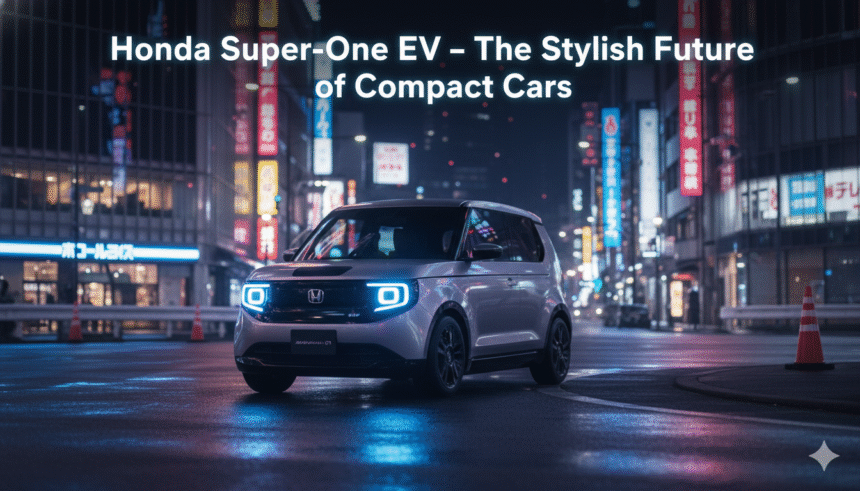
Honda is back with a revolution that redefines what small electric cars can look and feel like. Introducing the Honda Super-One EV, a stunning compact electric car that blends retro design cues with futuristic technology. Revealed recently at the Japan Mobility Show 2025, the Super-One EV has already turned heads for its boxy silhouette, bold character lines, and nostalgic charm reminiscent of the much-loved Honda N-One.
But this is not just another EV — it’s a fusion of old-school driving thrill and modern-day electric innovation. While the automotive world is moving rapidly towards SUVs and large electric sedans, Honda has decided to remind everyone that “small can still be mighty.”
With its simulated 7-speed gearbox, artificial engine sounds, and a dedicated “Boost Mode,” the Super-One EV promises an engaging drive that feels both emotional and electric.
Key Highlights of Honda Super-One EV (2025)
| Feature | Details |
|---|---|
| Model Name | Honda Super-One EV |
| Type | Compact Electric Car |
| Revealed At | Japan Mobility Show 2025 |
| Expected Launch | Japan: 2026; Global Rollout (UK, Asia, Oceania): 2027 |
| Platform | New N-Series EV Platform |
| Design Inspiration | Honda N-One Kei Car |
| Transmission | Simulated 7-Speed Gearbox |
| Driving Mode | Boost Mode + Standard EV Mode |
| Engine Sound Simulation | Yes (through speakers) |
| Cabin Design | Minimalistic with modern rectangular vents |
| Expected Range | 250–300 km (est.) |
| Expected Price (India Equivalent) | ₹9.5–12 lakh (est.) |
| Body Style | 2-door compact hatchback |
| Market Name (UK) | Honda Super-N |
| Official Designer Statement | “To bring nostalgic emotion into the digital EV age.” |
| Production Plant | Suzuka, Japan |
Retro Meets Future: A Fresh Take on Honda’s Design Language
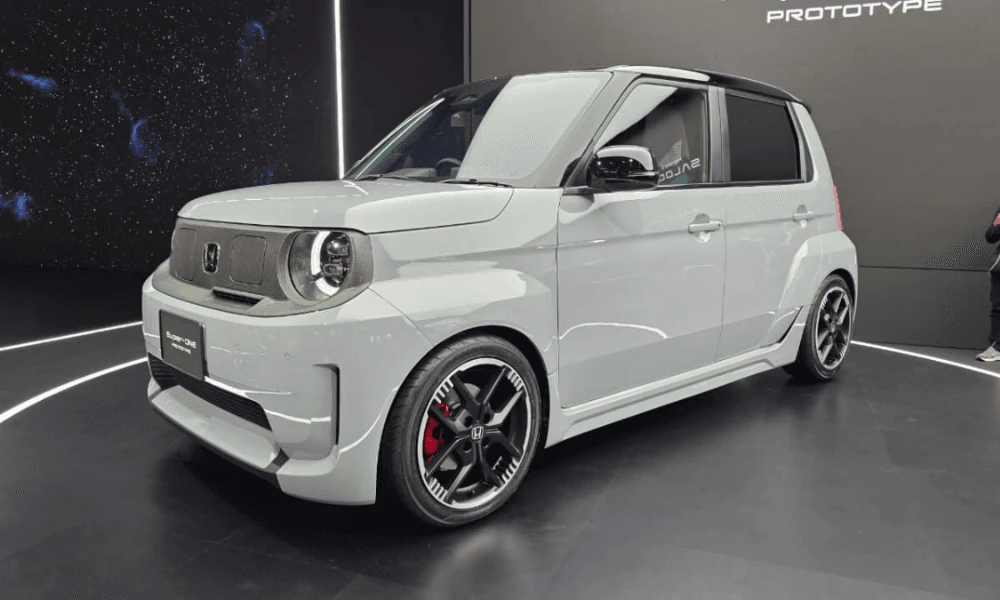
When you look at the Honda Super-One EV, you immediately sense a blend of simplicity and sophistication. The design pays homage to Japan’s legendary Kei cars — compact yet full of personality.
Honda has used clean surfaces, upright proportions, and pronounced wheel arches to give the Super-One a distinctive stance. The boxy shape is intentional — it maximizes cabin space while offering a confident road presence.
The front fascia features circular LED headlamps nestled in black bezels, giving it a classic yet futuristic vibe. The contrasting roof color, flush door handles, and slim LED tail lights add a modern edge.
The overall theme is clear — nostalgia with a futuristic twist.
Interior: Small Cabin, Big Innovations
Step inside, and you’ll realize that Honda’s focus on practicality hasn’t compromised comfort.
The cabin has been redesigned from scratch with minimalism and technology in harmony. Here are the major updates that make the Super-One EV stand out inside:
- Simplified Gear Selector:
Gone is the bulky gear lever. In its place sits a small, refined selector switch that enhances cabin space and aesthetics. - Rectangular Air Vents:
Replacing the previous round vents, these new angular vents give the dashboard a more mature, modern appearance. - Digital Display & Connectivity:
Expect a fully digital instrument cluster with connected features such as navigation, EV stats, and remote app integration. - Artificial Engine Sound:
Yes — you read that right! The Super-One EV can mimic the sound of a petrol engine through its speakers, offering a traditional driving feel to those who miss the growl of combustion. - Sustainable Cabin Materials:
Honda aims for a 90% recyclable interior build — using fabric and trims made from eco-friendly materials.
Driving Experience: Emotion Meets Electricity
Honda is clearly taking a stand against the “soulless EV” stereotype.
The Super-One EV offers a Simulated 7-Speed Gearbox — a first in this segment. It doesn’t actually change gears, but it simulates shifts to replicate the feel of driving a traditional car. This makes the drive interactive, emotional, and fun.
There’s also a Boost Mode that temporarily increases power output, allowing drivers to experience a sporty kick of acceleration — ideal for highway overtakes or spirited drives.
The inclusion of artificial engine sound is not just for fun — it’s psychological. Studies show that sound feedback enhances the driver’s sense of control and engagement.
For those who prefer quiet EV driving, both features (sound and gear simulation) can be turned off — letting you enjoy a smooth, noiseless glide.
Performance & Battery Expectations
While Honda has not officially revealed full technical specs, insiders suggest that the Super-One EV will use the same modular e:N platform that underpins Honda’s next-gen small EVs.
Based on early reports and test leaks:
- Battery Capacity: Estimated around 35–40 kWh
- Range: Between 250–300 km per charge
- Charging: 30 minutes fast-charging (0–80%)
- Motor Output: 100–120 hp equivalent
- Top Speed: Around 140 km/h
- Drive Type: Front-wheel drive
These numbers place the Super-One EV squarely in competition with models like the Nissan Sakura, Suzuki eWX, and Toyota C+pod.

Why Honda’s Strategy with Super-One EV Makes Sense
In an era where most carmakers are chasing large SUVs and premium EVs, Honda’s decision to go compact is not just refreshing — it’s strategic.
1. Urban Mobility Is the Future
Cities across Asia and Europe are becoming denser. Compact EVs are perfect for crowded streets, easy parking, and lower running costs.
2. Emotional Driving in the EV Age
With simulated gear shifts and engine sound, Honda is appealing to driving enthusiasts who feel something is missing in the silent EV experience.
3. Platform Scalability
The N-series EV platform is flexible enough to spawn multiple models, reducing production cost and allowing faster global rollout.
4. Eco-Friendly Appeal
Compact EVs consume fewer materials and energy to manufacture, aligning perfectly with Honda’s carbon-neutral 2050 vision.
Comparison: Honda Super-One EV vs. Rivals
| Car Model | Range (Approx.) | Top Speed | Unique Feature | Price (Est.) |
|---|---|---|---|---|
| Honda Super-One EV | 250–300 km | 140 km/h | Simulated 7-speed gearbox | ₹9.5–12 lakh |
| Nissan Sakura EV | 230 km | 130 km/h | City-friendly Kei car | ₹11 lakh |
| Suzuki eWX | 200 km | 120 km/h | Retro design | ₹10 lakh |
| Toyota C+pod | 150 km | 100 km/h | Ultra-light two-seater | ₹9 lakh |
Honda clearly dominates this comparison with driving emotion + practicality.
Launch Timeline and Global Availability
Honda has confirmed the following rollout schedule for Super-One EV:
| Region | Expected Launch | Model Name |
|---|---|---|
| Japan | Mid-2026 | Honda Super-One EV |
| United Kingdom | Early 2027 | Honda Super-N |
| Southeast Asia | Late 2027 | Honda Super-One |
| Oceania (Australia, NZ) | 2028 | Honda Super-One EV |
While India is not officially on the list yet, Honda has hinted at bringing the N-series EV lineup to emerging Asian markets once the infrastructure improves.
If launched in India, it could become one of the most affordable lifestyle EVs under ₹12 lakh — directly competing with Tata Tiago EV and MG Comet EV.

Target Audience: Who Is the Super-One EV For?
The Honda Super-One EV is not designed for everyone — it’s designed for those who value simplicity, nostalgia, and fun driving.
This car is ideal for:
- Urban commuters looking for an easy-to-drive electric car.
- Young professionals who want style and tech in a small package.
- EV enthusiasts who miss the feel of traditional gear shifting.
- Eco-conscious buyers who prefer compact, efficient mobility.
- Older Honda fans nostalgic about N-One and the brand’s heritage.
Safety, Connectivity, and Tech
Honda doesn’t compromise when it comes to safety and driver assistance.
The Super-One EV will feature:
- Honda SENSING Suite (Adaptive Cruise Control, Lane Keep Assist, Collision Mitigation)
- 360° Camera System
- ADAS Level 2 Support
- Over-the-Air Updates (OTA)
- Voice Assistant and Smartphone Integration
- Digital Key Access
Even though it’s small, it’s loaded with big tech.
Honda’s Philosophy Behind Super-One: Old Soul, New Heart
Honda designers have described the Super-One EV as “a car with an old soul and a new heart.”
The goal was not just to create another electric car, but to restore the joy of driving that many people feel has been lost in the EV era.
The artificial engine note, the pseudo gearbox, and the Boost Mode are all part of that philosophy — to keep the driver emotionally connected to the machine.
Expert Opinion
As a professional automotive journalist with five years of experience covering EVs, I believe Honda’s Super-One EV is not just another addition to the electric market — it’s a statement.
It challenges the idea that small cars are boring, and that EVs must be silent and emotionless.
By combining driving feel, nostalgic design, and modern electrification, Honda is carving a new niche — “Emotional EVs.”
This could well be the beginning of a new category of driver-focused compact EVs.
Expected Price and Value Proposition
Honda has yet to announce official pricing, but considering its position and segment, experts expect the Super-One EV to start around:
- Japan: ¥1.7 – ¥2.2 million
- UK: £10,000 – £12,000
- India (Equivalent): ₹9.5 – ₹12 lakh
At this price, it becomes an unbeatable combination of style, innovation, and heritage.

Conclusion: The Super-One EV — Small Car, Big Revolution
In a market obsessed with bigger, faster, louder vehicles, the Honda Super-One EV is a refreshing change — a car that reminds us that joy lies in simplicity.
It merges retro charm, modern performance, and emotional driving appeal in a compact body that’s perfect for the next generation of city mobility.
Honda has once again proven that innovation doesn’t always mean adding more — sometimes, it means bringing back what we miss.
The Super-One EV is not just a car — it’s a bridge between nostalgia and the electric future.